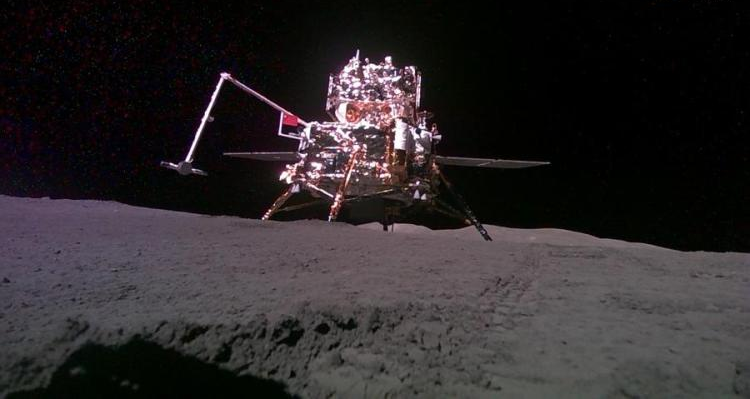
Beijing (GNP): New scientific analysis of lunar samples returned by China’s Chang’e-6 mission is offering fresh insight into one of the Moon’s longstanding mysteries, why its near side and far side are so dramatically different.
According to research highlighted by China Science, Chinese scientists used an independently developed ion probe system to examine feldspathic impact-melt rocks contained in lunar soil samples collected by the Chang’e-6 mission.
The findings suggest that the stark differences between the Moon’s near and far sides may be connected to an ancient giant impact that created the South Pole–Aitken Basin.
The South Pole–Aitken Basin is one of the largest and oldest impact structures known on the Moon.
Scientists have long examined the enormous basin for clues about the Moon’s early geological evolution and the processes that shaped its crust and upper mantle.
The latest analysis indicates that the ancient impact may have had effects extending well beyond the formation of the basin itself.
Researchers found evidence suggesting that the massive collision continued to reshape the lunar crust and upper mantle even after the Moon’s early magma ocean had solidified.
This process could have fundamentally altered the material composition of portions of the Moon’s far side, potentially helping explain why the hemisphere facing away from Earth has a substantially different geological character from the near side.
The findings add to the growing scientific value of Chang’e-6, which made history by collecting and returning samples from the Moon’s far side.
Unlike the near side, which has been extensively observed and sampled through previous lunar missions, the far side remains comparatively less explored.
Also Read: Meta Faces Landmark Trial Over Youth Safety on Its Platforms
The returned samples provide scientists with an opportunity to study material that cannot be obtained through observations alone.
Laboratory analysis can reveal information about the age, composition and geological history of lunar materials, helping researchers reconstruct events that occurred billions of years ago.
The new findings also contribute to a broader scientific understanding of how large impacts can influence planetary bodies.
Major collisions are not simply surface events; they can affect deeper geological structures and alter the evolution of a planet or moon over extremely long periods.
Previous research on Chang’e-6 samples has already provided new evidence about differences between the two lunar hemispheres.
A study reported in Nature Geoscience found evidence that the geological differences between the near and far sides extend into the Moon’s interior, strengthening scientific interest in the “two-faced Moon” phenomenon.
Scientists say continued analysis of Chang’e-6 samples could provide further information about the Moon’s early history, including its crust, mantle and the enormous impacts that shaped its surface.
The latest research therefore represents more than an examination of individual lunar rocks.
It demonstrates how samples returned from unexplored regions of the Moon can help scientists investigate fundamental questions about planetary formation and evolution.
As lunar exploration enters a new era, the Chang’e-6 samples are expected to remain an important resource for international lunar science, offering researchers a rare opportunity to examine material from the Moon’s far side directly.
The continuing study of these samples could ultimately help transform the scientific understanding of why the Moon has two remarkably different faces and how ancient events continue to shape the celestial body observed from Earth today.