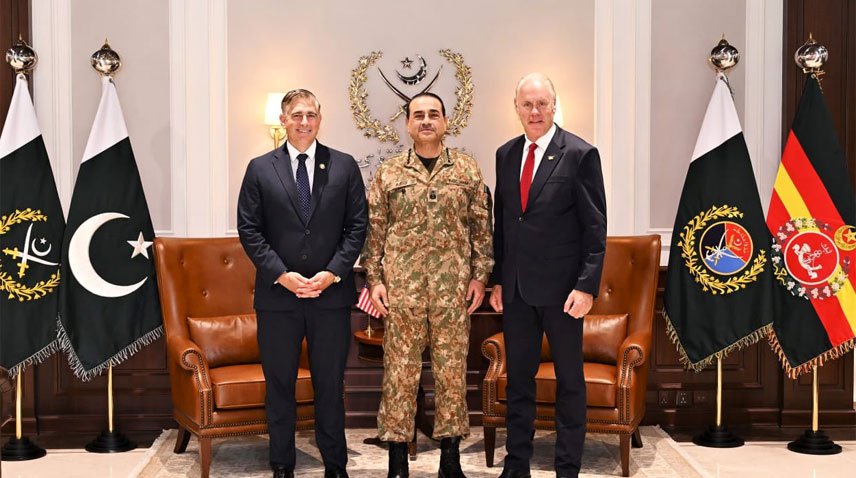
Rawalpindi (GNP): Field Marshal Syed Asim Munir has drawn attention to Pakistan’s continuing structural reforms designed to create a more welcoming climate for business and draw in foreign investment.
US Representatives Ryan Keith Zinke (Montana) and Michael James (Washington) met with Field Marshal Syed Asim Munir, Chief of Army Staff and Chief of Defence Forces, at General Headquarters (GHQ) in Rawalpindi.
The talks covered shared interests, regional security, defense ties between the two countries, and ways to expand economic cooperation and shared prosperity. The Field Marshal pointed to Pakistan’s substantial economic potential, noting that lasting regional stability depends heavily on economic growth, expanded trade, and improved connectivity. He also drew attention to the reforms Pakistan is pursuing to build a more investment-friendly business climate.
The American lawmakers acknowledged Pakistan’s important part in maintaining regional stability and economic resilience. Given the delegation’s professional expertise, both sides explored possible avenues for economic partnership, private-sector collaboration, and stronger trade links.
The delegation thanked military leaders for their hospitality and voiced a mutual desire to build deeper economic, commercial, and institutional ties between the US and Pakistan.
The economic and trade relationship between the two countries dates back to Liaquat Ali Khan’s 1950 visit, which brought Pakistan into the American-led bloc during the Cold War.
Significant US aid flowing through the 1950s to 1970s helped establish key institutions such as IBA and PIDE, and Pakistan became an important player in Cold War geopolitics. Ties cooled after 1971 as Pakistan moved closer to China, a shift that eventually produced the China-Pakistan Economic Corridor (CPEC).
https://x.com/i/status/2081746689254203443
While CPEC brought roughly $40 billion in Chinese investment, it also left Pakistan with heavy debt and excess capacity, pushing the country toward greater reliance on IMF loans—most of them taken out after 2008.
Looking forward, the piece argues that Pakistan’s energy future—particularly its untapped oil and gas reserves in the Indus Basin—would benefit more from Western know-how and technology than further Chinese lending. It positions the US, with its major oil companies and past exploration success in Pakistan, as a natural partner in this regard.
Also read: https://globalnewspakistan.com/icci-chinese-delegation-to-boost-pharmace/
The article frames renewed US-Pakistan collaboration as a practical, business-driven opportunity rather than an ideological one—one that could help stabilize both Pakistan’s economy and its energy security.

Sohail Majeed is a Special Correspondent at The Diplomatic Insight. He has twelve plus years of experience in journalism & reporting. He covers International Affairs, Diplomacy, UN, Sports, Climate Change, Economy, Technology, and Health.