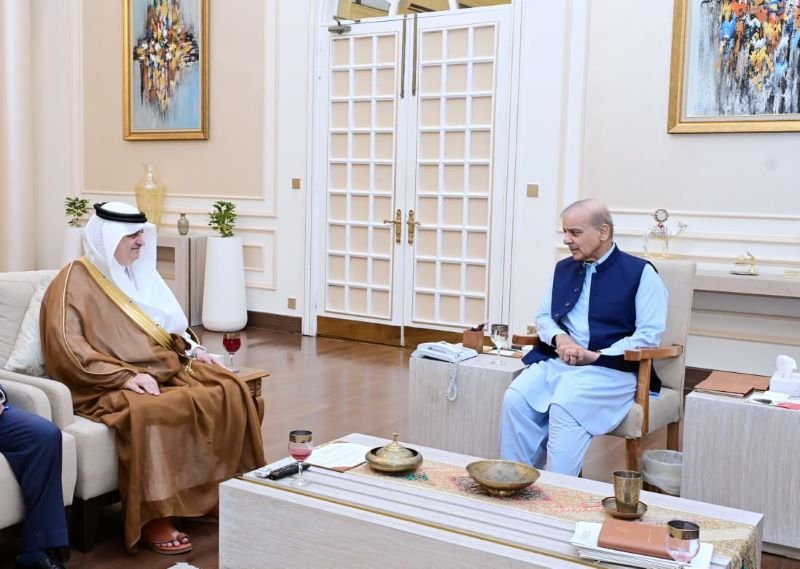
Islamabad (GNP): Ambassador of the Kingdom of Saudi Arabia to Pakistan, Nawaf bin Said Al-Malki, paid a farewell call on Prime Minister Muhammad Shehbaz Sharif at the PM House, Islamabad, after completion of his official tenure in Pakistan.
The Prime Minister congratulated the Saudi Ambassador on the successful completion of his official assignment.
He lauded the outgoing Ambassador for his outstanding contribution towards further strengthening the deep-rooted fraternal and strategic ties between Pakistan and the Kingdom of Saudi Arabia.
The Prime Minister conveyed his warmest regards and best wishes for the health and well-being of the Custodian of the Two Holy Mosques, His Majesty King Salman bin Abdulaziz Al Saud, and His Royal Highness Prince Mohammed bin Salman bin Abdulaziz Al Saud, Crown Prince and Prime Minister of the Kingdom of Saudi Arabia.
He reaffirmed Pakistan’s deep appreciation for the Kingdom’s steadfast support and generous assistance to Pakistan, and its pivotal role in promoting peace and stability in the region.
Ambassador Al-Malki expressed his profound gratitude to the Prime Minister and the Government of Pakistan for the warmth, cooperation, and hospitality extended to him throughout his assignment.
He described his stay in Pakistan as a deeply memorable and rewarding experience, and reaffirmed his personal commitment to the continued strengthening of Pakistan-Saudi Arabia relations.
The Prime Minister wished the Ambassador continued success in his future endeavours.
Pakistan and Saudi Arabia signed a Strategic Mutual Defence Agreement (SMDA) on September 17, 2025. While the agreement represents solidifying long-standing defence cooperation that the two countries have shared for decades, there has been a large amount of speculation on its significance.
Some speculations contend that Pakistan would be providing a nuclear umbrella to Saudi Arabia, get militarily involved in military conflicts, and may pose a threat to certain neighbors. Some are interpreting it as a Saudi step away from the U.S. as it came in the wake of recent Israeli strikes on Qatar that shook the region. Others are interpreting it as a threat to India. Therefore, it is important to unpack what this defence agreement is about. Myth must be separated from reality so that guesses and speculation may be laid to rest.
Prince Mohammed bin Salman bin Abdulaziz Al Saud, Saudi Crown Prince, and Muhammad Shehbaz Sharif, Pakistan’s Prime Minister, signed the “Strategic Mutual Defence Agreement” during the latter’s visit to Saudi Arabia. Pakistan’s Foreign Office has stated: “This agreement, which reflects the shared commitment of both nations to enhance their security and to achieve security and peace in the region and the world, aims to develop aspects of defence cooperation between the two countries and strengthen joint deterrence against any aggression.
The agreement states that any aggression against either country shall be considered an aggression against both.” There is a defence cooperation element to the agreement. This essentially solidifies the long-standing defence cooperation that the two countries have had for decades.
Pakistan-Saudi defence and security cooperation goes back a long way. Pakistan has deployed military forces in Saudi Arabia since the 1970s, exceeding 10,000 troops at times. Pakistani forces helped secure the holy sites during the Gulf War of 1990-91.
Pakistan also routinely provides a rotation of forces to Saudi Arabia in training and advisory roles.3 There are, according to reports, approximately 1500-2000 troops in such roles presently. Further, over the years, Pakistan has trained 8000-10,000 military personnel and stationed its units in the Kingdom when needed.
While the defence cooperation may likely expand under the SMDA with joint exercises advisory, training, and advisory roles, joint logistics and information access, stationing of troops, the two countries are unlikely to get entangled in each other’s regional conflicts. The agreement may help Riyadh build human capital in the defence domain. It may also translate into the development and expansion of defence-industrial architecture.
Pakistan seeks to develop indigenous defence production capabilities; Riyadh can become an active partner in such an endeavor. The pact is unlikely to translate into military interventions into each other’s regional entanglements.5 The wording “any aggression against either country shall be considered an aggression against both” should not be taken literally.
Also read: Gilani Attends Luncheon Hosted by Cambodian Senate
The logical conclusion that flows from it is that, for example, Pakistan is not likely to come to Riyadh’s military defence if there is a conflict with Iran or any other Gulf nation. Conversely, Saudi Arabia is not likely to come to Pakistan’s military aid if there is a conflict with India. Thus, the agreement is likely to translate into greater defence, defence production cooperation, instead of military entanglement in each other’s regional conflicts.

Sohail Majeed is a Special Correspondent at The Diplomatic Insight. He has twelve plus years of experience in journalism & reporting. He covers International Affairs, Diplomacy, UN, Sports, Climate Change, Economy, Technology, and Health.