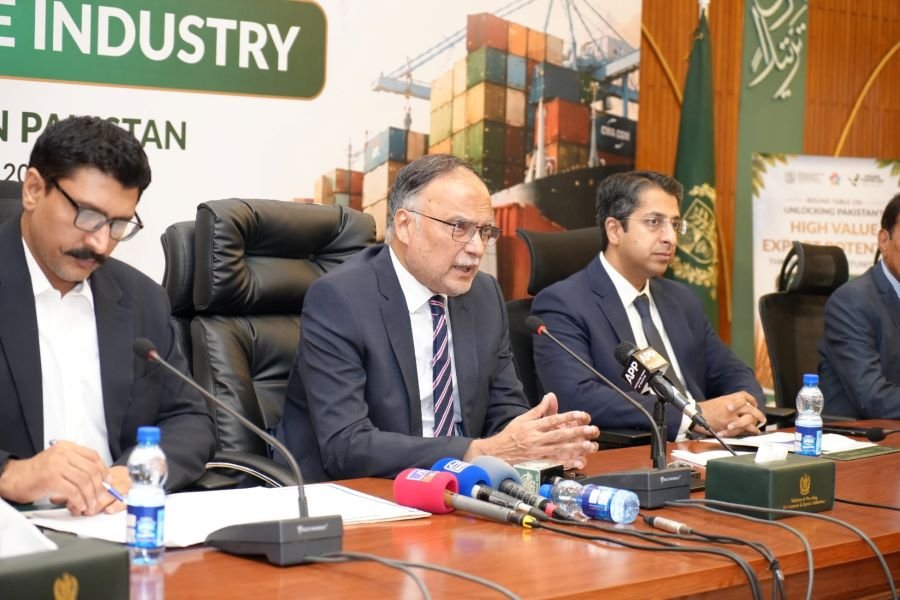
Islamabad (GNP): Federal Minister for Planning, Development and Special Initiatives Ahsan Iqbal has called for a fundamental transformation of Pakistan’s agricultural sector, urging a shift away from exporting raw commodities toward certified, branded, value-added goods. Speaking at the third session of the Strategic Dialogue Series on Unlocking Pakistan’s High-Value Export Potential, he asked stakeholders to partner with the government in charting a clear path forward.
The roundtable, moderated by Dr. Sohaib S. Hassan, Member for Private Sector Development and Competitiveness at the Planning Commission, brought together nearly a hundred participants — in person and online — representing federal and provincial bodies, agricultural and engineering universities, chambers of commerce, trade groups, certification agencies, and exporters and producers across meat, poultry, dairy, rice, dates, horticulture, olives and organic goods. Rana Ahsan, Coordinator to the Prime Minister on Commerce and Industry, also attended.
Iqbal explained that this dialogue series was designed to go beyond routine consultation, uniting government, industry, academia and research institutions to craft workable, sector-specific solutions. He pointed out that although agriculture accounts for roughly a quarter of GDP and employs about 37% of the workforce, its contribution to exports remains disproportionately small.
Reaffirming Pakistan’s Uraan Pakistan vision of reaching a trillion-dollar economy by 2035 — anchored by exports exceeding $100 billion — Iqbal noted that nations once on par with Pakistan, such as Vietnam and Malaysia, surged ahead through decades of consistent policy and a readiness to reform. He said agriculture must now carry its share of that export growth.
He stressed that access to premium global markets increasingly hinges on traceability, quality assurance and certification — no longer optional extras but baseline requirements. Livestock, he said, represents the country’s biggest untapped opportunity: Pakistan has one of the world’s largest herds, yet nations like Australia, New Zealand and the U.S. dominate global trade in processed, branded animal products. He argued that real value lies in processing and downstream products, including cosmetics and pharmaceuticals derived from agricultural raw materials.
Iqbal also advocated for modern, technology-driven farming — including climate-resilient seed varieties, cooperative farming models, and stronger private sector involvement — noting that many European nations have achieved far greater output on much smaller landholdings. He described olive cultivation as a national priority, expressing hope that Pakistan could emerge as a significant olive oil producer, and called for a shift toward scientific farming supported by better credit access and regulatory reform.
Rana Ahsan noted that agricultural goods make up about 22% of Pakistan’s total exports but remain overwhelmingly unprocessed, leaving the sector vulnerable to price swings and external shocks. He said achieving export targets of $60 billion — and eventually $100 billion by 2035 — is impossible without a decisive move toward branding and value addition.
He listed several initiatives in progress:
- A review of the Export Policy Order and related regulations via the Cabinet Committee on Regulatory Reforms
- Expansion of the EXIM Bank’s export financing pool from Rs 1 trillion to Rs 2 trillion between 2026 and 2028, with monthly monitoring
- A new SME financing window being developed with the Finance Ministry and State Bank of Pakistan
- A phased reduction of additional customs and regulatory duties under the National Tariff Policy’s second year
- The Pakistan Horticulture Development and Export Company serving as a central platform for exporters
- A new National Compliance Authority expected to be functional within three months
Food exports reached $5.02 billion in FY2026, against food imports of $9.15 billion. While commodity exports like rice and sugar declined, meat, fish and fruit exports grew. Early FY2027 figures showed food exports up 2.5%, rice up 19%, and meat up 16% in July 2026.
Participants pointed to strong potential in halal meat and poultry — targeted to reach $700 million under the Halal Meat Policy by 2028 — along with premium horticulture benefiting from new EU market access, branded basmati rice, processed foods, dates, edible oils, and organic and regeneratively grown produce. The global organic retail market, valued at roughly €145 billion in 2024, remains largely inaccessible to Pakistani exporters due to the absence of national standards and a domestic certification framework.
Industry representatives and academics proposed several reforms, including:
- Eliminating the sales tax gap that disadvantages formally processed meat compared to informal trade
- Launching a national cattle and goat farming program focused on disease control and breed improvement
- Safeguarding the electronic warehouse receipt system and preparing storage capacity ahead of the wheat season
- Taking regulatory action against exporters whose substandard shipments have damaged access to rice markets
- Reviewing tariffs on domestic edible oilseeds
- Partnering with PARC to develop high-yield, export-quality fruit varieties
- Establishing national organic certification standards, accredited labs, and affordable group certification for smallholders
- Leveraging university resources for training, market research and business incubation
The Ministry of National Food Security and Research confirmed that key legal and institutional frameworks for livestock exports — including the Breeding Policy, the Animal Health Bill, and a Rs 7.35 billion traceability program — are already in place but require funding and provincial-level implementation.
Iqbal emphasized that government’s core responsibility is to enable the private sector through a stable, business-friendly environment and consistent policy. He instructed that all proposals from the session be compiled and assigned to the relevant ministries for action, and confirmed the dialogue would continue as an ongoing collaborative platform. Stakeholders are set to reconvene in three months to assess progress on both the proposals and the follow-up actions taken by concerned ministries.
Also read: FM Maritime Proposes Maritime Business Facilitation Centre
The broader goal, as outlined in the session, is to rebuild and expand agricultural exports beyond FY2026 levels, dismantle tax, regulatory and certification barriers that keep exports in raw form, build the compliance and processing infrastructure premium markets demand, and position agriculture as a full partner in Pakistan’s push toward $100 billion-plus in exports by 2035.

Sohail Majeed is a Special Correspondent at The Diplomatic Insight. He has twelve plus years of experience in journalism & reporting. He covers International Affairs, Diplomacy, UN, Sports, Climate Change, Economy, Technology, and Health.