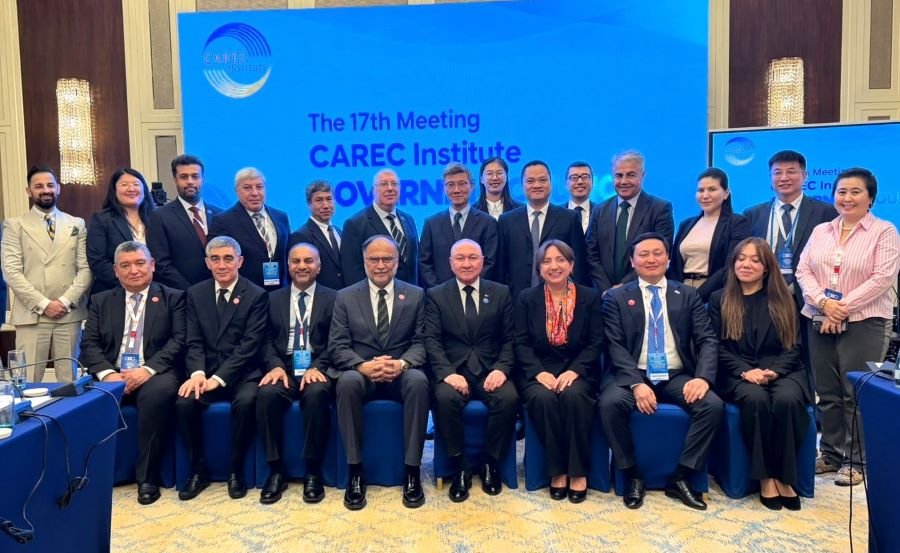
Ulaanbaatar, Mongolia (GNP): Federal Minister for Planning, Development and Special Initiatives Ahsan Iqbal called for transforming the CAREC Institute into a trusted regional knowledge clearinghouse capable of turning member countries’ experiences into practical solutions for shared economic and development challenges.
Addressing the Governing Council meeting of the CAREC Institute in Ulaanbaatar, Iqbal said that after 25 years focused on building roads, railways, energy links, and trade corridors, the next phase of regional cooperation should extend beyond moving goods and energy to include sharing knowledge and expertise across borders.
He proposed creating a living CAREC knowledge platform and expert directory that would bring together regional data, policy tools, project evaluations, and practical experiences — allowing policymakers to quickly identify successful approaches used elsewhere and adapt them to their own contexts.
Iqbal also proposed establishing a CAREC peer exchange facility to connect officials dealing with similar challenges, particularly in areas like trade facilitation, digital customs, logistics, renewable energy, disaster response, agriculture, and skills development. He stressed that the Institute’s work should be driven by actual demand, closely tied to policy decisions, and judged by its real-world impact.
He called for deeper regional cooperation on coordinated border management, interoperable digital trade systems, and shared climate-risk information, arguing that common challenges require coordinated regional responses.
With Pakistan set to assume the CAREC chairmanship in 2027, Iqbal said the country would place knowledge exchange at the heart of its agenda, working with CAREC member states, the Institute, and the Asian Development Bank on economic corridors, trade facilitation, digital connectivity, and climate resilience. He pointed to Pakistan’s experience with the Pakistan Single Window as a potential early case study for regional peer exchange, and said Pakistan would encourage its universities and research institutions to join the CAREC regional knowledge network.
He said the first twenty-five years of CAREC demonstrated what member countries could build together, and the next twenty-five should demonstrate what they can learn together — and what that shared learning can help them achieve.
Also read: Supreme Court Lets Trump Resume Third-Country Deportations
Iqbal stressed that the CAREC Institute should evolve from being primarily a producer of knowledge into a regional hub that gathers, tests, shares, and applies knowledge in practice — helping member countries turn evidence into actionable policy and regional cooperation.

Sohail Majeed is a Special Correspondent at The Diplomatic Insight. He has twelve plus years of experience in journalism & reporting. He covers International Affairs, Diplomacy, UN, Sports, Climate Change, Economy, Technology, and Health.