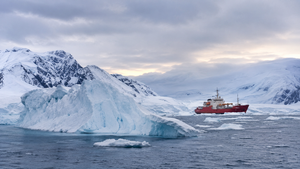
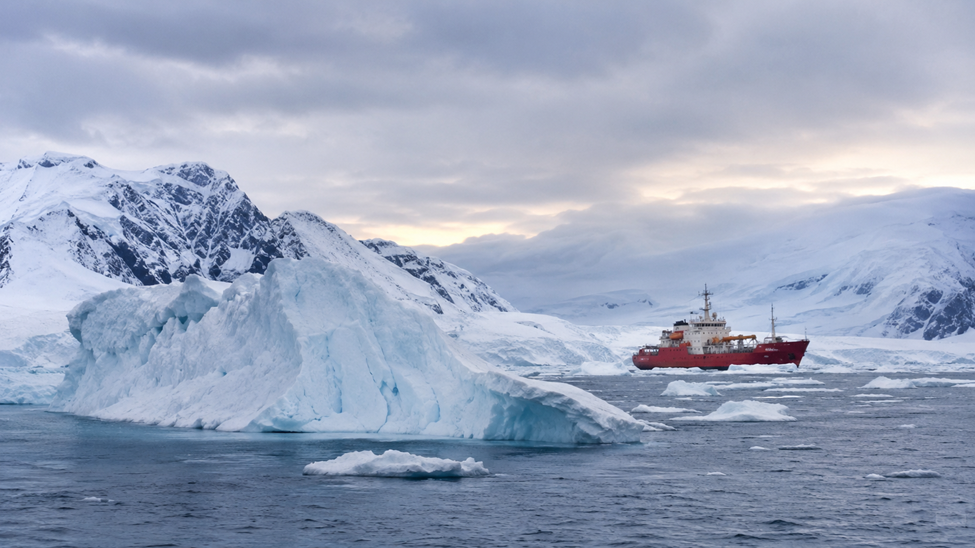
The Arctic region has been subjected to ice melt which has developed opportunities for shipping routes, natural resources and military. This has established the influence of world powers, such as the United States, China, Russia and European States.
Arctic is a region in the north pole which includes the Arctic Ocean and surrounding territories. This region has the territorial presence of Russia, Canada, United States, Denmark (through Greenland), Norway, Sweden, Finland and Iceland. Due to harsh climate conditions and thick ice, the Arctic never became an interest for commercial shipping, which has changed due to global warming.
According to the NOAA, Arctic sea ice extended at an average of 4.38 million square kilometres in September 2024, where in 1991 to 2020 the average was 5.58 million square kilometers. The data collected by the Arctic Council in February 2026 showed an approximate increase of 40% shipping traffic from 2013. Ice melt has made the sea route easily accessible. For example, the Northern sea route passes through the Northern coastline of Russia, and the Northwest passage passes through the Arctic lands of Canada. This could lead to alternative Maritime connections between Asia and Europe.
An important distinction is that the Arctic is not a replacement of the Suez Canal. It should be treated as a strategically important and future oriented region, instead of a substitute for the existing major global trade route.
Competing Interests of Major Powers
The Arctic region situation leads to an important question, what are the interests of major powers and if their interests clash with one another.
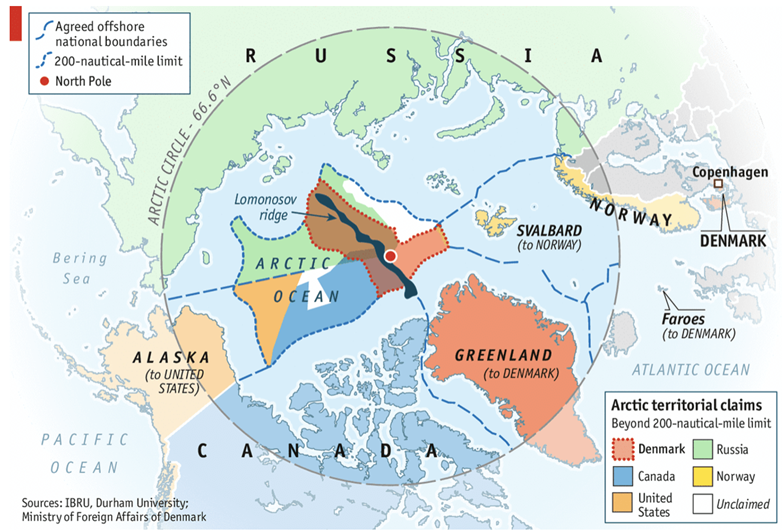
Russia: Russia has the most prominent extensive geographical presence in the Arctic. Its oil, natural gas and mineral resources are important for Russia’s economy. The northern sea route is considered an important economic development. Yamal extracts natural gas in the Russian Arctic area, through an LNG project and exports it to International markets, mainly China. Moreover, Russia has developed military bases, board airfields and ice breaker fleets in the Arctic. The Soviet Union and America considered the Arctic region important for military confrontations during the cold war.
China: China is not an Arctic state but in its Arctic Policy introduced in 2018 it addressed itself as a ‘near-Arctic state’. The main motive of China is to increase its participation in arctic resources, shipping routes and infrastructure. For example the polar Silk Road initiative is an Arctic-based extension of its Belt and Road Initiative (BRI). China and Russia are working together related to energy projects, in the Northern sea route. It could also serve as China’s future alternative connectivity trading route with Europe.
United States: The Arctic is worth more than natural resources for America, as it is significant for its national defence. Alaska provides a direct strategic presence in the Arctic region which could serve America’s concerns over the China-Russia corporation and military presence in the region. For American strategic calculations, Greenland is a significant area due to its location between Europe and the North Pole. It aims to establish strategic dominance in the region which would secure US national security in the long run.
Also Read: Bab el-Mandeb and The Strategic Politics of Global Trade
European States: There are many European states that are directly involved in the Arctic region such as Norway, Denmark, Finland, Sweden and Iceland. There has been major developments lately, such as Finland and Sweden becoming NATO members in 2023 and 2024. Currently there are 7 NATO members that are related to the Arctic state. In February 2026, NATO launched Arctic Sentry, announcing its objectives to deter through alliance formation and strengthen its defence for securing grounds in the area. Native Forward Land forces were established in June 2026 in Finland. These recent developments could be taken as a response to Russia’s military presence in the region.
Towards Coordination or Security Dilemma?
When understanding the Arctic case through the lens of international relations, an emerging security dilemma could be seen. As countries focus on improving their technology, military and security capability, it could be misinterpreted or considered as a potential threat to the other. The constant need to increase its military, could lead to an unpleasant action by a state. This is the exact situation they are moving towards.
There are several historical examples that back these arguments. For example, the Arctic region was an important strategic military location until Soviet leaders Mikhail Gorbachev labelled it a ‘zone of peace’in his 1987 speech.
Post cold war, 8 Arctic States formed an Arctic council in 1996. The purpose of this Council was to promote environmental protection, scientific cooperation and sustainable development in the region. An important element of it was that military security was not covered in its mandate, this could mean that states intentionally kept military competition outside the council’s framework.
In more contemporary cases, Russia Ukraine war of 2020 and NATO expansion is a great example. After Russia’s invasion in Ukraine, the relationship of Western countries and Russia grew bitter. Russia has to face increased presence in the Arctic region by NATO States where nationalization is considered Russian military activities as it is a threat to their National interest. This is a critical case of security dilemma that, if led by miscommunication and fear could lead to disputes in the region.