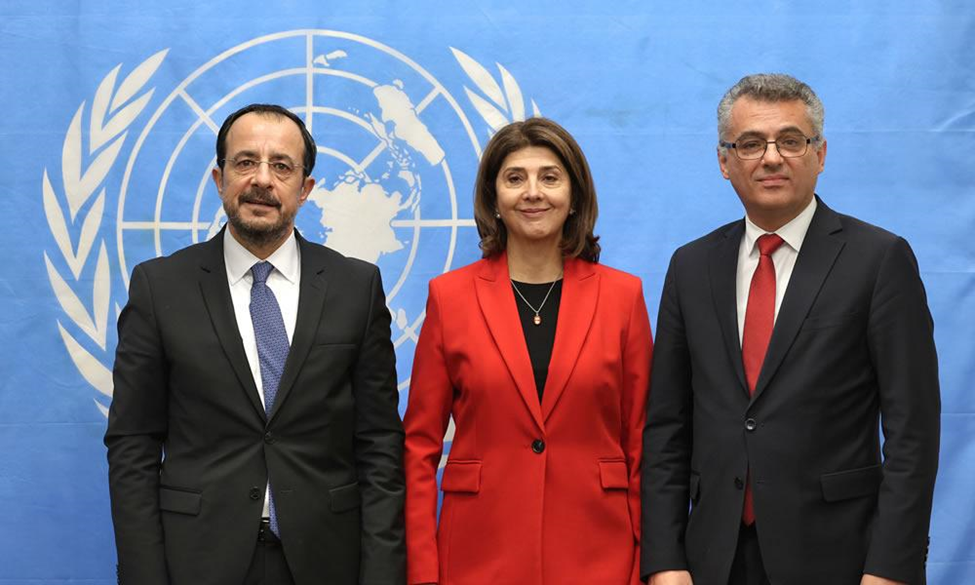
Nicosia (GNP): Cyprus peace talks moved forward on 9 November 2026, when Cypriot President Nikos Christodoulides and Turkish Cypriot leader Tufan Erhürman met in Nicosia with María Ángela Holguín, the UN Secretary-General’s Personal Envoy. The meeting came as UN mediation continues to face challenges. Territorial partition and confidence-building remain at the heart of a conflict that has lasted for decades.
From Confidence-Building to Political Settlement
The outcome of the talks held on 9 November between the two leaders, Nikos Christodoulides and Tufan Erhürman, is a minor but significant step towards restarting a stalled peace process. The leaders agreed to open two more crossing points at the same time and to increase cooperation in cultural heritage, environmental sustainability projects, education and emergency response. They also agreed to exchange archival data and plan to hold discussions with the UN Secretary-General in future.
The agreement has immediate significance because of its implications. New crossing points could help people move across the island’s division, while joint projects could provide regular interaction between communities whose relations remain weak. Even with limited paths for cooperation, such steps can help build communication in a conflict that has been deadlocked for a long time.
The Prolonged Complication of Cyprus
This pact should not be mistaken for a breakthrough towards reunification. Since 1974, the political framework of Cyprus has been the main cause of the split. Greek Cypriot leaders are committed to a bi-zonal, bi-communal federation in line with the UN framework, while Turkish Cypriot leaders are pressing for recognition of sovereign status and a two-state solution, which is also gaining support. Any path towards a sustainable resolution will face disagreements over power sharing, insecurity and Turkey’s actions.
This is where confidence-building measures become necessary. Opening crossing points would likely ease tension among people and encourage positive progress. However, it is important to understand that this would not automatically resolve the old disputes over sovereignty or lead to a workable constitutional arrangement. Coordination between technical committees also remains uncertain, as no compromise has been reached on basic political positions and requirements. The political value of these steps depends on what comes next, but they are crucial for building a potentially positive environment.
Also Read: Board of Peace Rebukes Israel Over Gaza Flood Aid Response
The question being raised is whether the leaders’ planned discussions with UN Secretary-General António Guterres have the potential to create a negotiating framework. The United Nations can help bring the parties to the dialogue table and keep the world’s attention on the issue, but politics cannot be forced. Whether the two community leaders can draw cooperation from each other, and whether these talks will lead to progress, remains uncertain.
The difference lies in emphasis. Symbolic progress may seem like a major shift in the maturity of the conflict, but in reality little has been done on the fundamental issue. The November 2026 agreement is seen as a confidence-building step rather than a direct effort towards reunification.