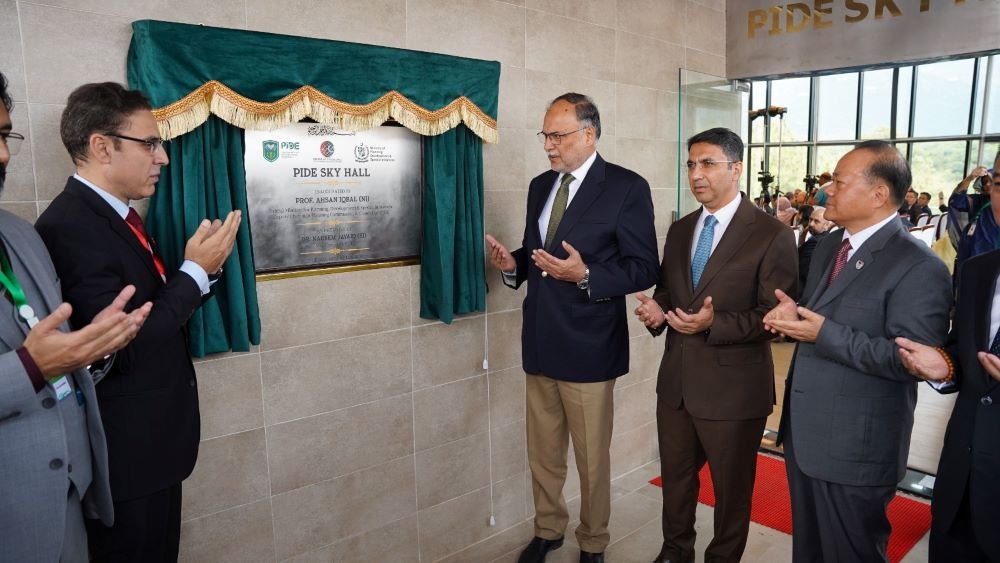
Islamabad (GNP): Federal Minister for Planning, Development and Special Initiatives Prof. Ahsan Iqbal outlined a roadmap for Pakistan’s $100 billion export ambition, calling for cluster-based development across the eight domains identified under URAAN Pakistan and stronger integration with global supply chains.
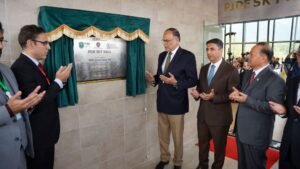
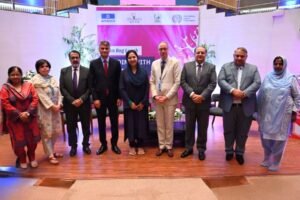
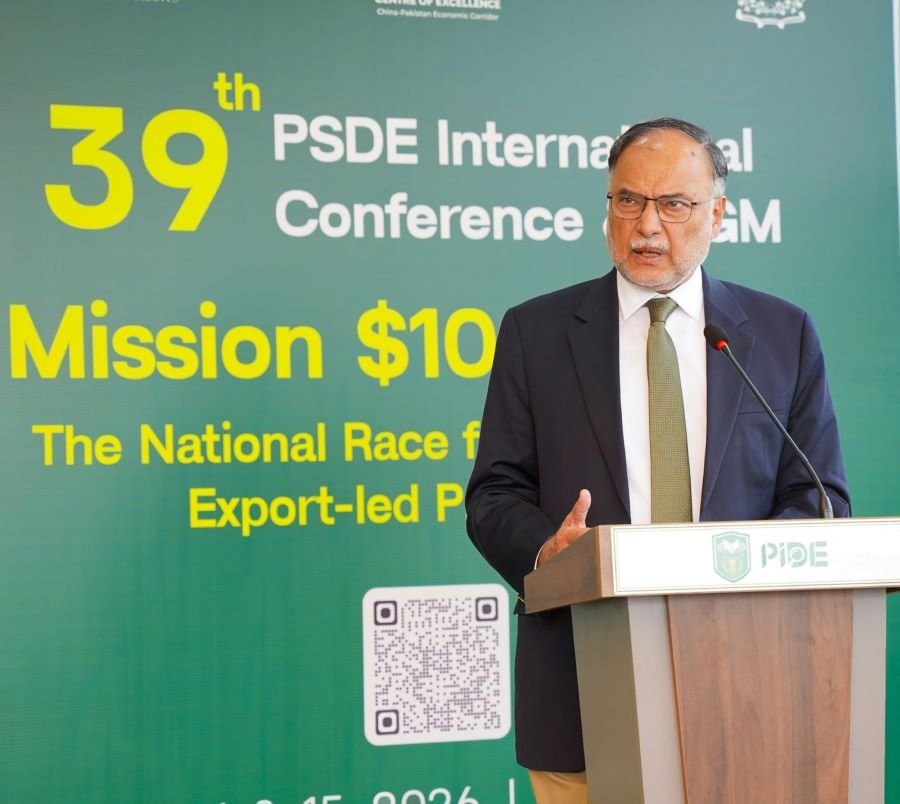
Opening the 39th Annual Conference of the Pakistan Society of Development Economists at the Pakistan Institute of Development Economics (PIDE), the Minister said Pakistan’s economic sovereignty depended on its ability to earn the resources needed to finance development.
“How do we build a Pakistan that earns its prosperity, finances its development and commands its economic destiny? Our answer is Mission $100 Billion,” he said.
Highlighting the export gap with peer economies, Ahsan Iqbal noted that Pakistan’s merchandise exports in calendar year 2024 stood at approximately $32.3 billion, compared with Bangladesh’s $47.2 billion, Malaysia’s $330.4 billion and Vietnam’s $404.8 billion. He clarified that these figures excluded services.
The Minister said Pakistan could overcome recurring external-account pressures by expanding productive capacity and competitiveness while safeguarding macroeconomic stability.
He called for export clusters that connect producers with specialised suppliers, skilled workers, universities, testing laboratories, finance, logistics and international buyers.
“Build the cluster. Strengthen the value chain. Connect it to the world,” he said.
The approach would cover agriculture, industry and manufacturing, services, information technology, mining, manpower and skills, the blue economy, and creative industries. He emphasised that cluster strategies should begin with buyers’ requirements and align investment, training, infrastructure and standards with identified market opportunities.
Ahsan Iqbal stressed that participation in global supply chains should develop domestic suppliers, increase local value addition and create better employment. He also highlighted opportunities under CPEC’s next phase to link infrastructure and special economic zones with export-oriented production.
Calling for policy continuity, he said: “The future of a Pakistani export order should not depend on the future of a political administration.”
The Minister invited PIDE and conference participants to prepare practical cluster and value-chain roadmaps, identifying priority products, target markets, capability gaps, responsible institutions, costs and implementation timelines. He welcomed independent research that challenged government assumptions and helped improve policy decisions.
Also read: COMSTECH, Alecso sign two-year programme for scientific cooperation
He said the mission’s success would ultimately be measured by improved lives and livelihoods.
“The ultimate measure of this mission is how many Pakistanis achieve better lives because Pakistan becomes more productive and competitive,” he concluded.

Sohail Majeed is a Special Correspondent at The Diplomatic Insight. He has twelve plus years of experience in journalism & reporting. He covers International Affairs, Diplomacy, UN, Sports, Climate Change, Economy, Technology, and Health.