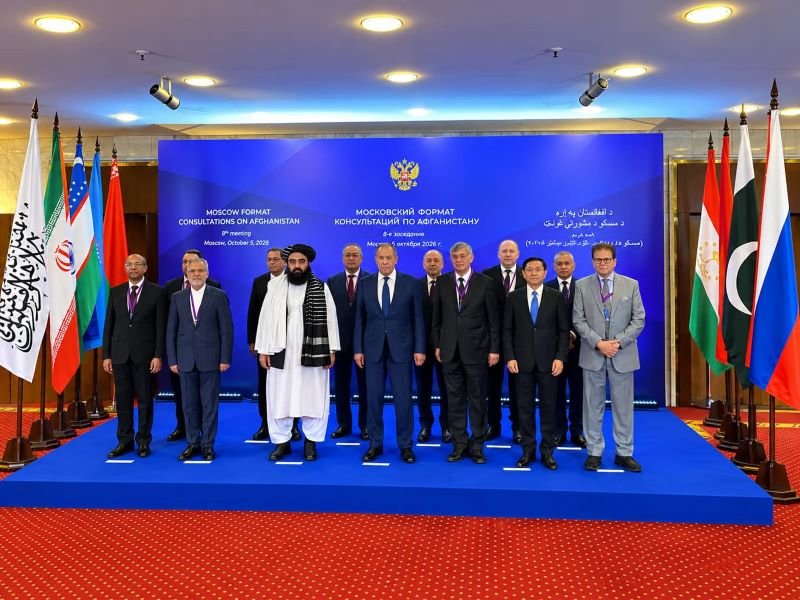
Moscow (GNP): The 8th Meeting of the Moscow Format Consultations on Afghanistan opened in Moscow, bringing together Afghanistan and regional countries to discuss the Afghan situation and broader regional concerns.
Russian Foreign Minister Sergey Lavrov attended and addressed the opening session. Pakistan was represented by a high-level delegation led by Ambassador Mohammad Sadiq, Special Assistant to the Prime Minister and Special Representative for Afghanistan, along with Pakistan’s Ambassador to Russia Faisal Niaz Tirmizi, Ambassador to Afghanistan Ubaid-ur-Rehman Nizamani, and other senior officials.
The talks focused on regional peace and security, counter-terrorism, economic cooperation and connectivity, and continued engagement with Afghanistan. Pakistan reiterated its longstanding emphasis on the importance of a peaceful, stable Afghanistan and sustained regional dialogue to address shared security and economic challenges.
Speaking at a press conference following the meeting, Russian envoy Zamir Kabulov said delegates encountered disagreements between the Afghan and Pakistani sides while drafting the meeting’s final joint statement. According to Russia’s TASS news agency, he expressed regret that the two delegations could not reach consensus, explaining that the Taliban delegation objected to language referencing Afghanistan too frequently in connection with terrorism. The Taliban side argued that similar wording had appeared in last year’s statement, but that bilateral relations had since evolved.
Kabulov said the Moscow Format can continue functioning without a joint statement, though having one would be more consistent with tradition and protocol. He stressed that the platform remains intact but is not designed to resolve bilateral disputes, functioning instead as a mechanism for coordinating regional cooperation.
Established in 2017, the Moscow Format serves as a regional consultative mechanism addressing political, security, and economic developments in Afghanistan, bringing together special representatives and senior officials from Afghanistan, India, Iran, Kazakhstan, China, Kyrgyzstan, Pakistan, Russia, Tajikistan, and Uzbekistan. This latest round, held in Moscow, included Lavrov, Taliban Foreign Minister Amir Khan Muttaqi, and representatives from India, Iran, Kazakhstan, China, Pakistan, Tajikistan, and Uzbekistan, with delegations from Belarus and Egypt attending as guests.
Pakistan’s special envoy Mohammad Sadiq pushed back, asserting that terrorism remains the central challenge facing Afghanistan. He said groups including Tehrik-e-Taliban Pakistan, the Balochistan Liberation Army, the East Turkestan Islamic Movement, Islamic State Khorasan Province, and al-Qaeda continue operating from Afghan soil without consequence, posing Pakistan’s most serious security threat. He noted that more than 4,700 Pakistani civilians have been killed by terrorism originating from Afghanistan over the past three years alone, arguing that no country would tolerate such losses. He described Pakistan’s military operations as precise, intelligence-driven, and defensive in nature.
Sadiq said Pakistan would continue taking all necessary measures to protect its citizens’ safety in line with international law, guided by principles of necessity and used only as a last resort, characterizing these actions as legitimate defensive responses to sanctuaries used for planning and launching attacks inside Pakistan.
Tensions between Pakistan and the Taliban authorities, once close allies, have persisted for nearly a year. In the most recent incident, Pakistan conducted airstrikes in two Afghan provinces last week, which the United Nations said killed at least 10 civilians and injured nine others.
Also read: Pakistan Sends Top Leadership to Makkah Defence Pact Talks
The UN has documented more than 1,100 civilian casualties from cross-border violence in Afghanistan so far in 2026. Pakistan maintains that its strikes targeted militant hideouts and killed dozens of fighters, accusing the Taliban of allowing groups like Tehrik-e-Taliban Pakistan to use Afghan territory to plan and launch attacks — an allegation the Taliban deny.

Sohail Majeed is a Special Correspondent at The Diplomatic Insight. He has twelve plus years of experience in journalism & reporting. He covers International Affairs, Diplomacy, UN, Sports, Climate Change, Economy, Technology, and Health.