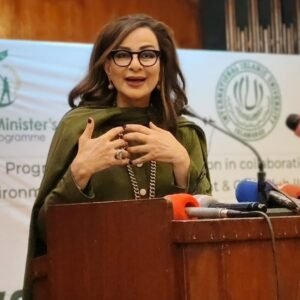
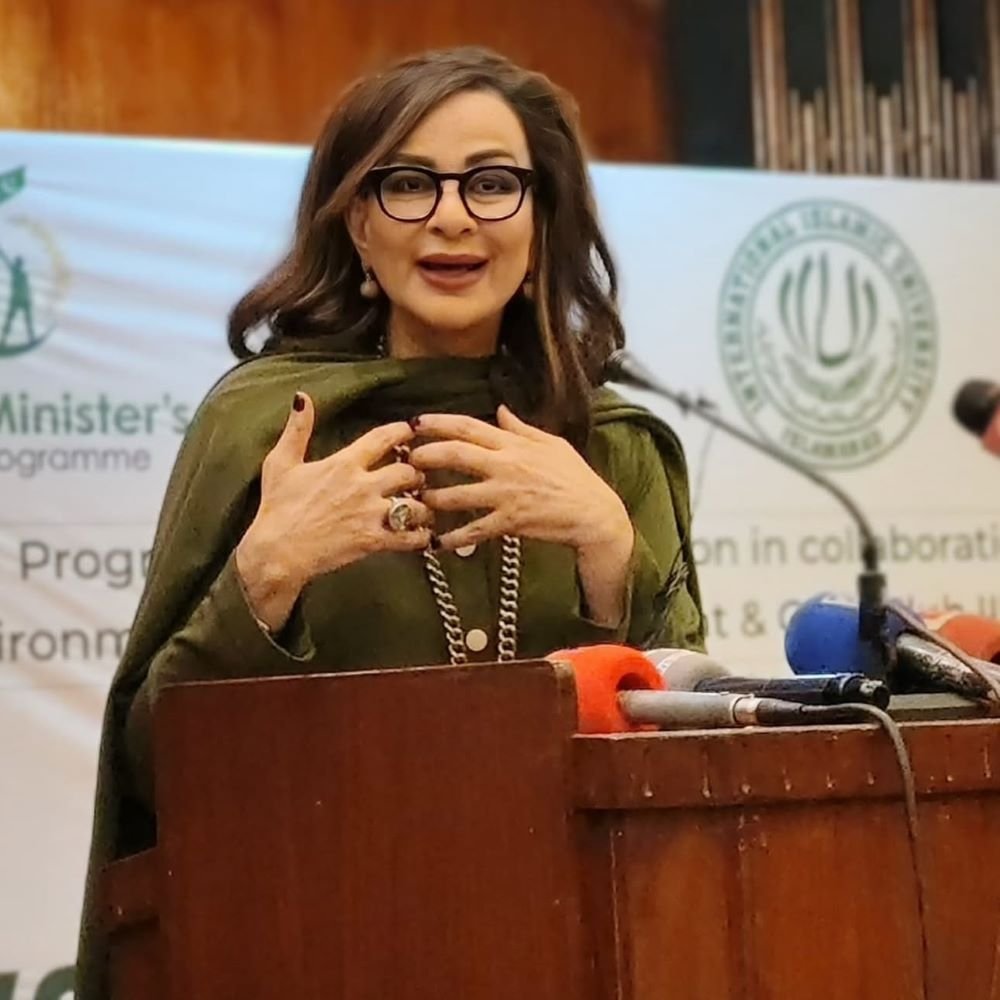
Islamabad (GNP): Senator Sherry Rehman has called for urgent action, both globally and domestically, to confront the worsening plastic pollution crisis.
Speaking at the ICEPP Parliamentary Exchange on Plastic Pollution on September 29, Rehman argued that the world still isn’t treating the scale of the plastics crisis with the seriousness it demands. She said the economics of the plastics industry have enabled a globally subsidized crisis, noting that more than 9 billion tonnes of plastic have been produced worldwide since the 1950s according to documented figures — with the true total likely even higher.
She stressed that plastic pollution can no longer be viewed simply as a waste-management problem, arguing that its entire lifecycle — from fossil-fuel extraction and production through consumption, disposal, and environmental leakage — must be addressed. She warned that toxins and pollutants are increasingly entering ecosystems, food chains, and water systems even as plastic production continues to grow, describing this as a shared global responsibility.
Rehman called for stronger international accountability and genuine consensus on curbing plastic use, cautioning that recycling alone cannot solve the problem. She cited OECD data showing only around 9% of global plastic waste is successfully recycled, with the rest landfilled, incinerated, or leaked into the environment, questioning whether recycling can realistically be framed as a solution while production and consumption keep climbing.
She also linked the plastics crisis directly to climate change, noting that plastic production alone accounts for roughly 3.4% of global greenhouse gas emissions, with the vast majority of single-use plastics derived from fossil fuels. She argued that plastic production is deeply embedded in the fossil-fuel economy, since nearly all single-use plastics originate from oil and gas-based petrochemicals — the same fuels driving climate change — and said continued mass production cannot simply be offset by recycling.
Turning to Pakistan specifically, Rehman described the country’s track record on single-use plastics as deeply disappointing, citing a significant gap between legislation, implementation, and actual compliance. She pointed to four plastics-related initiatives she has led since 2022, both as a minister and parliamentarian, stressing that legislation alone cannot succeed without institutional capacity, enforcement, and affordable alternatives. She noted that while legally binding rules exist, Pakistan — like much of South Asia — remains stuck due to the lack of scalable, low-cost alternatives, with both compliance and enforcement posing ongoing challenges.
She said Pakistan’s basic waste-management infrastructure is struggling to handle the sheer volume of plastic entering the system, noting that despite efforts to shift away from single-use plastic bags toward more durable alternatives in supermarkets and across Islamabad, most plastic still ends up clogging waterways and waste systems.
Rehman also pushed back against industry narratives suggesting plastics can simply be made safe through recycling or technological solutions, calling such claims a myth perpetuated by the petrochemical industry in the absence of real low-cost alternatives. She noted this problem is especially visible across South Asia, where plastic packaging has become deeply embedded in daily life — citing the common practice of carrying milk and yogurt in single-use plastic bags — and argued that consumers shouldn’t be blamed when affordable alternatives simply don’t exist.
She called for greater public awareness of plastic pollution’s environmental toll on rivers, coastlines, landfills, and waterways, noting that plastic waste now appears in even the most remote environments, from mountaintops to oceans — describing it as a hidden emergency that receives too little attention.
Rehman highlighted the particularly dire condition of the Indus River, which she said supports roughly 90% of Pakistan’s livelihoods while ranking as the second most polluted river in the world, with its tributaries at risk of becoming toxic — plastics being the primary culprit. She cited World Bank data showing plastics make up approximately 40% of solid waste entering the Indus, with thousands of tonnes carried into the Arabian Sea annually. She warned that as plastics break down into microplastics and nanoplastics, they don’t disappear but instead continue moving through water systems, ecosystems, and food chains.
She called for credible, independently verifiable data covering the entire plastics lifecycle, criticizing the formal sector for allowing a misleading narrative that recycling happens at scale, when Pakistan’s actual recycling rate is closer to 1% — raising serious questions about what happens to the remaining 99%. She urged the creation of a transparent national accounting system tracking plastic production, imports, consumption, collection, recycling, disposal, and environmental leakage, arguing that without this data, effective regulation, circularity, and accountability are impossible.
Rehman also called for stronger enforcement of Extended Producer Responsibility, arguing that the burden of managing plastic waste cannot continue to fall mainly on governments, municipalities, and citizens. She said companies that introduce plastic into the market must also bear responsibility for what happens to it after use, rather than leaving governments and communities to manage the resulting waste and pollution.
She stressed that multinational corporations operating in Pakistan must be held accountable for the full lifecycle of their products and packaging, warning that symbolic gestures cannot substitute for genuine accountability when packaging lacks any viable system for recovery. She called for packaging circularity to become a core element of both national and international plastic policy, criticizing the continued design of products for a linear “produce, consume, discard” model while claiming circularity.
She pointed to the pervasiveness of unnecessary plastic packaging in daily life — even citing the practice of wrapping books in plastic, a practice she has personally legislated against — as evidence of how deeply embedded the material has become.
Rehman noted the stark contradiction facing Pakistan, which contributes less than 1% of global carbon emissions yet suffers severe climate and environmental consequences, including catastrophic monsoons, floods, and pollution. She argued that climate resilience cannot be built while plastic continues to damage waterways, drainage systems, coastlines, and public health, and said the international community must recognize that plastic pollution, climate change, public health, and infrastructure resilience are deeply interconnected challenges. She warned that the world’s continued dependence on plastic cannot keep shifting environmental costs onto poorer and more vulnerable countries.
Also read: President Pays Tribute to Teachers for Nation-Building Role
She said Parliament has a critical role to play in closing the gap between legislation and implementation, strengthening producer responsibility, improving transparency, enforcing packaging circularity, and ensuring affordable alternatives are available. She framed the central question as how to scale up effective solutions, stressing the need for both global consensus and national enforcement, legislation paired with compliance, and an end to treating plastic pollution as someone else’s problem.

Sohail Majeed is a Special Correspondent at The Diplomatic Insight. He has twelve plus years of experience in journalism & reporting. He covers International Affairs, Diplomacy, UN, Sports, Climate Change, Economy, Technology, and Health.