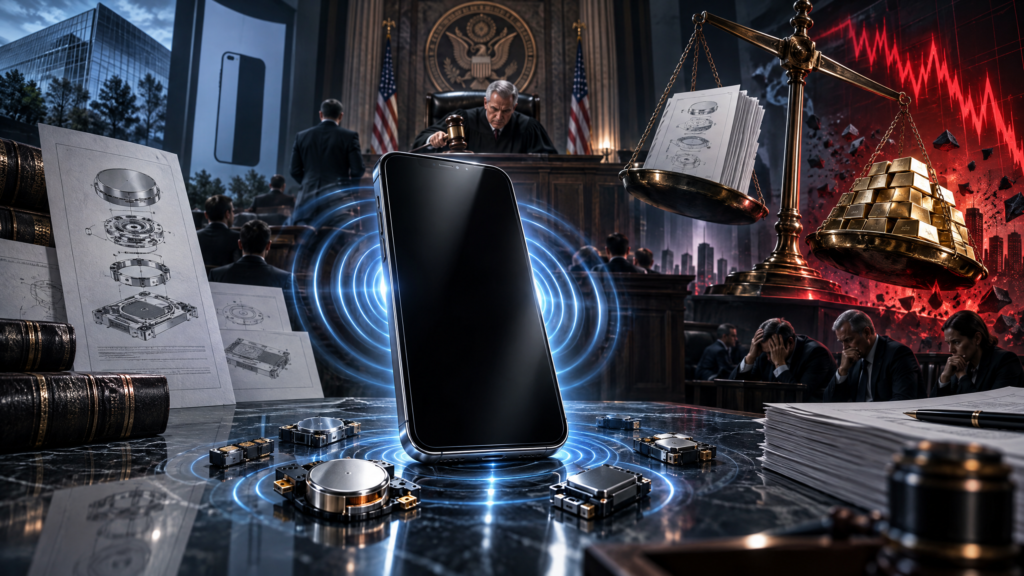
Cupertino (GNP): Apple Vibration Patent Loss has become a major legal and financial development after a US jury ordered Apple to pay more than $5.7 billion to Taction Technology in a patent dispute involving haptic technology.The Apple Vibration Patent Loss case has attracted major attention because of the unusually large value of the jury award.
The technology enables the vibrations and touch feedback that users experience when interacting with devices such as iPhones and Apple Watches.
Taction Technology, an audio company located in San Diego, has initiated the lawsuit against Apple.The Apple Vibration Patent Loss dispute began when Taction alleged that Apple’s haptic technology infringed its patented inventions.
According to them, Apple has violated two patents with their haptic systems. Taction filed the case in 2021, saying that the changes that Apple made in Taptic Engine violated the patents that Taction has received in 2020.
The Apple Vibration Patent Loss dispute therefore involves both the development of haptic technology and the legal rights connected with patented inventions.
Haptic technology has become an important part of modern consumer goods since it lets devices give a physical reaction in the form of vibration when someone presses a button on the device, gets a notification, or uses an app. The Taptic Engine from Apple has been used in such devices as iPhone and Apple Watch.
Apple Vibration Patent Loss has also highlighted how an invisible technology can become central to a major technology dispute.
Apple has introduced the Taptic Engine for the first time in the Apple Watch in 2014 and has then further developed it and used it in many products since that time. It has made the technology a key part of the user’s experience since it enables the physical sensation during the action performed digitally.
The loss of the Apple vibration patent took place after a long and complicated legal battle.
Vibration Patent Loss case reached this stage only after several years of proceedings and an earlier ruling in Apple’s favour.In 2023, a San Diego judge ruled in Apple’s favour, finding that Apple did not infringe Taction’s patents. However, another stage of the case was still ahead, as it was appealed to a federal court.
The Apple Vibration Patent Loss case was later revived through the federal appeals process, allowing the dispute to return to trial.
As a result of this appeal, a new jury trial was held at the US District Court for the Southern District of California. The jury sided with Taction and found that Apple had committed patent infringement of its two patents. The awarded damages were more than $5.7 billion, making it one of the most notable cases in patent litigation in the technology industry.
The jury did not find that Apple committed patent infringement wilfully. This means that the infringement was proved but not the intention to infringe.
Apple has defended itself against the jury’s decision and announced that it will appeal this decision. The company is convinced that its Taptic Engine is not the same as Taction’s equipment.
The Apple Vibration Patent Loss case may also be open to future legal proceedings. While the jury verdict is an important step in the case, the appeal process to be initiated by Apple will mean that the issue will be pursued in courts in additional legal proceedings.
The scale of the verdict has drawn attention not only from Apple and Taction. Litigation finance firm Burford Capital, which financed Taction’s lawsuit against Apple, stated that it may claim around $1.4 billion from the verdict based on the terms of its investment. Burford also warned that such verdicts may become reduced during the post-verdict process.
The case demonstrates how critical patents have become in today’s technology business. While companies spend millions of dollars on research and development, patent owners rely on patents to manage the commercial use of their inventions. It can lead to significant financial claims in cases of disputes connected to widely used technologies.
This case is just another patent claim for Apple in a long list of similar cases. In November 2025, Apple was ordered to pay $634 million to the medical technology firm Masimo in a patent case related to blood-oxygen monitoring technology in Apple Watch.
Also Read: China Targets Solid-State Batteries In New Five-Year Plan
The Apple Vibration Patent Loss Case is a good example of how a seemingly minor technological piece can be the subject of an extremely heated lawsuit. The haptic feedback usually goes unnoticed by users as a separate technology; however, when its patents are applied to the production of goods for international markets, their business value becomes extremely high.
The trial will now proceed to the next phase as Apple files an appeal. As a result, the total financial outcome may turn out different from what the jury first decided because further legal proceedings will change the damage sum or any other aspect of the judgment.
Thus, the Apple Vibration Patent Loss Case is a serious patent lawsuit between one of the biggest technology companies in the world and a smaller technology company specializing in certain technologies. The final outcome of this lawsuit will depend on the decision made in Apple’s appeal.