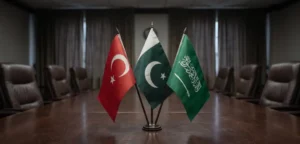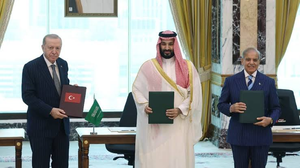
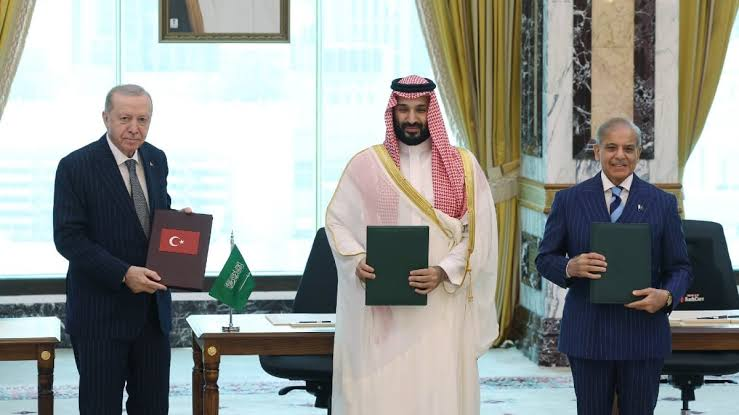
When Houthi drones allegedly turned toward Islam’s holiest city this month, the Mecca Pact, the trilateral defense arrangement binding Saudi Arabia, Pakistan and Türkiye, faced the only test that matters for any alliance: not whether it exists on paper, but whether it moves when its members are struck. It didn’t. What followed instead was a masterclass in strategic ambiguity, led almost entirely by Islamabad, and it has exposed just how decorative this “Muslim NATO” may actually be.
Pakistan’s Foreign Office has been busy explaining, without quite explaining. Asked directly what mechanism exists to stop Houthi attacks on the kingdom, spokesperson Sajjad Haider Khan offered only that “operational confidentiality” required discretion on when, how and with what force the pact would be enforced. Days earlier, the same office had said expansion was “not on the cards” for now, a retreat from an earlier line that the pact was open to any regional state willing to sign on. Meanwhile, the military’s spokesman, Lt Gen Ahmed Sharif Chaudhry, went on Saudi television to insist the pact has “no regional aspirations” and is not “a club” for Muslim countries at all, an odd disclaimer for an agreement its own architects have elsewhere branded an Islamic NATO precursor. Between confidentiality, consolidation and disclaimers, the pact’s obligations remain undefined.
That vagueness became impossible to ignore when Riyadh, rather than invoking its new allies, turned to London. Bloomberg reported that the Saudis asked Britain’s government for operational support against the Houthi push toward the Bab el-Mandeb Strait, and Prime Minister Andy Burnham has reportedly agreed to send military advisers. Middle East Eye’s reporting on the episode noted flatly that Pakistan and Turkey, pact partners who had just signed a mutual-defense agreement, had not come to Saudi Arabia’s aid over the attacks. If the kingdom’s first instinct in a real crisis is to dial a non-member half a world away rather than mobilize the “Muslim NATO” it just built, that tells you what Riyadh itself thinks the pact is currently worth: useful for photographs in Mecca, less so for logistics in the Red Sea.
There is a real argument for restraint. The Houthis have not conducted a confirmed strike on Saudi soil in this latest episode; coalition officials said they intercepted a drone headed toward Mecca, and the Houthis themselves rejected that account as fabrication. When even the alleged attacker denies the alleged target, invoking a mutual-defense clause built for confirmed aggression looks premature, not cowardly. Islamabad and Ankara’s caution, in that light, is less evidence of a hollow pact than evidence that its authors built it for clearer red lines than a disputed drone report currently offers.
What is harder to explain away is the asymmetry between the two junior partners’ postures. Pakistan has been almost compulsively vocal, with its foreign ministry, defense minister, and army spokesman all fielding questions and offering some version of commitment “in intent and spirit.” Turkey, by contrast, has been comparatively quiet, with a Turkish official telling reporters the pact has not yet become operational. Ankara’s own Parliament has, if anything, been more openly skeptical than Islamabad’s government, with opposition lawmakers asking whether a Houthi or Iranian strike on Saudi Arabia would drag Turkish troops into someone else’s war.
Pakistan’s eagerness is not mysterious. As the only nuclear-armed Muslim-majority state, with the largest standing army among the three signatories, Pakistan has long nursed an aspiration to be recognized as the security guarantor of the wider Islamic world. That ambition is not unreasonable on its face. But branding an untested, still-classified arrangement as the seed of an “Islamic NATO” before anyone has agreed on its trigger conditions, its command structure, or even whether it is a Muslim bloc at all- recall the DG ISPR’s own denial of that framing- reads less like statesmanship than eagerness to wear a crown that hasn’t been forged yet.
Then there is Bangladesh, whose brief flirtation with the pact supplies the episode’s most instructive subplot. A state minister first said Dhaka had “expressed interest,” language that let domestic commentary run well ahead of the facts, with some voices publicly treating an invitation as all but issued. Foreign Minister Khalilur Rahman had to walk it back in Parliament, telling lawmakers plainly that Bangladesh had received no invitation and that joining was not under discussion, forcing everyone who had amplified the stronger claim to stand down quietly. Pakistan itself delivered the final word, confirming there was no plan to expand the pact for now. A pact three signatories can’t yet operationalize for themselves was, unsurprisingly, in no position to onboard a fourth.
So here is the joke, and it isn’t funny: the Muslim world’s largest defense experiment in a generation has spent its first real crisis being defended in press briefings rather than deployed in the field, while its most enthusiastic member markets a status it hasn’t earned. Its most hopeful applicant gets quietly shown the door. This is, depressingly, the house style. From the Arab League to the OIC, the Ummah has an unmatched talent for producing solidarity statements and an equally unmatched talent for producing nothing when the missiles are actually in the air. Call it a fifty-seven-member support group that meets, expresses concern, and adjourns.
Also Read: Different Times, Shared Hearts: What Brings China and the US Together
None of this argues against the pact’s premise. A collective-security arrangement among Riyadh, Islamabad and Ankara answers a genuine strategic need: three states with complementary strengths, Saudi capital, Turkish industry, Pakistani manpower and a nuclear umbrella, in a neighborhood that has learned, the hard way, not to outsource its security indefinitely to Washington or London. The tragedy is not that the idea is wrong; it’s that the execution is so achingly familiar. Every generation produces its own version, an Arab Legion, an Islamic Military Alliance, an OIC peacekeeping force announced with fanfare and never fielded, and each collapses into the same pattern of vocal committees and a founding member dialing a Western capital the moment theory meets a drone.
The Mecca Pact, on current evidence, needs the Muslim world’s fifty-seven flags far more than the reverse. If history from Baghdad to Gaza to the Gulf is any guide, that mismatch between rhetoric and readiness isn’t a bug to be patched before the next crisis. It’s the operating system, installed decades ago and never meaningfully upgraded. Pakistan’s foreign ministry can keep issuing careful statements about intent and spirit, Turkey can keep waiting for the fine print, and Riyadh can keep dialing London in the meantime. The Ummah, ever resourceful, will doubtless convene another summit to discuss why the last one didn’t work, and nobody serious expects that particular reboot anytime soon.

Political and International Affairs Analyst; Research Fellow, Bangladesh Neeti Gobeshona Kendra (Policy Research Center, NGK)