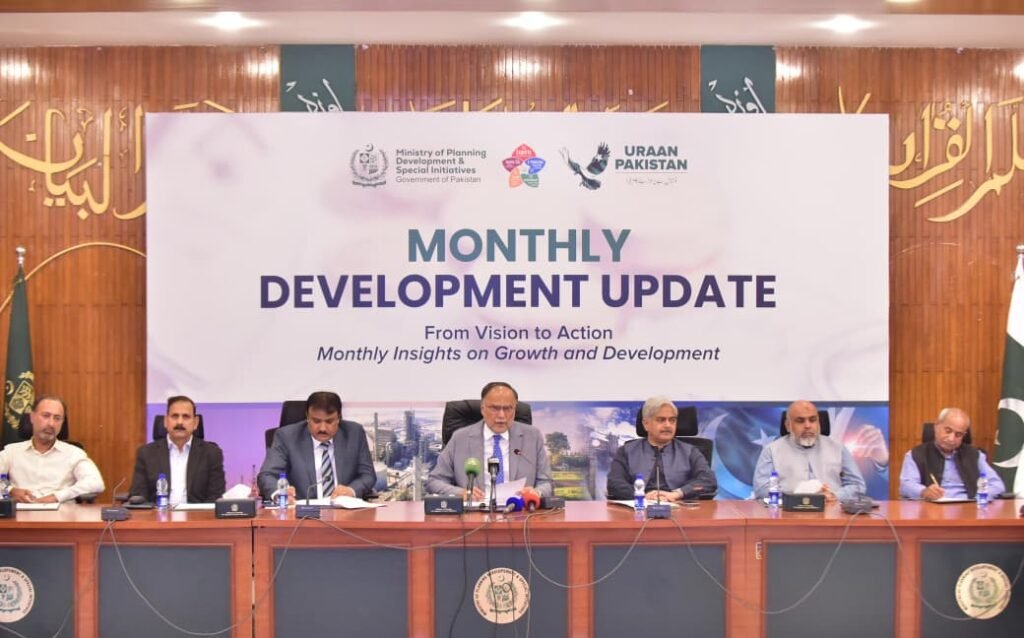
Islamabad (GNP): Presenting the September 2026 Monthly Development Update (MDU), Federal Minister for Planning, Development and Special Initiatives Ahsan Iqbal said Pakistan has made substantial progress over the past two and a half years in rebuilding economic confidence and strengthening the country’s economic foundations, and must now translate its global and diplomatic achievements into greater domestic economic resilience.
Iqbal noted that declining oil prices would help ease inflationary pressures, pointing out that recent inflation challenges were largely tied to rising global oil prices — a burden shared by countries worldwide. He said Pakistan’s economic indicators have improved significantly over the past four years alongside notable international and diplomatic successes, but stressed the need to further strengthen these indicators and maintain the current recovery momentum.
He said Pakistan must convert its international successes into internal economic strength, warning that political and social instability could jeopardize the country’s economic progress and undermine investor confidence. He called on political parties to ensure their actions do not inadvertently serve the interests of external adversaries, stating that political disputes should be resolved through constitutional and democratic channels. He noted that the Pakistan Muslim League-Nawaz has pursued its legal and political battles through Parliament and the courts and has never conspired against the state.
Iqbal said no one would be permitted to jeopardize Pakistan’s future, warning that instability and disorder could derail the country’s economic trajectory. He accused a segment within the Pakistan Tehreek-e-Insaf of attempting to create unrest, saying efforts to turn Islamabad into a site of confrontation would not serve national interests. He added that the cases against the former PTI chairman are corruption-related rather than politically motivated, urging PTI members and supporters to seek clarity from their leadership regarding these allegations.
Turning to the substance of the MDU, Iqbal said the government’s focus over the past two and a half years has been on restoring economic confidence, strengthening fundamentals, and creating conditions for more resilient growth. He said this progress provides a foundation for greater emphasis on sustainable growth, investment, and opportunity creation, with a people-centered approach remaining central to the government’s economic strategy — prioritizing a more productive, export-driven economy by boosting investment, strengthening industry, and empowering Pakistan’s youth as a driver of economic growth.
He said this direction is being pursued through URAAN Pakistan and the government’s wider development agenda, with the Monthly Development Update reflecting the Planning Ministry’s commitment to transparent and accountable governance based on evidence.
On inflation, Iqbal said price stability remains a top priority given its direct impact on household budgets and purchasing power, with the government focused on addressing price pressures in essential goods and services while pursuing higher GDP growth and job creation. He noted that average CPI inflation for July-August 2026 stood at 10.2 percent, compared to 3.6 percent during the same period last year, while monthly inflation rose to 11.1 percent in August 2026, up from 9.2 percent in July and 3.1 percent in August 2025. Food and non-alcoholic beverages saw inflation of 13.9 percent, while transport costs rose 20.2 percent.
He said the National Price Monitoring Committee (NPMC) continues to hold regular meetings to address price pressures, including tackling unjustified gaps between wholesale and retail prices and strengthening oversight of essential goods, noting the committee had also flagged discrepancies between notified and actual market prices of LPG and directed authorities to take corrective action.
On manufacturing, Iqbal said Pakistan’s sector is gaining momentum, with Large-Scale Manufacturing (LSM) growth reaching 3.0 percent in July of FY2026-27 and expanding 9.5 percent compared to June 2026. He cited strong growth across several sectors: automobiles at 57.01 percent, transport equipment at 40.22 percent, tobacco at 35.82 percent, apparel at 22.03 percent, electrical equipment at 7.88 percent, and non-metallic mineral products at 4.25 percent — reflecting a strengthening industrial base, though he noted the continued need to revive traditional export sectors.
On the external sector, Iqbal said Pakistan enters FY2026-27 with greater confidence in its external position. Goods exports reached $5.4 billion during July-August of the fiscal year, while combined goods and services exports rose to $7.3 billion — a 9.2 percent increase from $6.6 billion during the same period last year. He highlighted the diversified nature of this growth, with food exports up 9.3 percent, petroleum products up 42 percent, leather goods up 12.8 percent, textiles up 3.0 percent, and surgical goods up 10.2 percent.
Services exports grew by 29 percent, he said, with ICT and digital services playing an increasingly important role in Pakistan’s foreign exchange earnings. ICT exports reached $811 million during July-August of the fiscal year, up from $691 million during the same period last year, reflecting the gradual diversification of Pakistan’s export base beyond traditional sectors.
Iqbal said the government’s current focus is on converting economic stability into sustained, higher growth by expanding exports, increasing value addition, scaling up technology and services exports, and creating conditions conducive to private investment and foreign exchange generation. Despite stronger import demand, he noted the current account deficit for July-August stood at $543 million, down from $853 million a year earlier — an improvement of $310 million, or 36 percent.
He described remittances as a key pillar of external stability, noting they reached $7.3 billion during the first two months of the current fiscal year, up from $6.4 billion during the same period last year. The GCC remains the largest source of remittances, led by Saudi Arabia at $873 million and the UAE at $750 million, followed by the UK at $564 million and the US at $309 million.
Foreign investment also gained momentum at the start of the fiscal year, with net FDI rising 77 percent to $316 million in August 2026 from $179 million in July, bringing net FDI for July-August to $494 million — 24 percent higher than the $399 million recorded during the same period last year.
On fiscal matters, Iqbal said FBR tax collection rose 3.7 percent to Rs. 1,722 billion during July-August, compared to Rs. 1,661 billion the previous year, reflecting continued efforts to boost domestic revenue. He noted strong international investor interest as well, with a record $3 billion international bond issuance attracting nearly $6 billion in demand — a sign of improved market confidence in Pakistan’s external financing position.
Consumer confidence is also showing early signs of recovery, with the IPSOS Consumer Confidence Index rising to 33.6 in the third quarter of 2026 from 33.2 in the second quarter, while expectations of economic improvement nearly doubled over two years, climbing from 12 percent to 23 percent.
On development spending, Iqbal said the government is front-loading expenditure in priority sectors under the Federal PSDP 2026-27, with a total allocation of Rs. 1,000 billion — including Rs. 355.9 billion for transport and communication, Rs. 602.5 billion for water and energy, Rs. 180.9 billion for health and nutrition, Rs. 88.8 billion for special areas, and Rs. 74.5 billion for the SDGs Achievement Programme. He said Rs. 19.65 billion had already been utilized during the first two months of the fiscal year, with Rs. 6.4 billion spent on water, Rs. 2.9 billion on transport and communication, and Rs. 3.4 billion on education, including HEC.
He said development activity is proceeding with greater discipline, noting that the Central Development Working Party (CDWP) approved seven projects worth Rs. 25.4 billion in August 2026 and recommended five major projects worth Rs. 283.9 billion to ECNEC for further review. Through rigorous scrutiny, the CDWP saved Rs. 6.5 billion in August alone, bringing cumulative savings to Rs. 7.5 billion for the fiscal year’s first two months by eliminating non-essential project components and improving efficiency.
Iqbal said public investment continues to drive growth and job creation, with projects approved in August 2026 expected to generate roughly 4,538 direct and 19,118 indirect jobs, bringing the cumulative expected job count to 23,656 across key sectors. He added that the Ministry of Planning strengthened its oversight during July-August by monitoring 22 projects and evaluating three others to identify implementation gaps and ensure alignment with planned outcomes.
He noted that the Prime Minister’s Review Committee reviewed Gilgit-Baltistan’s fiscal, energy, and development priorities on August 5, 2026, reaffirming federal commitment to sustainable development, hydropower investment, and improved connectivity. On August 12, the Planning Commission began work on unlocking Pakistan’s automotive export potential, tasking the sector with developing five-year export strategies centered on technology, productivity, and global market access.
A high-level roundtable on August 14 identified research and development, innovation, technology adoption, and domestic value-chain development as key drivers for expanding pharmaceutical exports, which reached a 20-year high of $457 million in FY2025 — a 34 percent increase. The industry was urged to develop a comprehensive export roadmap aligned with Pakistan’s broader goal of surpassing $100 billion in exports by 2035.
Also read: Shaza Formally Inaugurates ‘Innovation Hive’ Estb by USEFP
Iqbal concluded that the indicators presented in the Monthly Development Update reflect the progress made in economic stabilization, while the next phase will require sustained effort to convert that stability into productivity, investment, exports, and employment. He stressed that Pakistan’s international and diplomatic achievements must be translated into internal economic strength through continued reforms, political stability, productive investment, and a stronger export-oriented economy, adding that the government will continue monitoring economic and development indicators through regular, evidence-based assessments to ensure public investment and reform efforts remain aligned with Pakistan’s long-term goals under URAAN Pakistan.

Sohail Majeed is a Special Correspondent at The Diplomatic Insight. He has twelve plus years of experience in journalism & reporting. He covers International Affairs, Diplomacy, UN, Sports, Climate Change, Economy, Technology, and Health.