For much of the modern era, international politics was often described through the lens of a dominant power or a small group of powerful states.
After the Cold War, the United States emerged as the world’s most influential military, financial and diplomatic power. But the international system is changing.
China’s economic rise, Russia’s continued geopolitical influence, the growing strategic importance of India and the increasing autonomy of Middle Eastern powers are contributing to a more complicated distribution of global power.
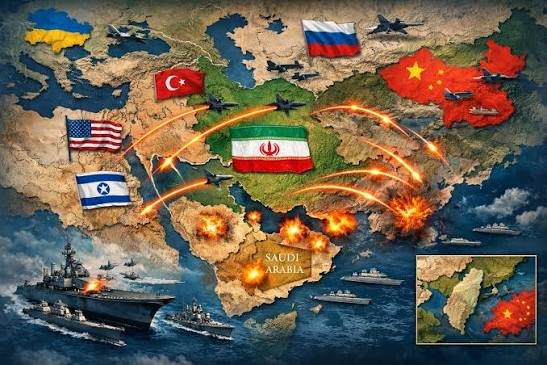
The conflicts involving the United States and Iran, followed by the renewed confrontation between Saudi Arabia and Yemen’s Houthis, provide a striking example of this changing environment.
These conflicts are not isolated wars. They are connected through energy markets, maritime trade, regional alliances, diplomacy and the competition for influence across the Middle East.
From a Unipolar Moment to a Multipolar World
A multipolar world does not necessarily mean that the United States has ceased to be a major global power.
Rather, it means that power is increasingly distributed among several countries and regional actors, each capable of influencing international outcomes. China has become an important economic and diplomatic actor in the Middle East.
Russia maintains significant military and diplomatic influence. India has expanded its economic and strategic relationships across the Gulf. Saudi Arabia, Iran, Türkiye, the United Arab Emirates and Qatar increasingly pursue their own interests rather than simply aligning with one major bloc.
Recent developments in the Middle East illustrate this shift. China, which has close economic ties with Iran and is heavily dependent on Middle Eastern energy, has reportedly urged Tehran to help restrain the Houthis following Saudi appeals to Beijing.
China also previously played a role in facilitating the restoration of Saudi-Iranian diplomatic relations in 2023.
This is one of the defining characteristics of a multipolar system: countries can compete in one arena while cooperating in another.
The Iran–US War and the Return of Energy GeopoliticsThe war between the United States and Iran has demonstrated how a regional conflict can quickly become a global economic issue.
The Strait of Hormuz is central to this story. It is one of the world’s most important energy chokepoints, connecting the Persian Gulf with the Gulf of Oman and the wider Indian Ocean.
During the conflict, disruptions to shipping through the strait affected oil and gas markets far beyond the Middle East.
The IMF warned that the war was creating higher commodity prices, inflationary pressure and tighter financial conditions. Its July 2026 outlook projected global growth of 3.0 percent for 2026 and 3.4 percent for 2027, while warning that renewed conflict and geopolitical fragmentation remained significant downside risks.
The consequences extend well beyond oil-producing countries. When energy becomes more expensive, transportation, electricity, manufacturing and food production can all become more costly.
Developing countries that depend heavily on imported fuel can face particularly difficult choices between protecting consumers and protecting government finances.
The IMF has also noted that the effects of the war have been highly uneven, with energy-importing economies and vulnerable countries facing greater pressure.
The Houthis Open Another Strategic Front
The renewed Saudi-Houthi conflict has added another dimension.The Houthis’ attacks and advances in Yemen have brought the Bab el-Mandeb Strait into sharper focus.
The waterway connects the Red Sea with the Gulf of Aden and is crucial for shipping between Europe, Asia and the Middle East. In July, the Houthis announced a naval blockade against Saudi Arabia.
Analysts at Chatham House described the development as a potentially dangerous new phase because it compounds the disruption around the Strait of Hormuz and threatens maritime security in the Red Sea.
More recently, Houthi forces have advanced along Yemen’s Red Sea coast and captured the strategically important port city of Mocha, according to Chatham House.
The development has increased concerns about the security of the Bab el-Mandeb and the wider Red Sea trade route.
Reuters has also reported Houthi missile and drone attacks against Saudi targets, while Saudi Arabia has sought international and regional support as the conflict has intensified.
This means that two separate maritime chokepoints — Hormuz and Bab el-Mandeb — have become linked to the same broader regional crisis.
Why the World Should Care
The importance of these conflicts is not limited to military strategy. Energy security is perhaps the most immediate concern.
The Middle East remains central to global oil and gas supplies, and disruptions can affect prices in countries thousands of kilometres away.Global shipping is another major concern.
If ships avoid the Red Sea or Strait of Hormuz, they may have to take longer routes, increasing fuel, insurance and transportation costs. These additional expenses can eventually reach consumers.Inflation can also return when energy and transportation costs rise.
The IMF and other international institutions have repeatedly warned that the war has created asymmetric pressures on energy, food security and economic activity.
There is also a broader security dimension. The Houthi advance means that a non-state armed group can affect international maritime routes and regional calculations involving major powers.
Iran’s relationship with the Houthis further connects Yemen’s conflict to the wider regional confrontation. The Council on Foreign Relations describes Iranian support as having significantly strengthened the Houthis’ ability to project force into the Red Sea.
China, Saudi Arabia and the New Diplomatic LandscapePerhaps one of the most interesting aspects of the current crisis is the role of countries outside the traditional US-led security framework.
Saudi Arabia remains closely connected to Washington, but Riyadh is simultaneously developing relationships with China and other powers.
China has become an important economic partner for Gulf states and a major buyer of Middle Eastern energy.
That creates an unusual situation. Beijing has an interest in maintaining relations with Iran while also protecting its economic relationships with Saudi Arabia and other Gulf countries.
The recent Chinese effort to encourage Iran to restrain the Houthis demonstrates how economic interdependence can become a diplomatic instrument.
For Saudi Arabia, the conflict is also forcing questions about how its security relationships should evolve. Analysts at Chatham House have argued that the Iran war could encourage Gulf states to diversify their strategic partnerships rather than relying exclusively on one external power.
This does not mean that the United States is disappearing from the Middle East. Rather, it suggests that regional states increasingly have more options — and may attempt to balance relationships among Washington, Beijing and other powers.
The Economic Cost of a Multipolar World
A multipolar world can create opportunities. Countries have more choices in trade, investment, technology and diplomacy.
But it can also make international politics more complicated. When several powers compete for influence, local conflicts can become connected to larger strategic rivalries.
A confrontation in Yemen can affect Saudi Arabia. Saudi Arabia’s response can affect Iran. Iran’s relationship with the United States can affect global energy markets.
China’s economic interests can become part of the diplomatic equation. The result is a world where geography and economics are increasingly intertwined.
The IMF has estimated that the global economy has shown considerable resilience despite the Middle East war, but it has also warned that the energy shock, geopolitical fragmentation and financial risks remain significant.
This resilience should not be mistaken for immunity. Global markets can absorb individual shocks, but prolonged disruptions can gradually increase costs for governments, businesses and households.
Also Read: International Day of Peace: Choosing Humanity Over War
A New Global Balance
The current Middle Eastern crisis may ultimately become one of the defining examples of the emerging multipolar era.
The Iran–US conflict demonstrates the continuing importance of American military power and the ability of regional actors to challenge it.
The Saudi–Houthi confrontation demonstrates how non-state groups can influence global trade routes. China’s involvement demonstrates the growing importance of economic and diplomatic power outside the traditional Western alliance system.
At the same time, Saudi Arabia and other Gulf states are demonstrating greater strategic autonomy. They are seeking security partnerships, investment relationships and diplomatic channels with multiple powers rather than depending entirely on one.
The multipolar world, therefore, is not simply a world with more powerful countries. It is a world in which more actors have the ability to influence outcomes.
For ordinary people, that geopolitical transformation can be felt through the price of fuel, food and transportation, through disruptions in global supply chains and through changing economic opportunities.
For governments, it means that foreign policy can no longer be separated easily from energy security, trade and economic resilience. The conflicts in Iran, Yemen and the Gulf are therefore about more than borders and battlefields.
They are part of a broader transformation in which military power, economic influence, technology, diplomacy and control over strategic routes are becoming increasingly interconnected.
The central question for the coming years may not be whether one country replaces another as the world’s dominant power. It may instead be how major and middle powers learn to operate in a world where no single actor can determine every outcome.