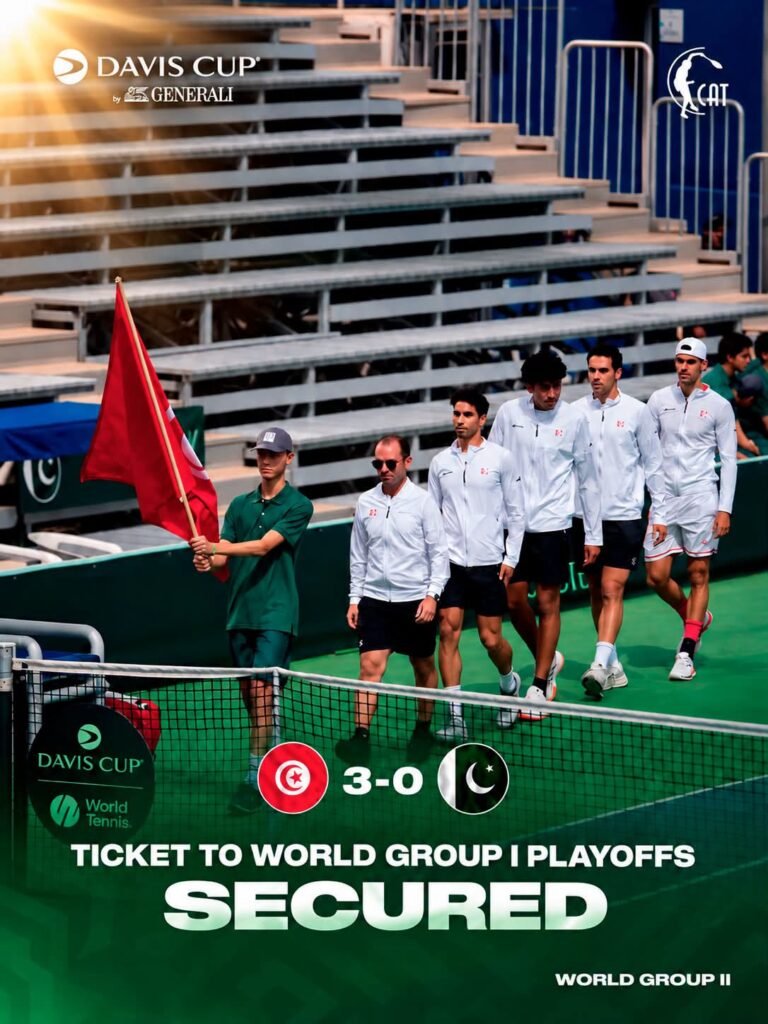
MONASTIR, TUNISIA (GNP): Pakistan’s men’s tennis team has been comprehensively beaten, whitewashed and outclassed by Tunisia in the Davis Cup World Group II tie, losing 3-0 and exposing once again the widening gap between Pakistan and competitive international men’s tennis.
Pakistan, ranked 57th in the Davis Cup standings, arrived in Tunisia hoping to make progress in World Group II. Instead, the team leaves Monastir facing another relegation battle after Tunisia, ranked 51st, swept the tie without dropping a single match. The official Davis Cup record shows Pakistan losing both singles and the doubles, with the two scheduled reverse singles subsequently not played after Tunisia had already secured an unassailable 3-0 lead.
The opening day had already exposed the scale of the problem. Muhammad Shoaib, ranked 928th in the world, was beaten by Aziz Dougaz, ranked 419th, 6-2, 6-3 in just 55 minutes. Muzammil Murtaza, ranked 1392nd, then suffered an even heavier defeat against Moez Echargui, ranked 215th, going down 6-1, 6-1 in only 56 minutes.
The two singles defeats were completed in a combined 111 minutes, with Pakistan failing to win a single set.
Saturday offered Pakistan an opportunity to fight back through the doubles, but that chance disappeared just as quickly. Echargui and Aziz Ouakaa defeated Mohammad Abid Ali Khan Akbar and Muzammil Murtaza 6-3, 6-3 in one hour and 14 minutes, sealing a 3-0 victory for Tunisia.
With the tie already decided, the two scheduled reverse singles were not played. The result is more than another Davis Cup defeat. It raises fundamental questions about the direction of Pakistan men’s tennis, the development of its next generation and the selection philosophy that has dominated the national team for years.
For decades, Pakistan has continued to depend heavily on established veterans, most notably Aisam-ul-Haq Qureshi and Aqeel Khan. Their contribution to Pakistani tennis and their achievements over long international careers are undeniable. But the continuing dependence on veteran players for Davis Cup and major international assignments has increasingly raised a different question: where is the pathway for the next generation? The Tunisia tie has made that question impossible to ignore.
Pakistan sent a team whose singles players were ranked 928 and 1,392 in the world, while Tunisia’s singles players were ranked 419 and 215. The difference was reflected brutally on the scoreboard.
The issue is not simply that Pakistan lost to higher-ranked opponents. International sport inevitably produces defeats. The bigger concern is whether Pakistan has built a sustainable system capable of producing players who can regularly compete at this level.
Instead of creating a competitive pipeline in which younger players are gradually exposed to international pressure, difficult away ties and higher-ranked opponents, Pakistan appears to remain caught between dependence on veterans and insufficiently developed replacements.
The situation surrounding the upcoming Asian Games has added another layer to the debate.
Aisam-ul-Haq Qureshi was originally listed as unavailable for the Davis Cup tie, with the Pakistan Tennis Federation stating that he was managing an injury and would remain in Pakistan.
Yet shortly afterwards, Qureshi confirmed that he would compete in men’s doubles at the Asian Games in Aichi-Nagoya after assessing his fitness. He said he was fully fit and continued to play tennis regularly, and was subsequently named in Pakistan’s six-member tennis squad alongside Aqeel Khan, Muhammad Shoaib, Muzammil Murtaza, Maheen Aftab and Ushna Sohail.
That sequence is bound to generate debate, particularly after the crushing Davis Cup result. The concern is not about whether a veteran player is physically capable of competing. The larger question is whether major international events should primarily be used to protect established names or to expose emerging players to the highest level of competition and give them the experience required to build the next generation of Pakistan’s men’s tennis.
Every international appearance has a developmental value. Every Davis Cup rubber against a higher-ranked opponent can provide experience that cannot be replicated in domestic competition. When those opportunities repeatedly go to established players, younger players inevitably lose valuable exposure.
The Tunisia tie provides a particularly stark example. Pakistan went to Monastir, lost the opening two singles in 55 and 56 minutes, lost the doubles in 74 minutes and then did not play the reverse singles.
The reverse singles would not have changed the outcome of the tie, but they could have provided competitive experience to Pakistani players. Instead, once Tunisia reached 3-0, those matches were abandoned.
That leaves Pakistan with almost no positives from a tie that was supposed to provide an opportunity to compete at World Group II level.
The consequences are now serious.
Pakistan could be forced into another World Group II relegation play-off, where the team will have to fight to retain its position at this level. A defeat in that stage would push Pakistan down into the Asia/Oceania Group III structure. The Davis Cup’s 2026 calendar confirms that World Group II and its play-off pathway sit above the regional Group III competition.
For Pakistan tennis, that would represent a significant setback and would make the need for structural reform even more urgent.
The warning signs have been visible for years. Rankings have not produced a sustained pipeline of players capable of challenging internationally. Young players struggle to accumulate sufficient high-level match experience. Davis Cup selection continues to attract debate over the balance between experience and youth. And major events repeatedly become occasions for familiar names to return rather than opportunities to accelerate the development of the next generation.
The Tunisia whitewash has now put all of those questions back into the spotlight.
Pakistan tennis does not need another round of photographs, ceremonial announcements and social-media posts celebrating participation. It needs a serious course correction.
That means creating a genuine transition plan, giving younger players sustained international competition, increasing their exposure to ATP and ITF-level events, improving coaching and physical preparation, and establishing transparent selection criteria for Davis Cup and major multi-sport events.
Most importantly, Pakistan needs to decide what it wants its men’s tennis programme to look like five and ten years from now.
If the objective is simply to survive one Davis Cup tie at a time, the current approach can continue.
If the objective is to rebuild Pakistan into a competitive international tennis nation, then the Tunisia defeat should be treated as a wake-up call.
A team ranked 57th has been beaten 3-0 by a team ranked 51st. The numbers alone do not explain the entire problem, but the scoreline exposes the gap.
Pakistan did not merely lose the tie. It failed to win a set, lost its singles matches in just 111 minutes, surrendered the doubles in straight sets and ultimately did not play the reverse singles.
That is not the moment for another photo opportunity.
Also read: Security Forces Kill Eight Khwarij in Hangu: ISPR
It is the moment for an honest assessment of where Pakistan men’s tennis is heading, why the current pathway is failing to produce internationally competitive players, and whether the country’s young tennis talent is being given enough opportunities to replace the generation that has carried the national team for so long.
The next Davis Cup assignment may determine whether Pakistan remains in World Group II or drops into Group III. But the bigger battle is already underway: whether Pakistan tennis continues managing decline or finally commits to rebuilding its men’s game for the future.

Sohail Majeed is a Special Correspondent at The Diplomatic Insight. He has twelve plus years of experience in journalism & reporting. He covers International Affairs, Diplomacy, UN, Sports, Climate Change, Economy, Technology, and Health.