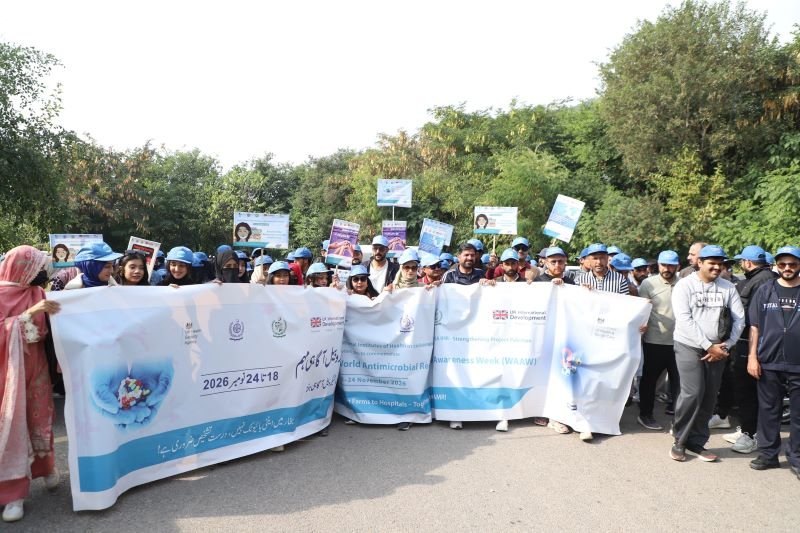
Islamabad (GNP): The National Institute of Health (NIH), in collaboration with the UK Health Security Agency and Getz Pharma, organized a community hiking activity at Trail 5, Islamabad, as part of World Antimicrobial Awareness Week (WAAW). The event aimed to draw attention to the rapidly growing challenge of Antimicrobial Resistance (AMR) and promote responsible antibiotic use across the human, animal, and environmental sectors. Officials from the Islamabad Wildlife Management Board also participated.
The global theme for WAAW for the year 2026, “One Health, one action: Prevent AMR now,” served as the unifying call for the event, underscoring the urgency for bold, coordinated, cross-sectoral action.
More than 200 participants including healthcare professionals, public health experts, students, civil society, and representatives from partner organizations joined the “Hike for Health to Fight AMR” Hike. The activity symbolized unity and collective responsibility in addressing the silent but escalating global threat of drug-resistant infections.
Experts from NIH and UKHSA highlight that the misuse of antimicrobials in humans, animals, and agriculture is a major driver of AMR. Poor infection prevention, limited access to quality diagnosis and treatment, weak healthcare and animal health systems, pollution and environmental contamination from wastewater and waste can also create conditions that contribute to the emergence, persistence and spread of resistant microorganisms.
It is widely cited in recent studies that Pakistan is the third-largest consumer of antibiotics among low- and middle-income countries (LMICs), behind India and China. This high consumption is a major contributor to the rising rates of antimicrobial resistance (AMR) in the country. AMR continues to undermine the effectiveness of life-saving medicines.
Also read: Justice Ayesha Joins Asia-Pacific Women Judges Network
Rising misuse and overuse of antibiotics, lack of proper surveillance, self-medication, poor sanitation, and circulation of substandard or falsified drugs are accelerating resistance. This leads to longer illnesses, higher medical costs, and increased mortality, making previously treatable infections harder or sometimes impossible to cure.

Sohail Majeed is a Special Correspondent at The Diplomatic Insight. He has twelve plus years of experience in journalism & reporting. He covers International Affairs, Diplomacy, UN, Sports, Climate Change, Economy, Technology, and Health.