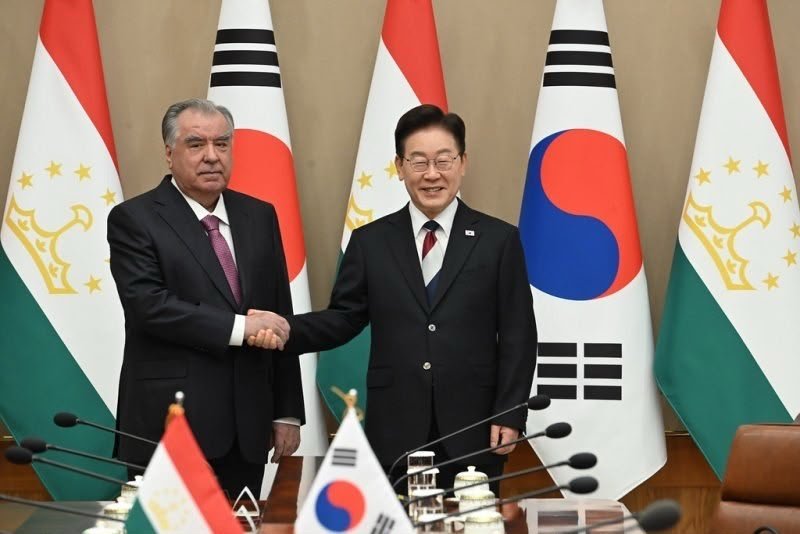
Yesterday, September 15, 2026, a fundamentally new and deeply symbolic page was inscribed into the annals of the sovereign diplomacy of the Republic of Tajikistan. The Founder of Peace and National Unity — Leader of the Nation, President of the Republic of Tajikistan, His Excellency Emomali Rahmon, arrived in Seoul on an official visit and to participate in the historic, first-ever Summit of the Heads of State of “Central Asia – Republic of Korea.” This event, unfolding amidst a tectonic transformation of the global world order, the erosion of traditional multilateral institutions, and the aggravation of inter-state contradictions, serves as irrefutable evidence of the viability, flexibility, and high pragmatism of Dushanbe’s foreign policy course, the unshakeable foundation of which remains the constructive doctrine of the “Open Doors” policy.
The representative and unprecedentedly profound profile of the official delegation accompanying the Head of State commands immense scientific and practical interest. The inclusion of the heads of key macroeconomic, energy, financial, educational, and fiscal agencies of the country clearly demonstrates that Dushanbe views the Seoul Summit not as a conventional protocol event, but as a unique strategic window of opportunity for the accelerated conversion of high political trust into tangible, high-tech, and investment dividends.
Expert analysis allows for the identification of four baseline dimensions that determine the long-term geopolitical and practical implications of this visit for the future of our Republic.
1. Transformation of the “C5+1” Format and the Crystallization of Central Asia’s New Subjectivity
The first Summit of Heads of State in the “Central Asia – Republic of Korea” format vividly captures a qualitative shift in the mainstream of world politics. In an era when old international organizations are experiencing a systemic crisis of capacity, regional multilateral dialogue platforms are acquiring defining significance. The Republic of Korea, positioned at the vanguard of global economic and industrial leaders, officially recognizes Central Asia not as a conglomerate of fragmented countries, but as a unified, geostrategically cohesive, and indispensable node of the new global market.For the Republic of Tajikistan, participation in the Seoul process carries fundamental political consequences:
Strengthening of Sovereign Subjectivity: The multilateral format allows the five states of the region to engage with external centers of power from a balanced, consolidated, and weighted position, completely excluding dictation and asymmetry.
Diversification of Foreign Policy Balance: This step enables the diplomatic corps of Tajikistan to masterfully maintain a geopolitical equilibrium, expanding the circle of strategic partners beyond traditional global heavyweights. Dushanbe signals to the world its readiness for an open dialogue with all actors who embrace the principles of mutual respect and non-interference.
2. The Concept of a “Third Technological Partner” as an Instrument of Institutional Equilibrium
The most profound theoretical and practical innovation of Dushanbe’s updated foreign policy agenda is the clear positioning of the Republic of Korea as the “Third Technological Partner” of Tajikistan. Within the framework of realizing our country’s long-term national interests, this concept forms an ideal triangle of institutional sustainability:
1. The First Vertex (Military-Political): The traditional strategic alliance with the Russian Federation, which serves as a reliable guarantor of regional stability and security on the southern borders of the CIS.
2. The Second Vertex (Financial and Infrastructural): Large-scale trade and economic partnership with the People’s Republic of China, ensuring the influx of investments into transport arteries, tunnels, and basic industrial facilities.
3. The Third Vertex (High-Tech and Innovation): The Republic of Korea, which perfectly satisfies Tajikistan’s demand for qualitative technology transfer without burdening bilateral cooperation with hidden geopolitical requirements or ideological dogmas.For Dushanbe, Seoul acts as a safe, depoliticized, and highly effective alternative, allowing for the successful implementation of the fourth national strategic goal — accelerated industrialization of the country — without the risk of falling into unilateral dependence on transnational corporations.
3. Transactional Pragmatism and Synergy in the Sphere of Green Development
The presence of the ministers of economic development, energy, the chairman of the National Bank, and the leadership of the Customs Service within the delegation shifts the visit into the plane of strict transactional pragmatism. Every direction of the negotiations is subordinated to the principle of economic expediency and mutual benefit.
The Republic of Korea possesses unique global competencies in the field of financial sector digitalization, the implementation of artificial intelligence technologies, and clean energy. In these coordinates, the visit of the Leader of the Nation lays a long-term regulatory and legal foundation for the integration of Korean capital into Tajikistan’s mega-projects. A special place here is occupied by the completion of the Rogun HPP, which in the medium term is destined to become the core of green energy for the whole of Central and South Asia. The Seoul vector opens up new avenues for financing this carbon-neutral giant.
In parallel, the participation of the heads of the export and customs agencies clearly points to Tajikistan’s desire to optimize the logistical chains of the Middle Corridor. Dushanbe aims to radically simplify procedures for exporting Tajikistan’s unique, ecologically clean agricultural products to the lucrative, high-margin markets of East Asia.
4. Investment in Human Capital and the Projection of New-Generation “Soft Power”
The participation of the Minister of Education and Science of the Republic of Tajikistan in the Seoul negotiations reflects the far-sighted strategy of President Emomali Rahmon in managing the country’s primary wealth — its demographic potential. Tajikistan is a young country, and the modernization of human capital serves as a key guarantee for preserving national identity and stability.
Also Read: New Provinces: A Governance Imperative for Pakistan
The South Korean educational model is recognized as one of the most effective in the world in the fields of exact sciences, engineering, and the IT industry. The socio-political consequences of the visit in this area promise to be highly practical:
- The creation of joint innovative scientific and technical institutes directly on the basis of Tajik universities.
- The launch of large-scale academic exchange programs, allowing for the training of the Tajik intellectual elite according to advanced international standards.
- The formation of a civilized legal framework for legal, highly qualified labor migration of citizens of Tajikistan to Korea, which will reduce dependence on traditional labor markets and ensure an influx of advanced expertise into the domestic economy.
Furthermore, the promotion of these initiatives is closely intertwined with the global peace-building projects of the Leader of the Nation within the UN arena, including the International Decade for the Strengthening of Peace for Future Generations (2027–2036), declared by a resolution of the world organization. Tajikistan clearly demonstrates that its “soft power” is built on creation, environmental responsibility, and care for the future of humanity.
Summing up, it can be stated with absolute certainty: the official visit of the Founder of Peace and National Unity — Leader of the Nation, President of the Republic of Tajikistan, His Excellency Emomali Rahmon, to the Republic of Korea has become a triumph of the “Open Doors” doctrine. In an era of total geopolitical fragmentation, Tajikistan demonstrates a model of sovereign maturity, successfully distancing itself from blocks and alignment thinking, and building equal, mutually beneficial relations with all key centers of innovation and capital.
The Seoul Summit has de facto anchored our Republic’s status as a proactive, independent, and influential player in Central Asia. Implementing the agreements reached will help establish a robust economic, technological, and human-capital foundation, ensuring Tajikistan’s prosperity, security, and sustainable innovative development for generations to come.
The author is a Chief Researcher, Department of South and East Asia,Institute for the Study of Asian and European Countries,National Academy of Sciences of Tajikistan and Doctor of Political Sciences.