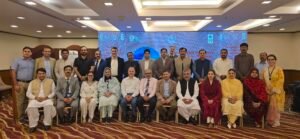
URUMQI, CHINA (GNP): Federal Minister for Planning, Development and Special Initiatives Professor Ahsan Iqbal has put forward a proposal to establish an SCO Digital Governance and AI Capacity-Building Network, designed to link governments, civil-service training institutions, universities, research bodies, technology centres, and private-sector innovators across member states.
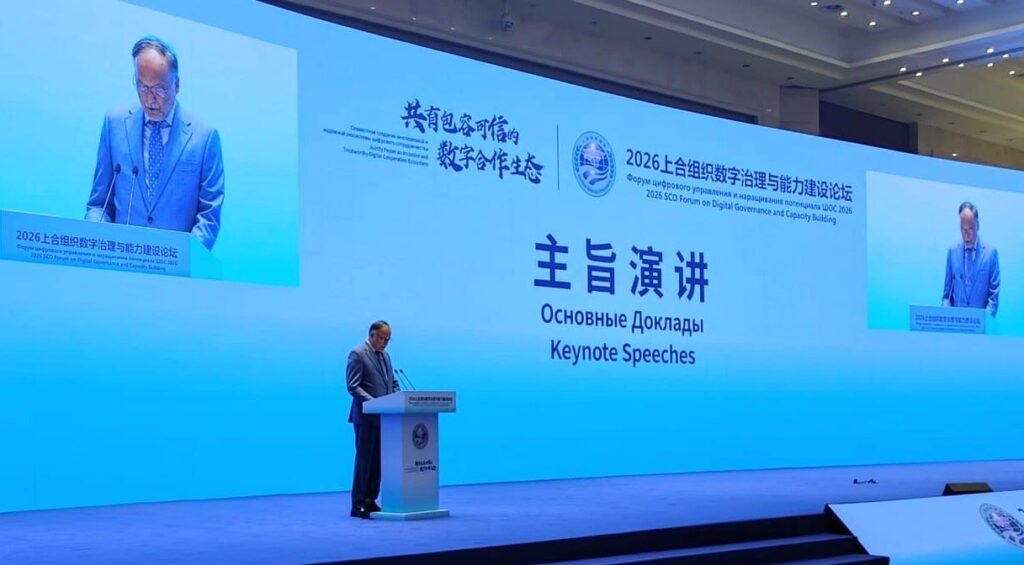
Delivering the keynote address at the Thematic Forum on Digital Governance and Capacity Building, held during the 2026 Shanghai Cooperation Organization (SCO) Digital Economy Forum in Urumqi, Iqbal argued that the next major shift ahead was not digitisation alone, but genuine digital governance.
He explained that while digitisation simply moves existing government processes online, digital governance involves rebuilding government systems around citizens, data, interoperability, and results. He cautioned against mistaking the digitization of paper-based bureaucracy for true transformation, calling instead for a shift from department-focused to citizen-focused governance, from disconnected databases to interoperable digital infrastructure, and from reactive administration to intelligent, data-driven government.
Iqbal noted that technology by itself cannot transform a state, stressing that genuine digital transformation depends on skilled personnel, capable institutions, sufficient resources, and governance structures that ensure data and emerging technologies are used securely and responsibly.
Turning to Pakistan’s own progress, he said digital transformation is a core component of URAAN Pakistan through its E-Pakistan pillar, and that these priorities align with the Growth, Innovation, Green Development, Livelihood, and Openness Corridors under CPEC 2.0.
He pointed to the Digital Nation Pakistan Act 2025, which established the National Digital Commission and the Pakistan Digital Authority to provide institutional oversight of the country’s digital transformation efforts, alongside the Digital Economy Enhancement Project, which is further building Pakistan’s digital infrastructure and its capacity to deliver integrated, accessible, citizen-focused public services.
According to the Minister, Pakistan is transitioning from simply being AI-aware to actively adopting AI, and now moving toward measurable economic and social outcomes from that adoption. He highlighted Pakistan’s National AI Task Force, which brings together government, academic, industry, and technology stakeholders across twelve thematic areas, as well as the National Centre of Artificial Intelligence — operating through nine laboratories across six major universities — which has produced more than 220 AI-based products and designs across various sectors.
Pakistan has also set a goal of training one million non-IT professionals in AI skills by 2030, with seven AI hubs being established under the National AI Advancement Initiative to deliver 20,000 training opportunities for graduates, teachers, government officials, and industry professionals. The Digi Skills programme, he noted, has already attracted more than 4.5 million enrollments.
Iqbal stressed that digital capacity building cannot be limited to technology specialists alone — ministers need digital leadership skills, civil servants must be data-literate, regulators need to understand the systems they oversee, and entrepreneurs require access to training, mentorship, financing, and markets.
He described digital capacity building as resting on three interconnected pillars: human capability, institutional capability, and financial capability, noting that training yields limited results unless institutions can retain and apply new skills, and that innovation cannot scale without adequate infrastructure, investment, and market access.
Outlining Pakistan’s proposed framework for SCO cooperation, the Minister presented five key initiatives: an SCO Digital Governance Academy to train ministers, regulators, civil servants, and municipal leaders in digital transformation, AI governance, cybersecurity, data management, and citizen-centered service delivery; an SCO Digital Public Infrastructure Exchange to share experience, standards, and adaptable solutions across areas like digital identity, instant payments, e-procurement, taxation, health, education, and business registration.
SCO Fellowship for Digital Government and AI to enable exchanges and placements for young civil servants, researchers, and technologists among member states; a Responsible AI and Data Governance Forum to foster cooperation on privacy, cybersecurity, algorithmic accountability, ethical AI, and well-regulated cross-border data flows; and an SCO Digital Inclusion and Innovation Facility to support capacity building, regulatory assistance, and pilot projects benefiting young people, women, underserved communities, and institutions located outside major tech hubs.
Iqbal suggested launching cross-border data cooperation with targeted pilot projects in trade and logistics, where digital integration could cut transaction times and costs while improving predictability, with the potential to later expand into agriculture, climate, health, research, and industrial applications as institutional trust grows.
He emphasized that SCO initiatives should be measured against concrete targets — including the number of officials trained, systems made interoperable, fellowships completed, joint projects launched, and citizens gaining access to digital public services — stating that cooperation must move beyond declarations toward tangible outcomes.
Describing Pakistan as a natural bridge linking China, Central Asia, South Asia, the Middle East, and the Arabian Sea, Iqbal said CPEC 2.0 would pair physical connectivity with digital connectivity, likening trusted digital corridors to roads and railways that can carry knowledge, services, finance, and opportunity rather than just goods.
He noted that Urumqi, long a crossroads of civilizations and trade, was a fitting location to help build a new digital Silk Road grounded not only in fibre-optic cables and data centres but also in skills, shared standards, trust, and strong institutions.
Also read: EMGS Malaysia Education Fair 2026 Draws Pakistani Students
Closing his remarks, Iqbal said that while technology will provide the tools for the future, it is human capacity, public trust, and collective wisdom that will ultimately shape the future societies build — expressing hope that the SCO could become not just a community linked by technology, but one empowered by knowledge and united by trust. He reaffirmed Pakistan’s readiness to collaborate with China and other SCO member states to turn this shared vision into measurable cooperation, inclusive development, and shared prosperity.

Sohail Majeed is a Special Correspondent at The Diplomatic Insight. He has twelve plus years of experience in journalism & reporting. He covers International Affairs, Diplomacy, UN, Sports, Climate Change, Economy, Technology, and Health.