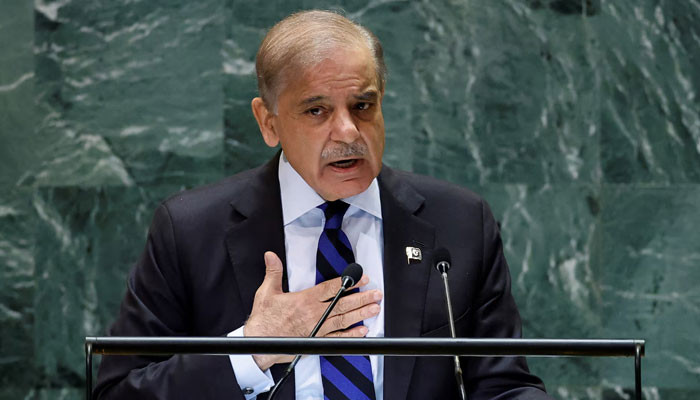
Washington (GNP): Prime Minister Shehbaz Sharif is set to travel to New York later this month for the United Nations General Assembly, where he is expected to highlight Pakistan’s ongoing efforts to help find a peaceful resolution to the US-Iran conflict.
The prime minister will address the 81st session of the UN General Assembly on September 25, a debate expected to be dominated by the Gulf conflict amid growing concern over regional security. This year’s session carries the theme “Restoring Trust, Managing Transformation: A United Nations That Delivers for All,” with the general debate running from September 22 to 26 and a final sitting scheduled for September 28.
Fighting between Washington and Tehran is expected to feature prominently in discussions among world leaders, particularly around the security of the Strait of Hormuz, regional stability and prospects for a diplomatic resolution to the confrontation. Against this backdrop, Pakistan is expected to use the General Assembly platform to reiterate its position that the conflict should be settled through negotiation rather than continued military confrontation, while also highlighting Islamabad’s contacts with countries involved in de-escalation efforts.
The question of Iranian participation remains unresolved ahead of the high-level week. President Masoud Pezeshkian appears on the tentative speakers’ schedule as the fifth speaker on September 23, though Tehran has not confirmed whether he will attend, with Iranian officials citing what they describe as conditions imposed by Washington on the Iranian delegation’s travel arrangements.
US President Donald Trump is scheduled to open the high-level debate on September 22 following Brazil’s traditional opening address, and Prime Minister Shehbaz is expected to attend a reception hosted by President Trump the same day. Israeli Prime Minister Benjamin Netanyahu is scheduled to speak on September 24, while India will be represented only by its foreign minister on September 26.
The Iranian issue is already shaping the UN’s agenda ahead of the leaders’ arrival. The Security Council is due to vote on September 17 on renewing the mandate of the panel of experts monitoring sanctions on Iran, a mandate that expires on September 26, during the General Assembly’s high-level week itself.
Russia and China have opposed continuing the monitoring mechanism, arguing the Security Council no longer holds the authority to pursue the matter in its current form, setting up a likely confrontation with the United States and its Western allies.
Also Read: Youth Delegates From 45 Nations Sign Historic Porto Youth Declaration
The dispute traces back to the restoration of UN sanctions on Iran under the “snapback” mechanism, triggered after Britain, France and Germany determined last year that Tehran was not complying with its obligations under the 2015 nuclear agreement, an allegation Iran has rejected, maintaining it is not pursuing nuclear weapons.
For Pakistan, the stakes are heightened by its geographical proximity to the conflict and its economic and security interests in the Gulf region. Prime Minister Shehbaz will be accompanied by a high-level delegation, including senior government officials, and is expected to hold a series of bilateral meetings on the sidelines of the General Assembly.
The session formally opened this week with Bangladesh’s Khalilur Rahman assuming the presidency of the 81st General Assembly, having placed peace and security, restoration of trust in multilateral institutions and UN reform among his presidency’s priorities. The gathering also marks a transitional moment for the UN, coming ahead of the final months of Secretary-General Antonio Guterres’s tenure, which concludes on December 31, 2026.

Managing Editor at Global News Pakistan (GNP), with a Bachelor's degree in International Relations from Riphah International University, graduated with a Gold Medal. Reach out at sabahtareengnp@gmail.com