
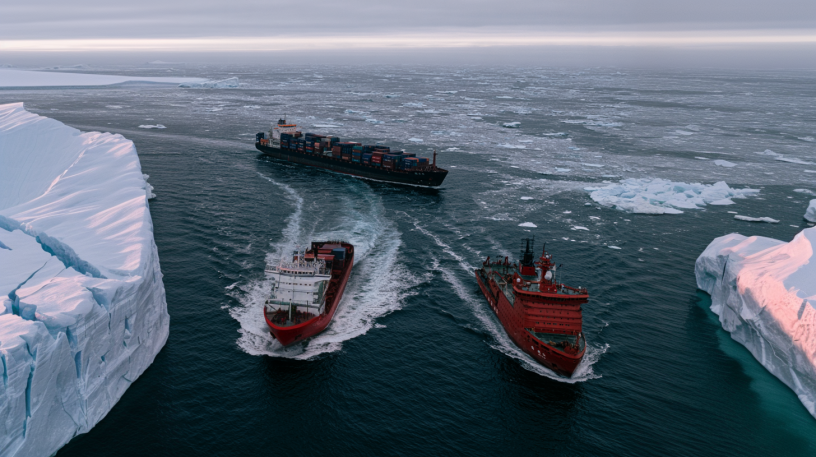
Beijing (GNP): China has launched the first scheduled commercial shipping service along the Arctic’s Northern Sea Route, marking a significant step in Beijing’s long-standing ambitions to develop a viable trade corridor between China and Europe as alternatives to the congested Suez Canal and Strait of Hormuz gain renewed attention.
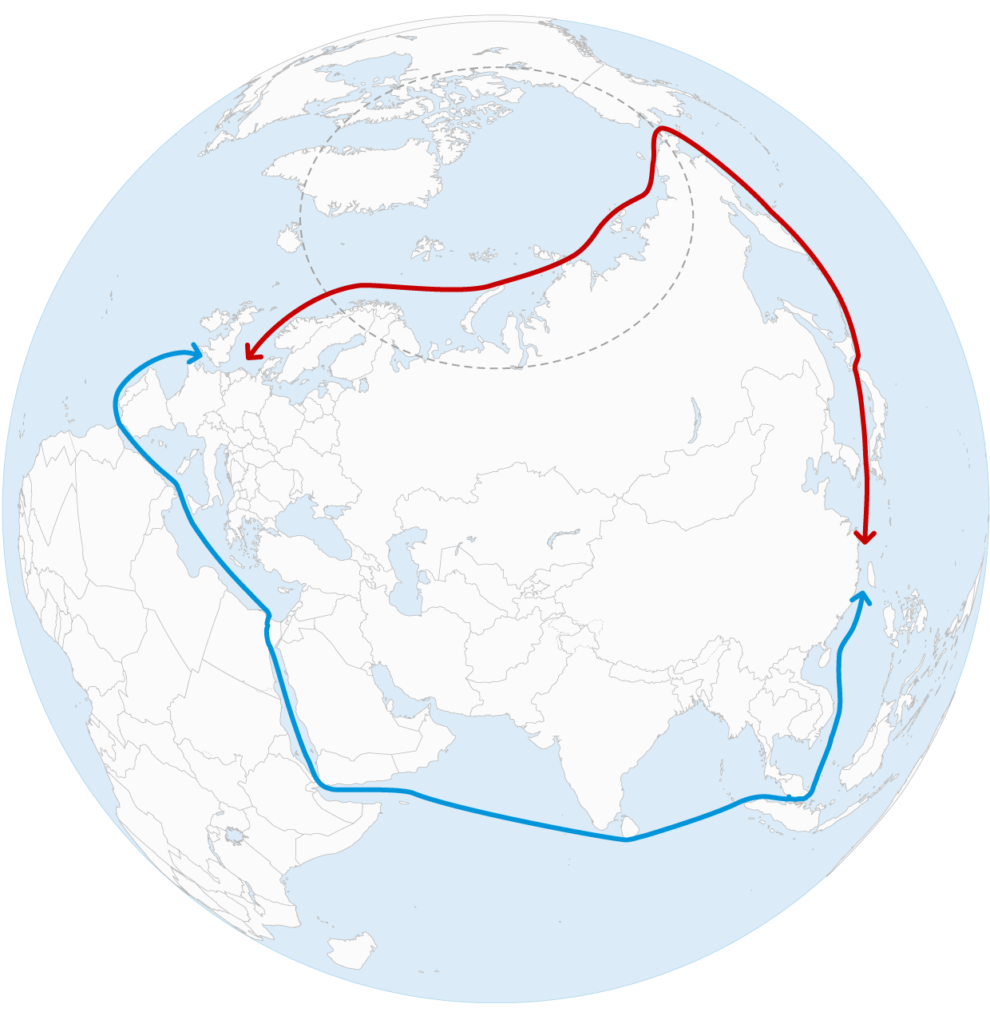
Shipping company Sea Legend has begun a regular container service via the Northern Sea Route following a single pilot voyage in 2025. The 5,500-kilometre channel cuts through the Arctic Circle along Russia’s northern coast and is navigable only during warmer months, though that window has widened in recent years due to shrinking summer sea ice.
According to Sea Legend chief operating officer Li Xiaobin, a direct journey from Ningbo-Zhoushan to Felixstowe in the United Kingdom takes as little as 18 days via the Arctic route, compared with more than 40 days through the Suez Canal.
Li said this month that instability in the Middle East had exposed the vulnerability of the Suez Canal and Strait of Hormuz to regional turmoil, reinforcing the need to develop alternative trade routes between China and Europe. Experts note the Arctic route is particularly well suited to temperature-sensitive cargo, including electric vehicles, lithium batteries and solar products, categories in which China has become a dominant global exporter.
As the only regular commercial cargo service currently operating on the route, Sea Legend’s venture is expected to serve as a test of whether Beijing’s Arctic strategy can translate into a sustainable regular trade link with Europe.
The push to develop Arctic shipping traces back to 2017, when Chinese President Xi Jinping first publicly called for China and Russia to jointly develop Arctic shipping routes and build what he described as a polar Silk Road. Russia, which controls much of the Northern Sea Route, was initially cautious about China’s growing presence in the Arctic.
However, following its full-scale invasion of Ukraine, Moscow has grown increasingly dependent on Beijing in the High North, a shift that has given China greater leverage and access to the region. Russia’s state nuclear company, Rosatom, issues navigation permits, oversees shipping along the route, and provides the nuclear-powered icebreakers required to escort most vessels through the ice.
Sea Legend has said the Arctic route could roughly halve emissions due to the shorter sailing time between China and Europe, but experts caution that environmental risks associated with the journey could offset any such gains.
A 2025 report from the Bellona Environmental Foundation warned that fuel spills pose serious dangers in the Arctic, noting that heavy fuel oil, banned in the region since 2024, is thicker than other fuel types and therefore far more difficult to clean up.
The report added that oil decomposes more slowly in cold conditions and becomes almost impossible to remove once trapped in ice, while Russia remains largely unprepared to respond to a major spill given the route’s remoteness and limited logistical support.
Capt Nitin Chopra, principal marine risk consultant for Asia at Allianz, said the isolation of the region significantly raises the likelihood of prolonged machinery breakdowns and groundings, which in turn heightens the risk of an environmental oil spill in a fragile ecosystem.
Bellona’s report also highlighted the danger posed by black carbon, a byproduct of heavy fuel oil emissions, describing it as one of the most potent absorbers of solar radiation. The organisation noted that black carbon can reduce the Arctic’s reflectivity, causing the region to absorb more sunlight and trap additional heat, further accelerating global warming.
International sanctions imposed on Russia following its invasion of Ukraine could further complicate rescue efforts should a vessel run into difficulty along the route, according to Allianz Commercial’s 2026 safety and shipping review.
Much of the current traffic along the Northern Sea Route is reportedly linked to Russia’s so-called shadow fleet of tankers, which often operate without insurance or proper regulatory oversight to evade sanctions on Russian oil exports.
Bellona researcher Ksenia Vakhrusheva noted in a report last year that around a hundred such ships were under international sanctions in 2025, accounting for nearly a third of all cargo vessels sailing the route, with indications suggesting shadow fleet activity has increased further in 2026 amid milder summer conditions.
Vinh Thai, professor of logistics and supply chain management at RMIT University, said ongoing climate change could extend the period each year during which the Northern Sea Route remains open to commercial shipping, adding that early signs of this shift are already visible.
Also Read: Trump Orders Reduction in US Military Drills With South Korea
A Russian liquefied natural gas transporter began an early transit through the route in May, benefiting from reduced summer sea ice, while ship-watchers recently observed an unusually large convoy of Russian tankers, reportedly carrying about eight million barrels of oil, taking a northern path that passed within 500 miles of the North Pole.
Despite Russia’s efforts to promote the Northern Sea Route as a viable alternative for international shipping, experts say the underlying economics remain unfavourable for now. Safety concerns, high operating costs, a short sailing season and sanctions-related risks are likely to continue limiting the scale of Arctic shipping in the near term.
Thai said any oil spill along the route would represent both an environmental and economic disaster, not only for Russia but for the surrounding region as a whole, concluding that the Northern Sea Route cannot yet serve as a genuine substitute for the Strait of Hormuz or the Suez Canal.

Managing Editor at Global News Pakistan (GNP), with a Bachelor's degree in International Relations from Riphah International University, graduated with a Gold Medal. Reach out at sabahtareengnp@gmail.com