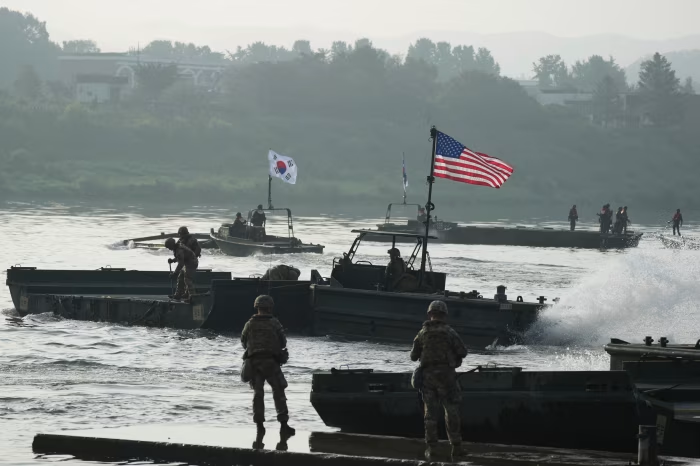
Washington (GNP): US President Donald Trump has instructed the Pentagon to substantially reduce joint military exercises with South Korea, citing the cost of the drills and Seoul’s refusal to join Washington’s military action against Iran.
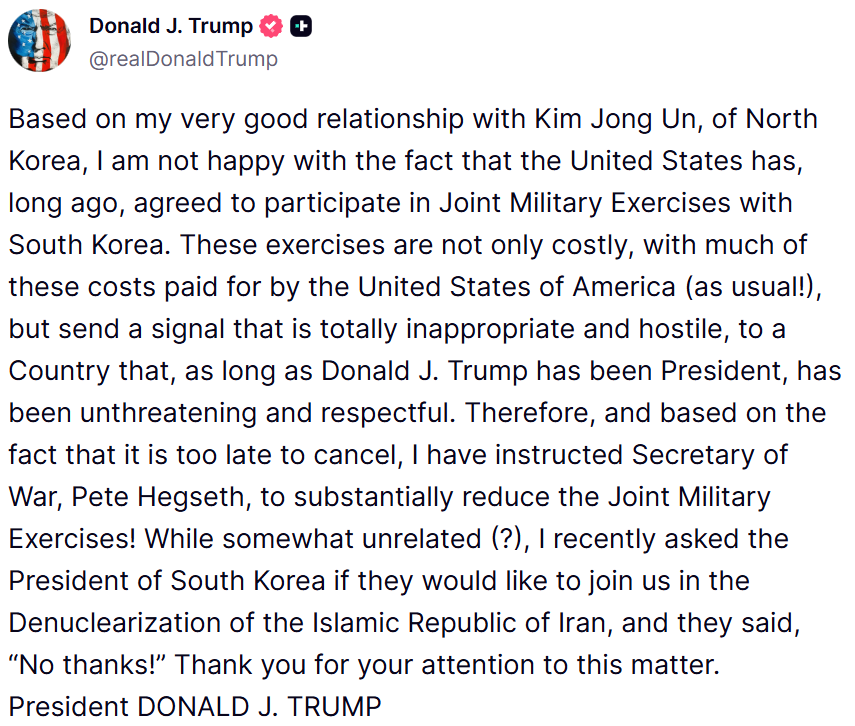
Trump made the announcement on his Truth Social platform on Sunday, hours before the annual Ulchi Freedom Shield exercises were scheduled to begin. He said he was not happy that the United States had agreed to participate in the drills and pointed to his what he described as a very good relationship with North Korean leader Kim Jong Un. Trump wrote that the exercises were costly and sent a signal that was totally inappropriate and hostile toward a country that had remained unthreatening and respectful during his presidency.
The Ulchi Freedom Shield exercises are scheduled to run until August 27, with around 18,000 South Korean military personnel taking part. South Korea’s Joint Chiefs of Staff confirmed the drills began as scheduled on Monday but declined to comment further on Trump’s remarks.
The country’s presidential office and its defence and foreign ministries did not immediately respond, as Monday was a public holiday in Seoul. A Pentagon spokesperson referred questions on the matter to the White House, which also did not immediately respond.
Trump linked the decision to a recent exchange with South Korea’s president, saying he had asked whether Seoul would join the United States in efforts toward the denuclearisation of Iran and that the response had been a firm decline. He described the connection between the two issues as somewhat unrelated but chose to raise them together in his post.
The announcement followed a separate social media post a day earlier in which Trump shared an old photograph of himself with Kim Jong Un from 2019, describing the two as great friends despite what he called the unfriendly look on that particular picture.
The relationship between the two leaders has fluctuated significantly over the years, moving from public insults during Trump’s first term to three in-person summits, without resulting in any change to North Korea’s nuclear weapons or ballistic missile programmes.
North Korea, which remains technically at war with South Korea under a 1953 armistice, has consistently criticised the joint US-South Korea drills as rehearsals for invasion. Pyongyang fired a ballistic missile from its eastern coast toward the Sea of Japan last week, according to South Korean and Japanese military assessments, following a similar short-range missile launch days earlier.
Jenny Town, who heads the 38 North programme at the Stimson Center think tank, said the decision may reflect a broader effort by Trump to create a diplomatic opening with Pyongyang, though she noted the manner of the announcement was unlikely to leave a strong impression in North Korea.
Victor Cha, who leads the Korea programme at the Center for Strategic and International Studies, offered a different reading, suggesting Trump may be seeking to limit North Korea’s deepening military ties with Russia by engaging directly with Kim.
That concern stems from North Korea’s continued support for Russia’s invasion of Ukraine. US military officials have said North Korean troops fighting alongside Russian forces have gained combat experience, while Ukrainian officials said last week that North Korean-made missiles were used in a Russian ballistic missile strike on a steel plant in Zaporizhzhia.
Separately, a senior US Northern Command official, Lieutenant General Joseph Jarrard, warned last week that North Korea had successfully tested intercontinental ballistic missiles capable of delivering a nuclear payload to targets anywhere in North America.
It remains unclear exactly how the exercises will be scaled back, though drills in recent years have already shifted away from live-fire components toward computer-simulated missile and cyberattack scenarios. About 28,500 American troops are currently stationed in South Korea, a presence Trump has repeatedly argued should be matched by greater South Korean financial contribution.
Also Read: US to Press Allies to Choose Sides in AI Race with China
Economic tensions have added further strain to the relationship. A former US official from Trump’s first administration said Trump was frustrated with what he saw as intransigence from the government of South Korean President Lee Jae-myung on economic matters, alleging the administration had pursued policies antagonistic to American companies and shown little follow-through on an investment agreement with the United States.
The two countries signed a trade deal last year that lowered Trump’s auto tariffs in exchange for a South Korean commitment to invest $350 billion, though Seoul has yet to announce details of that investment plan. The allies have also clashed over a Seoul-led investigation into US-listed e-commerce company Coupang following a large-scale data leak.
Trump has scaled back joint exercises with South Korea before, having suspended them entirely in 2018 during denuclearisation talks with Kim, and again in 2020 amid the COVID-19 pandemic. Last week, South Korea’s president proposed talks with North Korea aimed at formally ending the war between the two countries.

Managing Editor at Global News Pakistan (GNP), with a Bachelor's degree in International Relations from Riphah International University, graduated with a Gold Medal. Reach out at sabahtareengnp@gmail.com