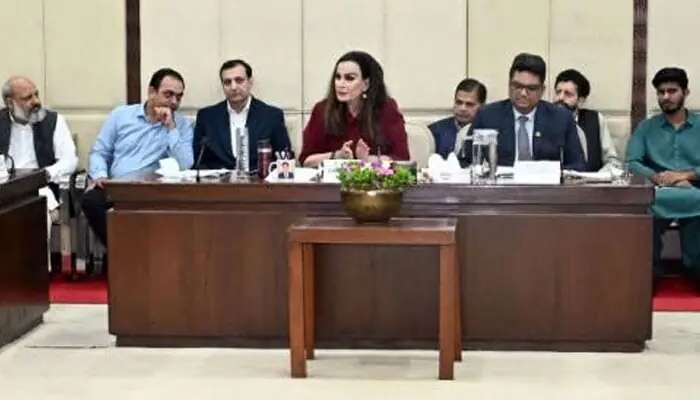
Islamabad (GNP): The Senate Standing Committee on Climate Change, chaired by Senator Sherry Rehman, undertook a detailed review of Pakistan’s climate governance structure, raising serious questions about the necessity and institutional value of the Pakistan Climate Change Authority (PCCA), which the committee said largely duplicates the mandate and functions already held by the Ministry of Climate Change and Environmental Coordination.
During a briefing on the PCCA, Senator Rehman expressed strong reservations about maintaining a separate authority at a time when the Climate Ministry itself faces shrinking budgetary resources — noting that the ministry’s PSDP allocation has fallen to Rs 2.478 billion, down from Rs 3.5 billion the previous year. She questioned why 24 posts had been sanctioned for the PCCA when its core responsibilities largely overlap with those already assigned to the ministry.
She noted broader concerns about state-owned entities generally, pointing out that combined losses among Pakistan’s SOEs reached Rs 832.848 billion in FY2025, with cumulative losses now standing at Rs 6.563 trillion, while continuing to receive significant budget allocations.
Rehman clarified that her concerns were institutional rather than personal, noting that many PCCA technical staff had previously worked within the ministry itself, including retired officers who had been reassigned. She questioned whether the authority was genuinely building new technical capacity or simply relocating existing expertise from one government structure to another.
On coordination with provincial governments — cited as part of the PCCA’s mandate — Rehman pointed out that the ministry already holds this responsibility, and that provinces would likely still require direct engagement with the ministry’s secretary regardless of the authority’s existence.
The committee also raised concerns about the PCCA’s role in mobilizing international climate financing, including through the Green Climate Fund, noting that the authority’s presentation failed to provide a clear answer on this front.
Rehman remarked that if the same expertise and personnel were simply being transferred from the ministry to a new authority, it remained unclear what additional capacity was actually being created.
She directed the ministry’s secretary to return to the committee with a full explanation covering the PCCA’s justification, staffing arrangements, financial implications, international linkages, and its distinct role compared to the ministry, warning that the authority should be dissolved if it cannot demonstrate clear added value.
The committee also received an update on Glacial Lake Outburst Floods (GLOFs) and risks facing Pakistan’s glacial regions. A UNDP representative noted that Pakistan has more than 30,000 glaciers, with climate change accelerating glacial melt, and that 108 disaster events — including two GLOF incidents — had been managed through early warning systems.
Rehman expressed dissatisfaction with the briefing, noting it closely resembled a presentation given the previous year without demonstrating meaningful progress.
She questioned why the update failed to adequately address reports that roughly 16% of glaciers have already melted, along with the vulnerability of affected communities and Pakistan’s long-term strategy for managing the growing cryosphere crisis.
She stressed that GLOF-related planning should not be treated as an isolated climate issue, calling for closer integration with the National Disaster Management Authority (NDMA) and the Pakistan Meteorological Department (PMD), noting that PMD holds the relevant technical expertise on weather and glacial conditions while NDMA needs to be fully involved in preparedness and response planning.
The committee also reviewed progress on enforcing the Islamabad Capital Territory (Prohibition of Plastic Book Covers) Act, 2026. Rehman voiced strong frustration over continued widespread plastic use in Islamabad, noting ongoing issues with plastic waste blocking drains and questioning the effectiveness of current enforcement mechanisms. She noted that legislation alone had not resulted in meaningful compliance and stressed the need for stronger enforcement.
She also raised concerns about products being marketed as “biodegradable” without adequate verification standards, noting that only about 9% of plastic is recycled globally, with the majority ending up in landfills or the environment.
Rehman emphasized that affordable alternatives to plastic remain particularly important for lower-income households that rely on plastic packaging for everyday goods such as milk and yogurt, noting that while alternative solutions exist through various startups, they have yet to reach the scale needed for widespread, affordable adoption. She stressed that any transition away from plastic must account for the needs of low-income consumers and be paired with accessible alternatives, while also questioning the availability of plastic collection and recycling infrastructure across the city.
The committee concluded that effective environmental regulation requires both stronger enforcement and supportive measures that allow businesses and consumers to transition away from harmful materials without creating undue hardship.
Also read: Typhoon Dolphin Floods Central China, Beijing on Alert
The meeting was attended by Senators Bushra Anjum Butt, Shazaam Durrani, Naseema Ehsan, Falak Naz, Syed Waqar Mehdi, Khalida Ateeb, and Sarmad Ali, along with the State Minister for Climate Change and Environmental Coordination.

Sohail Majeed is a Special Correspondent at The Diplomatic Insight. He has twelve plus years of experience in journalism & reporting. He covers International Affairs, Diplomacy, UN, Sports, Climate Change, Economy, Technology, and Health.