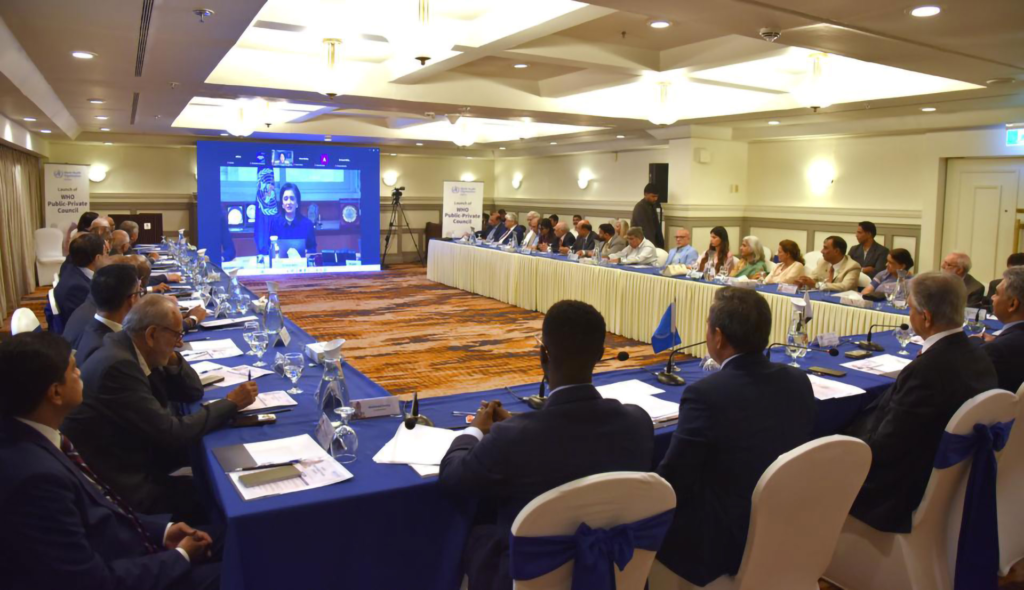
ISLAMABAD (GNP): The World Health Organization (WHO) has launched its first Council for Partnership with the Public and Private Sectors in Pakistan, bringing together the Government of Pakistan and 20 prominent business leaders in an effort to strengthen the country’s health systems and accelerate progress toward global health goals. The Council was formally launched in Karachi, with the aim of improving public health outcomes and advancing Pakistan’s commitments under the health-related Sustainable Development Goals.
The launch ceremony was led by Dr Hanan Balkhy, WHO Regional Director for the Eastern Mediterranean, alongside Aziz Memon, chair of the newly formed Council, and Muhammad Aslam Ghauri, Pakistan’s Federal Secretary for Health, who serves as the Council’s co-chair. WHO Representative in Pakistan Dr Luo Dapeng also attended, along with the Council’s 20 founding members drawn from the business and academic sectors.
Speaking at the event, Dr Balkhy said the Council brings together business and philanthropic leaders to build a healthier and more prosperous future for Pakistan and the wider region. She described the initiative as a way to combine WHO’s advocacy with the private sector’s strengths in financing, technology, logistics, and expertise, forming a long-term partnership intended to improve health outcomes regardless of where people live or their circumstances.
Memon, representing the business sector as Council chair, said the initiative positions business leadership as a partner in promoting public health alongside WHO. He characterized the Council as a structured platform through which individual efforts by business leaders could be consolidated and amplified with the backing of the World Health Organization.
Also Read: Chinese Solar Products Support Afghanistan Energy Access And Development
Ghauri, in his remarks as co-chair, said the Government of Pakistan fully supports the Council’s work and reaffirmed the government’s commitment to achieving universal health coverage under its National Health Strategy 2026–2035. He noted that the Council’s formation comes at a timely moment as the country begins a decade-long health strategy that will require participation from all sectors of society, adding that no government can achieve these goals in isolation.
Dr Luo Dapeng, WHO’s representative in Pakistan, emphasized the role of public-private partnerships in applying medical science toward improving and saving lives. He said the Council’s greatest impact may come not through direct funding but through the advocacy business leaders can carry into boardrooms and industry circles, helping build support for a healthier Pakistan. He added that WHO would continue to serve as a partner to Pakistan and its people in pursuing that goal, describing a healthier nation as one that is also more prosperous.

Managing Editor at Global News Pakistan (GNP), with a Bachelor's degree in International Relations from Riphah International University, graduated with a Gold Medal. Reach out at sabahtareengnp@gmail.com