Islamabad (GNP): The leader of Spain’s North African enclave of Ceuta has accused Morocco of enabling last week’s mass border crossing, describing it as an assault on Spanish territorial integrity rather than a migration crisis. Juan Jesús Vivas said the influx appeared to have been at least encouraged or permitted by Rabat, even if not directly orchestrated.
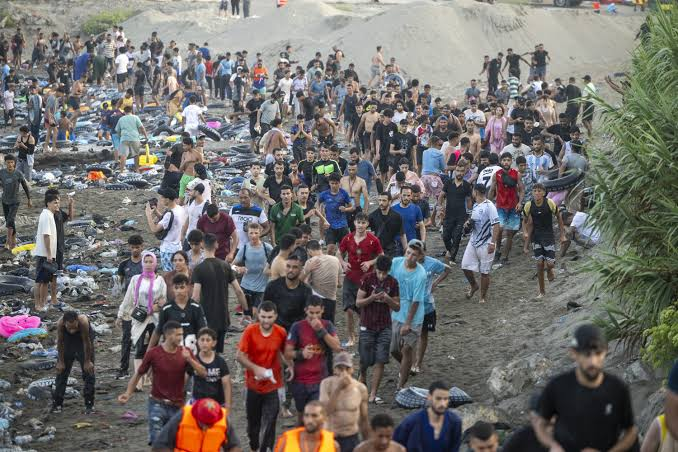
Spanish officials said Monday that roughly 69,500 of the people who crossed into Ceuta late last week had since returned to Morocco, while around 2,500 remained in the territory. The surge overwhelmed the city of 84,000 residents and triggered a wider political crisis within the European Union, with some member states placing responsibility on Spain rather than Morocco.
Vivas described the toll in stark terms, saying dozens of bodies had been recovered and that more remained on the Moroccan side of the border. He said residents viewed the episode not as an ordinary migration event but as a violation of the country’s sovereignty, drawing comparisons to a similar surge in May 2021 that followed a diplomatic dispute between Madrid and Rabat. Analysts have suggested Spain’s recent improved ties with Morocco’s regional rival, Algeria, may have contributed to the latest tensions.
Spain’s defence minister, Margarita Robles, called for a full Moroccan investigation into the incident, saying neither government could ignore what had happened. Preliminary findings from Spanish intelligence services reportedly concluded that Moroccan authorities had not planned the surge but failed to contain it, and in some instances allowed people through. Reports citing intelligence sources trace the trigger to a false claim circulating on social media, which suggested a Spanish court ruling barred the return of migrants arriving by sea. Moroccan border surveillance is said to have eased as the claim spread online before controls were dropped entirely.
Conditions in Ceuta remained difficult, with hundreds still sleeping outdoors near the coastline and local mosques. Officials said close to 900 unaccompanied minors were among those who had arrived. Accounts from people who made the crossing described chaotic and dangerous scenes at sea, including reports of Moroccan police urging people into the water, while families separated during the crossing continued searching for missing relatives.
Also Read: Is Spain Facing Retaliation for Challenging Israel?
The crisis has exposed divisions within the EU, with Italy suspending its passport-free travel arrangement with Spain for a month, despite Ceuta falling outside the Schengen zone. Spain’s foreign minister, José Manuel Albares, said the country would seek greater solidarity from EU partners ahead of an emergency meeting of interior ministers, arguing that misinformation about Spain’s handling of the situation had been amplified by some European governments.
He noted Spain currently records the lowest number of irregular Mediterranean crossings in the bloc, contrasting it with higher figures reported in Italy, and said Moroccan authorities had shown willingness to help manage the situation.
European Commission President Ursula von der Leyen said the incident underscored the need to reinforce border security at key points, while commending Madrid’s response. Separately, some EU states voiced suspicion that the surge may not have been accidental, alongside concerns that Russian disinformation networks could seek to exploit the crisis. Ukraine’s acting foreign minister said thousands of related posts had been traced to pro-Russian online networks, describing it as part of a broader effort to stir division across Europe.