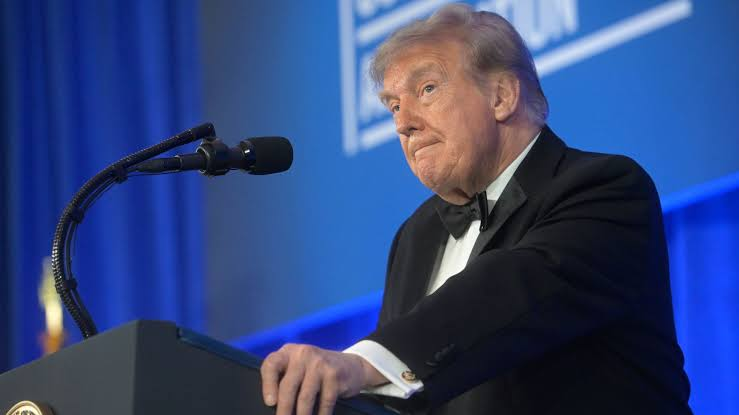
Washington (GNP): President Donald Trump said Monday that Washington and Tehran were engaged in constructive discussions and that a resolution to their five-month conflict remained possible, though he cautioned that American air strikes would resume if the negotiations collapsed.
His comments came even as Iran appeared to test the limits of a newly declared pause in U.S. military action, with Saudi Arabia, Jordan and Iraq all reporting drone attacks on the same day.
The pause followed Washington’s abrupt decision on Saturday to halt a two-week bombing campaign against Iran, marking another sharp shift in strategy for Trump during the ongoing standoff. “We’re having good talks,” the president said, adding that the two sides could reach an understanding, and that failing that, military action would resume as before.
Speaking later at a campaign rally in Michigan, he struck a tougher tone toward Tehran, insisting that Iran could not be bought off and would instead have to be confronted directly, while still describing the current back-and-forth as friendly.
Iran’s Foreign Ministry pushed back on part of that narrative. Spokesman Esmail Baghaei confirmed that messages were still being exchanged through intermediaries and that Tehran had not abandoned diplomacy altogether, but he rejected claims that Iran had specifically asked for renewed negotiations, calling such reports invented and out of character for the Iranian government.
A senior Iranian official had told Reuters a day earlier that Tehran would hold off on further attacks so long as the American ceasefire held. Iran’s central military command later accused Washington of menacing vessels and oil tankers in Iranian waters and of trying to enforce what it called an unlawful naval blockade, describing the move as a further escalation of the regional conflict.
The drone activity reported Monday added to the tension. Saudi authorities said they intercepted drones aimed at petroleum sites, including facilities in Riyadh, and said the aircraft had been launched from Iraqi territory by armed groups allied with Iran, adding that they reserved the right to retaliate.
Separately, Yemen’s Houthi movement, which is aligned with Tehran, said it had struck the East-West Pipeline that carries oil to Saudi Arabia’s Red Sea port of Yanbu, framing the attack as a response to earlier Saudi drone strikes. Iran also maintained that it continued to control the disputed Strait of Hormuz, the critical global energy corridor that Trump has insisted must remain freely navigable for all vessels.
Domestically, the drawn-out war has become a political liability for Trump and his Republican Party as they head into November’s midterm elections needing to defend narrow majorities in Congress.
A weekend Reuters/Ipsos poll found his approval rating had climbed to 37%, a three-point rise from the previous month when it had matched the lowest point of his presidency, yet only about one in three Americans said they supported the Iran war, the weakest level of backing recorded since the conflict began, with most respondents saying the administration had not clearly explained its objectives.
The halt in U.S. strikes, arriving after thirteen consecutive nights of escalating bombardment, sent oil markets sharply lower alongside Trump’s conciliatory remarks. U.S. crude dropped more than 8% to settle near $81.98 a barrel, while Brent crude fell over 9% to roughly $87.77 a barrel.
According to a U.S. official and multiple domestic media reports, the decision to pause the campaign followed direct advice from military leadership, who reportedly told Trump that American forces were running low on viable targets inside Iran.
The same official said Joint Chiefs of Staff Chairman General Dan Caine had voiced concern over dwindling air munitions stockpiles, though Trump rejected any suggestion of a shortage, saying the military was quickly replenishing supplies that had been drawn down by shipments to Ukraine and that he wanted access to more advanced weaponry going forward.
Also Read: ICCI, Chinese delegation to boost Pharmaceutical cooperation
Iranian state media, citing an unnamed source, reported separately that six vessels described as violators had been turned back Monday after attempting to cross the Strait of Hormuz without authorization. The renewed American bombing campaign had originally been launched after Iran fired on ships using a route Washington had recommended, one that directed vessels to sail near the coast of Oman.
Iran maintains that ships may only pass through a narrower channel closer to its own coastline, one it controls and plans to subject to transit fees. Over the two weeks of intensified strikes, dozens were killed inside Iran and bridges, tunnels and military sites across the south were destroyed, while four American service members died in retaliatory attacks on U.S. bases in neighboring countries, and Iran struck civilian infrastructure in Gulf states in what it called a response to the American offensive.
It remains uncertain what leverage the United States can use to loosen Iran’s hold over the strait. Washington and Tehran had agreed in June on a framework for talks intended to resolve core disputes, including Iran’s nuclear program, by the end of August, but the two sides continue to disagree over how that agreement’s language on the strait should be interpreted, with the U.S. insisting it guarantees free passage and Iran arguing it instead grants Tehran authority to oversee transit through the waterway.

Managing Editor at Global News Pakistan (GNP), with a Bachelor's degree in International Relations from Riphah International University, graduated with a Gold Medal. Reach out at sabahtareengnp@gmail.com