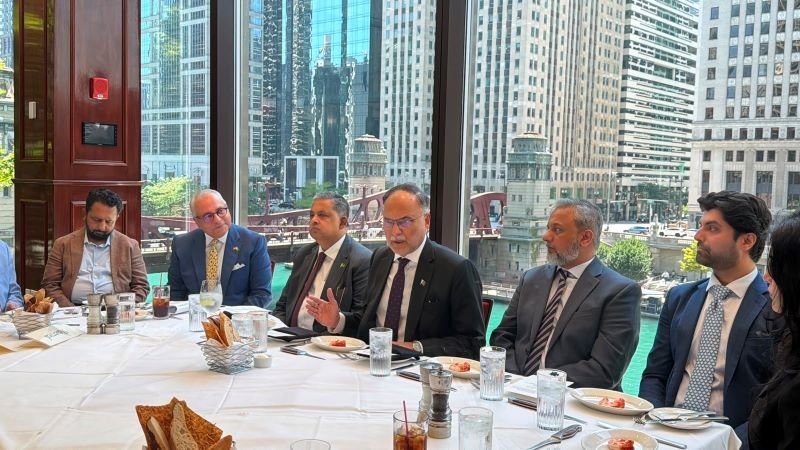
CHICAGO (GNP): Federal Minister for Planning, Development and Special Initiatives Ahsan Iqbal met on Wednesday with a highly accomplished group of Pakistani-American professionals — twenty entrepreneurs, technologists, and financiers, over a third of whom previously held senior roles at Fortune 500 companies — urging them to channel their capital, connections, and expertise toward Pakistan.
Speaking to the group, Iqbal said Pakistan is at a pivotal juncture, having made recent progress on national security, diplomacy, and macroeconomic stability that now needs to be converted into lasting economic growth.
He noted that overseas Pakistanis, particularly the Pakistani-American community, have excelled across sectors ranging from technology and finance to healthcare, energy, and academia, and remain closely tied to their homeland. Iqbal credited difficult reforms carried out under Prime Minister Shehbaz Sharif’s government with restoring macroeconomic stability, lowering inflation, easing interest rates, and earning Pakistan recognition internationally as an economic turnaround story. He told attendees the foundational work had been done and that what Pakistan now needed was their investment, networks, and expertise.
The minister said Pakistan’s efforts to promote regional peace have boosted investor confidence and opened up fresh avenues for trade and international cooperation, making it an opportune time for the diaspora to factor Pakistan into their professional and investment plans. Many attendees are already engaged in various investment and charitable initiatives in Pakistan, and the meeting aimed to formalize that involvement into a structured partnership tied to the government’s URAAN-Pakistan economic program.
URAAN-Pakistan Targets and Priority Sectors
Iqbal outlined URAAN-Pakistan’s goals of reaching a $1 trillion economy by 2035 and $3 trillion by 2047, built around a framework of five pillars: exports, digital governance, environmental and climate action, energy and infrastructure, and equity and empowerment. He identified information technology, agriculture, manufacturing, tourism, mining, the blue economy, skilled labor, and creative industries as key sectors for export growth.
He assured the diaspora that the government remains focused on building a favorable climate for investment and entrepreneurship, expressing optimism that with overseas Pakistanis’ involvement, the country could become a globally competitive, knowledge-driven economy.
Academic Partnerships and Chicago Meetings
Iqbal also reaffirmed the government’s push to strengthen Pakistan’s knowledge economy through collaboration with Pakistani-American academics and researchers, citing partnerships with the University of Illinois Chicago, Illinois Institute of Technology, University of Chicago, and the broader US-Pakistan Knowledge Corridor. He pointed to ongoing efforts to involve overseas Pakistani experts in the country’s push toward AI readiness and broader technological advancement.
During his visit, the minister held three separate meetings at the University of Chicago:
Public Sector Reform: In discussions with Professor Madhav Rajan and Professor Katie Hiranyak, Iqbal pointed to Pakistan’s low regional education rankings within South Asia and described human capital development as the government’s foremost priority. He said retraining federal and provincial civil servants was necessary to overcome bureaucratic inertia that has slowed policy implementation. Both sides agreed to launch a hybrid academic program combining coursework in Chicago with research conducted in Pakistan, along with a jointly designed public-sector transformation initiative — developed by the university’s public policy and business schools — aimed at equipping Pakistani civil servants with modern technical and professional skills.
Curriculum Reform: Meeting with Dr. Christina Brown and Zohaib Hassan of the University of Chicago’s Economics department, discussions centered on partnering with the Pakistan Institute of Development Economics (PIDE) to overhaul school and university curricula. The conversation focused on moving away from an education system participants described as rooted in colonial-era practices, particularly its heavy reliance on English as the primary teaching language — a practice they argued limits access and understanding for most students.
Climate Resilience: In a meeting with Sam Ori of the Institute for Climate and Sustainable Growth, Iqbal highlighted Pakistan’s status as the world’s seventh most climate-vulnerable nation despite contributing minimally to global emissions, referencing the 2022 floods as the country’s costliest climate disaster to date. Both sides agreed to expand existing cooperation on emissions trading — already underway with the Punjab government — alongside a federal electricity tariff study focused on energy access, a new memorandum of understanding with PIDE, and training support to strengthen Pakistan’s weather forecasting and early-warning capabilities.
The minister’s Chicago visit concluded with all parties reaffirming their shared commitment to turning discussions on economic cooperation, regional connectivity, climate resilience, and human capital development into concrete results.

Sohail Majeed is a Special Correspondent at The Diplomatic Insight. He has twelve plus years of experience in journalism & reporting. He covers International Affairs, Diplomacy, UN, Sports, Climate Change, Economy, Technology, and Health.