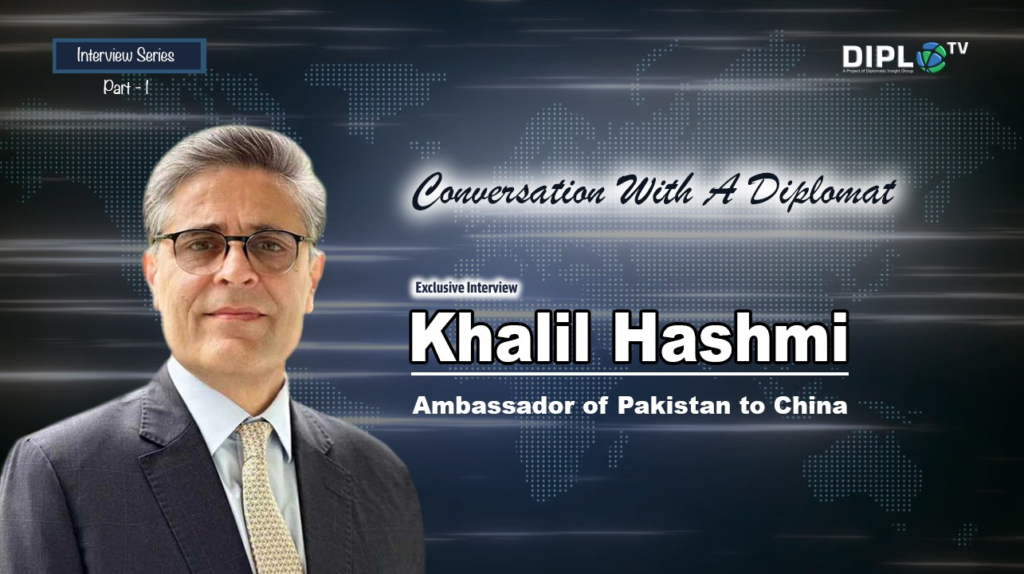
Islamabad (GNP): In this exclusive conversation, H.E. Khalil Hashmi, Ambassador of Pakistan to China, reflects on his personal journey into diplomacy, the realities of life in the Foreign Service, Pakistan-China relations, and the lessons he has learned through a career spent representing Pakistan around the world.
Ambassador Khalil Hashmi joined the Foreign Service of Pakistan in 1994 and has since held a number of significant diplomatic assignments. Before his current posting, he served as Pakistan’s Permanent Representative to the United Nations, other international organizations, and the Conference on Disarmament in Geneva. Over his distinguished career, he has held key positions at the Ministry of Foreign Affairs, including Director General for United Nations Affairs, the European region, and Arms Control, as well as Director of Armament Affairs for India and the South Asia region.
His overseas postings include Copenhagen and Beijing, along with two terms at Pakistan’s Mission to the United Nations in New York, where he also served as Deputy Permanent Representative. Over the years, he has worked extensively on arms control, counterterrorism, human rights, and climate change, representing Pakistan at numerous international conferences and multilateral negotiations.
Could you tell us about your personal journey and what truly drives you?
I think two things drive me: the pursuit of excellence, and the pursuit of a good life. At one level that might sound idealistic or aspirational, but that’s genuinely what drives me. To achieve either, I believe you first need fire in the belly — the drive to make a difference so that you can live a good life. In short, these two things shape how I organize myself and go about my daily life.
Beyond that, what also drives me is what I see around me. I believe there’s a great deal we need to do collectively — we have over 30 million children out of school in a country of 250 million people, which is a serious problem. We’ve also faced longstanding economic challenges as a developing country. These are factors that push me to create pathways and opportunities, and to come up with problem-solving approaches rather than simply highlighting problems. It’s one thing to point out issues and complain; it’s another to have a mindset that drives solutions and genuinely improves things for children and for our population. And going back to the core of it — a good life cannot be achieved without hard work, effort, and dedication.
Speaking of the 30 million out-of-school children you mentioned — that number keeps growing every year. Where do you think the gap lies that has made Pakistan the country with the highest number of out-of-school children in the world?
There are several things that need to be done — some are already underway, but others need more attention. From a solutions standpoint, we need to accelerate, expand, and create more platforms for technical education and vocational training for young people who are out of school. We’re doing this from within China as well, mobilizing resources for technical and vocational training.
We’re focused on two fronts. First, for children who are already out of school, the goal is to provide them with a skill set so they can pursue employment and live a decent, dignified, and productive life. Second, for children who may not go on to become engineers or pursue higher degrees, but who complete middle or high school, technical and vocational training in specific fields can still give them diplomas and a real shot at better employment opportunities.
Let’s rewind a little — take us back to yourself in your twenties, still figuring out life, before the idea of becoming a diplomat took shape.
This dream of becoming a diplomat was triggered in my first year of university. Until then, I hadn’t quite figured out what I wanted to do. I think the motivation was, in many ways, a natural one for young people — a desire for travel, adventure, and learning more about life, other people, and cultures. That curiosity combined with a search for purpose — something that would allow personal growth, learning, and a deeper understanding of the world. That’s how the dream and the journey started. I focused on the civil service exam, worked toward it, and thankfully was selected into the Pakistan Foreign Service. Here I am, 32 years into a diplomatic career.
When you entered the Foreign Service and began your career, what challenges did you face early on?
My first diplomatic assignment was in Copenhagen, Denmark. Like anyone starting a new job, I had a certain idea of what it would look like — meeting people, writing, negotiating, representing, attending ceremonial functions. But when I arrived, the first six months turned out to be nothing like what I had imagined.
I dealt daily with consular matters — people complaining about passports, visas, document attestation — along with a large Pakistani diaspora community in Denmark. Many young people who had grown up in Denmark knew very little about Pakistan and would come to talk through various issues. All of this consumed my time day in and day out, leaving little room for the more intellectual, representational, or negotiation-focused work I had imagined — discussions on politics, geopolitics, security, and development.
That was a tough first six months, but I was fortunate to have a very professional ambassador at the time who helped me navigate it. It was difficult, but I came through it, and there was never any looking back after that.
You’re currently serving in China, and you’ve been posted there before as well. What is one thing — perhaps a cultural practice — that has really surprised or impressed you?
Nothing has particularly surprised me, but there are many things I find inspiring. One trait I’ve learned and discovered more deeply here is patience — the Chinese, in general, are patient and reflective. Second, I find the notion of harmony very inspiring — the idea of reconciling differences and finding a middle ground where, in any complex situation, the solution feels like a win-win, where everybody gains something rather than it being an either-or outcome.
Third, and something I find truly inspiring, is what China has achieved on the ecological, environmental, and climate front. Everybody knows about China’s socioeconomic development, and people are increasingly familiar with its technological advancements. What’s less known is the progress on the environmental side. I served here before, in 2008 and 2010, and returning fifteen years later, I see a sea change — air quality has substantially improved in Beijing and many other cities, forest cover has expanded, and rivers, lakes, and waterways have been cleaned up.
Finally, what China has offered the world in green and digital technology is significant — electric vehicles, batteries, and other solutions. What matters most is that these technologies are being produced and made available at very large scale, and at prices that developing countries and people with fewer resources can actually afford and adopt. These are the three or four things that have truly inspired and impressed me about China.
Pakistan and China are celebrating 75 years of diplomatic relations. If you had to identify one thing that unites the two peoples — be it food, language, or something else — what would it be?
There are many ways to describe it, but my own way is that the common factor between the two countries and the two peoples — China and Pakistan — is a high degree of mutual trust. That’s one element, and linked to it is the question of how mutual trust develops. It develops by standing with each other in good times and in not-so-good times. Mutual trust doesn’t develop overnight — it takes years. I believe our people, our leaders, and our diplomats on both sides have decisively built that trust over time.
That is why this friendship exists not just at the government level but also at the people-to-people level. This is the reason we call it a friendship “higher than the highest mountains, deeper than the deepest ocean, and sweeter than honey.” At the foundation of this unparalleled relationship between two states and two peoples lies mutual trust.
What are the potential opportunities for Pakistani youth, especially in China?
China, in the 20th and 21st centuries, is the new land of opportunity. If the United States was the land of opportunity for the 20th century, China is that for this century — and the opportunities are endless.
Let’s start with education, since your audience is largely a young demographic. On the technology side, there are frontier fields — biotechnology, biomedicine, synthetic biology, and then quantum computing, AI, IoT, and so on. There are very high-quality universities here for bachelor’s, master’s, PhD, and postdoctoral studies. China is no longer what it was a generation ago — it is now at the cutting edge of these technologies.
Beyond education itself, there’s the career and research dimension. China is far ahead in research output today — it publishes the largest number of research papers and files the largest number of patents and copyrights globally. A third area is the commercialization of research — deploying knowledge and education into business, startups, and incubation centers. This is a very promising space.
On the economic side — trade and investment — there are huge opportunities as well. In the last two years alone, we’ve organized five China-specific business-to-business investment conferences, focusing on 21 priority sectors we’ve identified. This is a great opportunity to harness Chinese capital, finance, and management practices — bringing Chinese companies to work with Pakistani companies in these sectors to enhance our productive capacity, scale up our exports, and improve their quality and diversity.
The third area is technical and vocational training. China has over 70,000 technical and vocational training institutions. Whenever a Chinese company sets up a factory or plant abroad, it typically integrates training facilities to skill and train local people. We are harnessing this by combining investment mobilization with technical and vocational training in each sector. For example, next month we’re holding a conference in Karachi on pharmaceuticals, biotechnology, and healthcare combined. We’re not only bringing Chinese enterprises to work with Pakistani counterparts — we’re also bringing Chinese institutions that provide technical and vocational training, so that once a factory is established, it already has a built-in facility to train a skilled workforce, rather than facing the problem of having plants but no trained people to employ.
There are many other opportunities too — in science and technology, agriculture, and mining and minerals — but these are some of the ones I’d highlight.
Also Read: Conversation With a Diplomat: Exclusive Interview With H.E. Faisal Niaz Tirmizi
Please tell us how much learning the Chinese language can help, and in what ways.
It’s a great asset — a door opener. It’s certainly a big plus, because you immediately connect with people. We’re all human; there’s some hesitation and difficulty if you don’t know the language of the country you’re in, especially where few people speak English. That said, the anxiety level has gone down these days thanks to translation apps and real-time translation tools. It’s not like ten years ago, when not knowing Chinese meant a much higher level of anxiety. It’s relatively easier now, but there’s still nothing like knowing the language and connecting with people directly. It’s certainly a big advantage.
Can learning Chinese itself open more doors for young people who don’t have any other specific skill set?
If you’re in the educational field and want to pursue a degree or research, it’s certainly an additional advantage. If there are, say, five positions available, candidates with a Chinese-language background may be given implicit preference. If you’re in business — setting up a company or a startup — knowing the language reduces your expenses, since otherwise you’d need to hire people to interpret or translate for you. So not knowing the language can become an additional business expense, while having it gives you an edge over others.
What about the labor force — people without a degree, perhaps working in the food industry or other technical trades? What opportunities exist for them in China?
To give a simple example: in China, if you don’t have a skill set, if you’re not trained, if you don’t know a technical trade, you’re like a fish out of water — you cannot survive. This is a country where nearly everyone has a reasonably good, and in many cases very high, skill level, supported by strong talent-cultivation platforms. Chinese companies and the government have launched programs to attract highly talented and highly skilled professionals — that’s the bar they’ve set. A basic skill set may get you some level of employment, but it may not be a high-paying or attractive job. Without a skill set or basic certification, it’s almost impossible to secure a good position and open that window of opportunity.
Speaking of home — what do you miss most about Pakistan?
I suppose food is something you eat every day. My wife cooks excellent food, but when you’re in your own country, sometimes you like to go out and try different things. There are Pakistani and other restaurants in Beijing and across China, but there’s nothing like home, and Pakistan will always be home to us. Beyond food, I think what I miss most is the larger family and friends. We stay connected through different means, but there’s nothing like one-on-one, real-time interaction in person.
What are your interests outside of your job?
I would like to be an entrepreneur — not necessarily starting a business myself, but advising and consulting. That’s one part. My other passion is helping develop institutions — no matter how small — that become platforms to train people and amplify knowledge, skills, and techniques. These are the two things I’d like to continue in different capacities going forward.
You’ve been very busy in the foreign service, but there will come a time when that winds down and you retire. What are your plans for life after the foreign service?
A couple of things. First, I’d like to continue traveling as much as I can. When I’m not traveling, I’d like to do some consulting on areas where I’ve built expertise — including on difficult regional and security issues; I have a background in arms control, having spent half my career on that.
Beyond that, I’d like to do something on the business side, in more of an advisory capacity — drawing on what I’ve acquired in China over the past two and a half years: new models for conceiving, developing, planning, and organizing business-to-business investment conferences and vocational and technical training symposiums, and integrating the two. We’ve also established Pakistan Study Centers here — four so far, focused thematically on technology, agriculture, petrochemicals, and IT and frontier technology.
You can see in all of this an urge to develop structures and institutions, and to find solutions to complex problems — whether in politics or economics. For instance, when we have millions of children out of school, that’s a major problem to address. I probably can’t provide a solution for all 30 million, but I can create pathways so that at least a few thousand are able to acquire the skills necessary to secure a job.
Finally, what message would you like to leave with our viewers?
When we live abroad, we learn many things. In a nutshell, I’d say there are three things I’ve learned that are important for any country and its population.
The first is the ability to better understand each other — your surroundings, your own country and society, and, if you have the time, your region and the world at large. Enhancing that understanding is very important.
The second is tolerance — tolerance of each other. Even if you disagree strongly with other people, groups, or even the government, that’s not a problem, as long as you have a level of tolerance to agree to disagree.
The third is respect — and respect is a two-way street, a mutual exchange. Where you can make a difference is that even when you feel the other side isn’t giving you the respect you deserve, your own conduct over time will foster and generate that respect. If it doesn’t come from the other side first, doing it yourself will eventually earn you that reciprocity.
These are the three things I’ve gathered through my postings — two in North America, two in Europe, and two in Asia. I believe it would be valuable to see these three qualities embraced at a larger scale in our own country.