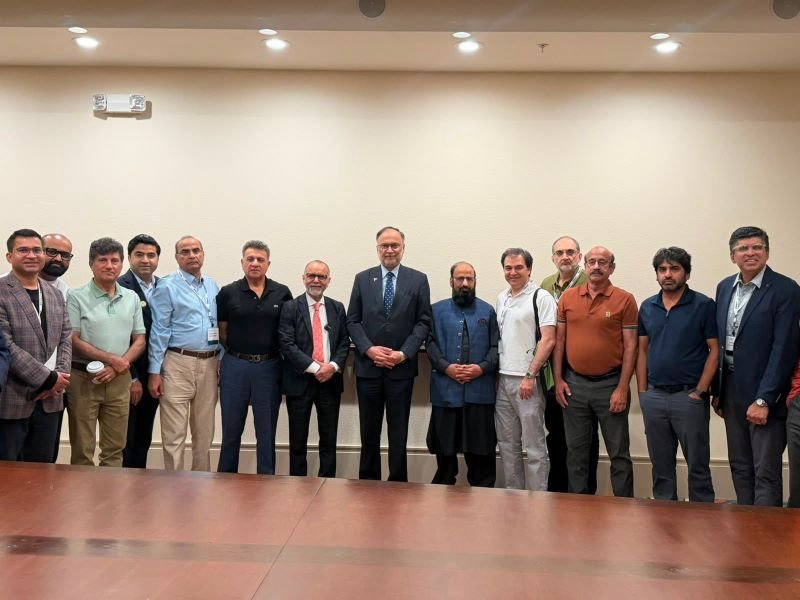
Orlando, Florida (GNP): During a visit to the United States, Federal Minister for Planning, Development and Special Initiatives Ahsan Iqbal took part in the 49th Annual Convention of the Association of Physicians of Pakistani Descent of North America (APPNA) in Orlando, along with a series of engagements with Pakistani-American business leaders, encouraging the diaspora to take an active role in Pakistan’s economic development.
Speaking at the APPNA convention, the minister outlined the government’s approach under URAAN Pakistan, which places human capital development at the core of national planning. He said Pakistan’s long-term progress hinges on investment in education, health, population management, innovation, and technology, alongside deeper collaboration with Pakistani professionals abroad.
Appealing to overseas Pakistani physicians to lend their expertise, Iqbal proposed a new Telemedicine Backup initiative that would set up a panel of ten US-based medical specialists for each of Pakistan’s sixty districts.
Under this model, the panel would offer remote clinical guidance to junior doctors working in underserved and remote regions, allowing them to consult overseas specialists directly and deliver better care through digital tools. He said the initiative would support knowledge sharing, strengthen healthcare delivery, and widen access to specialist treatment nationwide.
Pointing to the potential of artificial intelligence, the minister asked Pakistani doctors living abroad to help build AI-based healthcare tools, digital health systems, and other technology-driven medical innovations to modernize the country’s health sector.
He also flagged some of Pakistan’s biggest public health challenges — including Hepatitis C, diabetes, tuberculosis, polio, rapid population growth, and childhood stunting — saying these problems demand coordinated national action backed by global expertise. He noted that Prime Minister Muhammad Shehbaz Sharif has approved creation of a National Population Council, to be chaired by the prime minister and include all chief ministers, aimed at ensuring a unified national approach to population issues. He also mentioned that Hepatitis C elimination efforts are already underway in Islamabad, Gilgit-Baltistan, and Azad Jammu & Kashmir, with a nationwide diabetes awareness campaign set to launch soon.
During a question-and-answer session, Iqbal spoke about the need for responsible democratic engagement, saying that while peaceful political expression is a constitutional right, political disagreements should never come at the expense of state institutions or Pakistan’s standing internationally. He argued that politics should remain distinct from state affairs, noting that no functioning democracy allows partisan interests to weaken its core institutions, and urged citizens to voice disagreements responsibly while protecting national sovereignty and reputation.
He remarked that Pakistan has struggled to reach its full development potential due to frequent breaks in policy continuity. He credited the previous PML-N government with resolving the energy crisis, restoring stability, and launching the China-Pakistan Economic Corridor (CPEC), which he said laid groundwork for long-term growth. He added that since taking office in 2022, the current coalition government has made tough but necessary choices to avoid default, stabilize the economy, and bring inflation down from around 38 percent to roughly 5-6 percent, building a stronger base for sustainable growth.
In separate meetings with Pakistani-American business figures in Orlando, the minister encouraged overseas entrepreneurs, professionals, and investors to help drive Pakistan’s economic recovery by supporting exports, forming technology partnerships, and channeling productive investment into the country.
Describing the government’s economic strategy under URAAN Pakistan, he said Pakistan is pursuing growth built on exports, innovation, and knowledge, with the goal of boosting competitiveness, drawing investment, generating jobs, and speeding up sustainable development. He asked the diaspora business community to use its international connections to open new markets for Pakistani goods, support investment, enable technology transfer, and strengthen the country’s export sector.
Referencing Ma’arka-e-Haq, Iqbal said that under the leadership of Prime Minister Shehbaz Sharif and Field Marshal Syed Asim Munir, Pakistan showed strong national unity, professional capability, and technological readiness in defending its sovereignty. He said this success had boosted Pakistan’s global standing and demonstrated the professionalism of its armed forces, adding that while Pakistan has reinforced its strategic and diplomatic position, its next major challenge — Ma’arka-e-Maeeshat — lies in building economic strength through higher exports, stronger industry, technological progress, and greater investment.
The minister also pointed to emerging opportunities in artificial intelligence, digital technology, renewable energy, and climate resilience, saying the Pakistani diaspora has the skills, global connections, and entrepreneurial drive needed to help transform the country into an innovative, competitive, and sustainable economy.
Wrapping up his visit, Iqbal reaffirmed the government’s commitment to strengthening rule of law, maintaining policy continuity, improving the investment environment, and building lasting partnerships with overseas Pakistanis. He described the diaspora as one of the country’s most valuable strategic assets and invited them to help realize the goals of URAAN Pakistan in building a prosperous, resilient, and globally competitive Pakistan.

Sohail Majeed is a Special Correspondent at The Diplomatic Insight. He has twelve plus years of experience in journalism & reporting. He covers International Affairs, Diplomacy, UN, Sports, Climate Change, Economy, Technology, and Health.