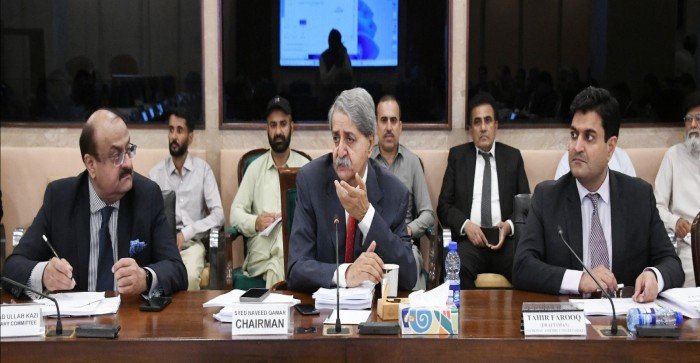
Islamabad (GNP): Chairing a meeting of the Standing Committee on Finance and Revenue at Parliament House, Syed Naveed Qamar voiced concern over the revenue impact of proposed tax concessions, questioning whether the expected losses had been properly calculated and what plan the government had to cover any resulting gap.
The Committee was briefed by the Minister of State for Finance and senior FBR officials on the tax measures, fiscal reforms, and revenue proposals in the Federal Budget FY 2026–27.
Members also examined relief for salaried individuals amid ongoing inflation, asking whether revised tax slabs would genuinely benefit middle-income earners. Further concerns were raised over cuts to property taxes and IT-sector incentives, and whether these would drive real investment and export growth rather than speculation.
While welcoming efforts to digitize tax administration, members flagged worries about taxpayer protections, transparency, due process, and data privacy under the planned faceless audit and AI-based assessment system.
The Chairman said relief measures need to stay fair and economically sound, while the tax base must be widened and compliance strengthened. He instructed the Finance Ministry and FBR to provide detailed revenue projections, impact studies, and implementation roadmaps before the Finance Bill, 2026 proceeds further.
The Committee heard that the budget includes eleven relief measures, ten rationalization steps, and five administrative reforms meant to spur growth, attract investment, widen documentation, and boost compliance and revenue.
Key relief items covered: a cut in exporters’ minimum tax from 2% to 1.25%, continued Final Tax Regime status for IT exporters, salaried-class relief via revised slabs and removal of the surcharge, lower withholding tax on property deals, adjusted Federal Excise Duty on international air travel, and reduced super tax rates for some corporate categories.
Other relief measures mentioned: scrapping taxes on contraceptives and certain women’s products, ending Capital Value Tax on foreign assets, exempting the shipping sector from sales tax, and incentives for upgrading brownfield refineries — all intended to encourage investment, exports, and economic activity while lightening the tax load on key sectors.
Rationalization steps discussed included expanding the Third Schedule, a fixed tax scheme for small retailers, new treatment of coupon-washing transactions, closing the tax gap between industrial and commercial importers, tougher non-compliance penalties, revised withholding tax on services, duties on luxury vehicles, and steps against fuel adulteration via adjustable excise duty on solvents.
Also Read: Pakistan Plays a Constructive Role in US-Iran Peace Efforts
On the administrative side, officials described plans for a National Faceless Audit Wing and National Assessment Wing, greater use of third-party data, algorithmic dispute resolution, digital invoicing, and an AI-supported Central Data Hub for risk assessment and compliance monitoring.
The Committee also approved minutes from its previous meeting.
Attendees included MNAs Rana Iradat Sharif Khan, Zeb Jaffar, Dr. Nafisa Shah, Hina Rabbani Khar, Dr. Sharmila Faruqui, Dr. Mirza Ikhtiar Baig, Muhammad Javed Hanif Khan, and Shahida Begum, along with the Minister of State for Finance and senior officials from the Finance Ministry and FBR.

Sohail Majeed is a Special Correspondent at The Diplomatic Insight. He has twelve plus years of experience in journalism & reporting. He covers International Affairs, Diplomacy, UN, Sports, Climate Change, Economy, Technology, and Health.