Islamabad (GNP): Pakistan’s gross domestic savings rate has fallen dramatically, from 17.4 percent of GDP in 1992 to a mere 6.4 percent in 2024, marking the country’s weakest savings performance in a generation and placing it far behind every comparable economy in the region.
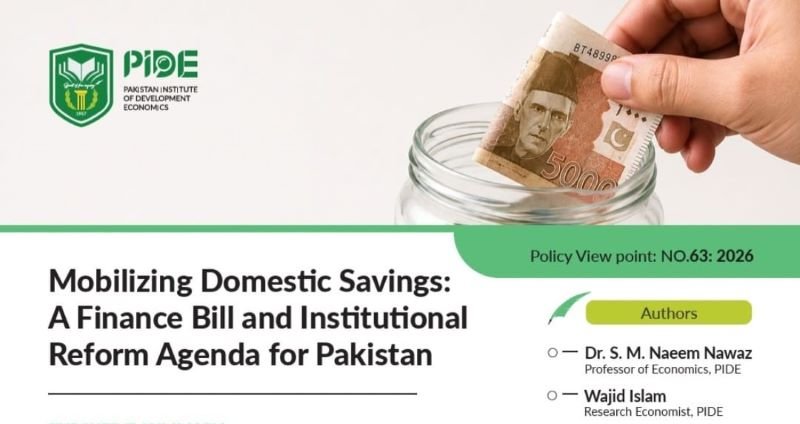
This alarming finding forms the centerpiece of a new policy viewpoint titled Mobilizing Domestic Savings: A Finance Bill and Institutional Reform Agenda for Pakistan, authored by Dr. S. M. Naeem Nawaz, Professor of Economics, and Wajid Islam, Research Economist, both affiliated with the Pakistan Institute of Development Economics (PIDE).
The paper issues an urgent call for the Finance Bill FY2026–27 to introduce a dedicated National Savings Mobilization Package before the country’s eroding savings foundation precipitates yet another external financing emergency.
The report’s diagnosis is unsparing: nearly every balance-of-payments crisis and IMF bailout Pakistan has endured over the past three decades can be traced back to the same underlying dysfunction — a nation that has steadily abandoned the habit of saving and now relies on borrowed foreign capital to fund its future.
Pakistan’s three-decade average savings rate of just 10.9 percent of GDP stands in stark contrast to its regional neighbors. Over the same period, Bangladesh saved close to 21 percent of GDP, India exceeded 28 percent, and Vietnam approached 30 percent.
Crucially, the authors note, these countries were not starting from a position of greater wealth — several were poorer than Pakistan at the outset. What distinguished them was a deliberate effort to make saving safe, rational, and financially rewarding. Pakistan, the report contends, moved in the opposite direction.
The authors identify a self-reinforcing cycle at the heart of the problem. With consumption now absorbing 93.6 percent of national income and inflation consistently outpacing bank deposit returns, formal saving has effectively become a losing proposition for Pakistani households.
The rational response has been to hoard cash, accumulate gold, and channel wealth into real estate — asset classes that generate no industrial investment and create no employment. Simultaneously, the government has become a net dissaver, borrowing so heavily from domestic banks that little credit remains accessible for productive private-sector activity.
The policy viewpoint lays out a concrete reform agenda centered on reviving and redesigning savings-related tax incentives within the Finance Bill FY2026–27.
Key proposals include restoring a capped tax credit for approved long-term savings instruments under a restructured Section 62 of the Income Tax Ordinance — a provision scrapped through the Finance Act 2022 — subject to minimum holding periods and clawback mechanisms to limit fiscal exposure.
Voluntary pension incentives under Section 63 should be bolstered with additional support specifically targeting first-time contributors, women, and workers in self-employment and the informal sector. A revived protection-linked savings credit under Section 62A is also proposed, covering health insurance, life insurance, and family takaful products to strengthen precautionary savings and reduce household reliance on distress financing.
A recurring theme throughout the report is the need to shield smaller, more vulnerable savers from fiscal policies that inadvertently penalize them. The authors recommend targeted concessions under the Second Schedule of the Income Tax Ordinance for approved products serving pensioners, widows, Shuhada families, women, and senior citizens — ensuring that fiscal support flows to genuine small savers rather than large passive income holders.
The report also firmly cautions against reintroducing transaction or entry-point taxes on transfers into formal savings instruments, noting that such levies have historically pushed households toward cash hoarding and informal channels.
The report argues that a substantial reservoir of household wealth currently locked in cash, gold, real estate, committees, and foreign currency needs to be redirected into regulated financial channels.
Achieving this requires broadening retail access to a range of instruments including Sukuk, Shariah-compliant savings products, voluntary pension schemes, takaful, micro-insurance, REITs, regulated gold funds, and digitized National Savings products. Simplifying Know Your Customer requirements for small-balance accounts is also identified as a critical enabler.
“For thirty years we have financed our ambitions with other people’s money and paid for it with recurring crises,” said Dr. S. M. Naeem Nawaz. “The choice is no longer austerity versus growth — it is whether we keep renting our future from foreign creditors or finally rebuild the domestic savings base that every successful economy has relied upon.”
Also Read: Pak-Mauritius Agree to Boost Trade and Business Connectivity
Wajid Islam framed the issue as one of incentive design rather than household behavior. “This is not about telling people to spend less — it is about restructuring the incentives so that saving becomes the rational choice,” he said. “Make formal saving safe, rewarding, and tax-efficient, and Pakistanis will save. The Finance Bill is the single most powerful tool available to begin that shift this year.”
The authors are careful to note that fiscal measures alone will not be sufficient to reverse the trend. Durable progress will require sustained price stability, credible after-tax real returns on savings, stronger consumer protection frameworks, and disciplined management of public expenditure. Unless the government also addresses its own role as a dissaver and reduces fiscal crowding-out of private credit, any savings mobilized through incentives risk being absorbed by recurrent budget deficits rather than channeled into productive investment.
To ensure accountability and track progress, the report recommends establishing an annual Savings Mobilization Dashboard covering domestic savings rates, formal savings uptake, voluntary pension participation, retail Sukuk investment, women-owned accounts, and private-sector credit allocation.

Sohail Majeed is a Special Correspondent at The Diplomatic Insight. He has twelve plus years of experience in journalism & reporting. He covers International Affairs, Diplomacy, UN, Sports, Climate Change, Economy, Technology, and Health.