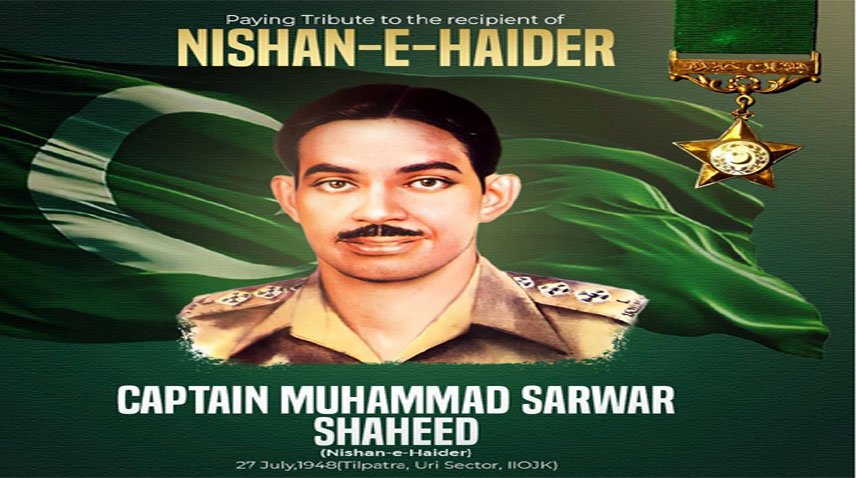
Rawalpindi (GNP): Pakistan is marking the 78th martyrdom anniversary of Captain Muhammad Sarwar Shaheed, recipient of the Nishan-e-Haider, today.
Field Marshal Syed Asim Munir, Chief of Army Staff and Chief of Defence Forces, along with Admiral Naveed Ashraf, Chief of Naval Staff, Air Chief Marshal Zaheer Ahmed Baber Sidhu, Chief of Air Staff, and the wider Pakistan Armed Forces joined in honoring the occasion, praising the captain’s remarkable bravery, steadfast dedication, and ultimate sacrifice for the country.
Captain Sarwar lost his life on 27 July 1948 at Tilpatra in Azad Kashmir during the First Kashmir War, becoming the first Pakistani ever honored with the Nishan-e-Haider. Commanding his troops from the frontline, he showed remarkable bravery, sharp tactical judgment, and total commitment to his mission.
His sacrifice remains a lasting symbol of bravery, endurance, and selfless service to the nation. Pakistan’s citizens and military continue to honor his memory with deep respect and appreciation, and his example continues to motivate generations to embrace duty, honor, and patriotism.
Background
Captain Raja Muhammad Sarwar (10 November 1910 – 27 July 1948), also known as Muhammad Sarwar Bhatti, was an army officer who became the first person awarded Pakistan’s top military honor, the Nishan-e-Haider, for his bravery during the 1947–48 war with India over Kashmir.
He was laid to rest at Tilpatra Hill, close to Uri in Indian-administered Kashmir, on the day of his death. Nearly eight years later, on 23 March 1956, Pakistan’s Parliament formally recognized his contribution, approving the posthumous Nishan-e-Haider award, which the President of Pakistan later conferred on him. His grave carries a citation in Urdu, summarized below.
The Battle at Tilpatra, Uri
After Muhammad Ali Jinnah called for Pakistan’s military to join the fight in Kashmir, Captain Sarwar—then attending a course at the Army’s School of Signals—requested and received permission to rejoin his unit, the 2nd Punjab Regiment, which had already moved into the conflict zone. Serving as signals officer, he volunteered to lead an assault on enemy positions at Tilpatra Hill.
Also read: Zong Joins WWF and ISPES for Plastic-Free July
On 27 July 1948, he advanced with his men under heavy machine-gun, artillery, and mortar fire. After his machine gunner fell, he manned the weapon himself before handing it to a replacement gunner. He then led a separate flanking group that destroyed an enemy machine-gun post, personally cutting through barbed wire to clear a path for his soldiers and pressing the attack forward. He was fatally wounded by enemy automatic fire during the assault. His conduct in this battle led to his posthumous award of the Nishan-e-Haider.

Sohail Majeed is a Special Correspondent at The Diplomatic Insight. He has twelve plus years of experience in journalism & reporting. He covers International Affairs, Diplomacy, UN, Sports, Climate Change, Economy, Technology, and Health.