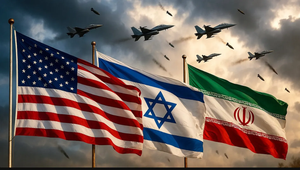
Israel is fighting three wars simultaneously: the war on Gaza, with daily civilian killings; the war on Iran, along with its partner, the US; the war on Lebanon, supposedly targeting Hezbollah, but indiscriminately killing Lebanese citizens not connected to Hezbollah.
Over 3,400 people have been killed in Lebanon, and nearly 10,000 have been wounded by Israeli strikes since fighting escalated in the region.
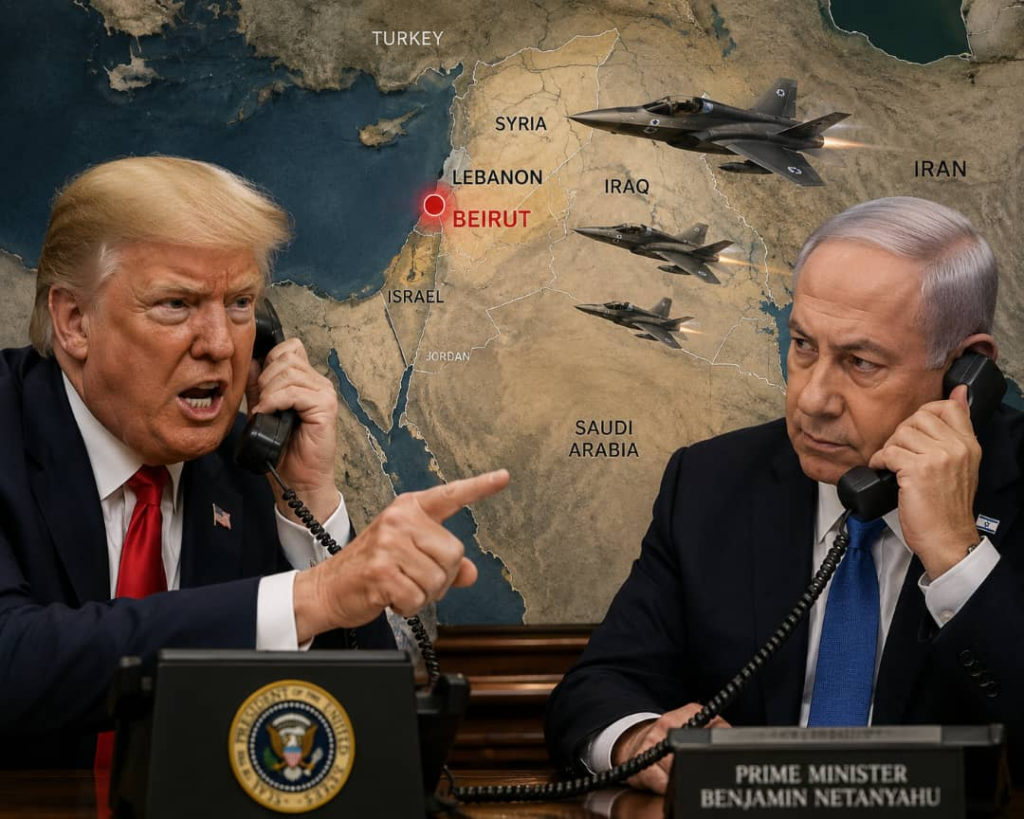
On June 1, Israeli prime minister Netanyahu and Defense Minister Israel Katz stated they had ordered massive airstrikes on Beirut “following the Hezbollah terrorist organization’s repeated and ongoing violations of the ceasefire in Lebanon and its attacks against our civilians and cities”.
Within minutes, Trump called Netanyahu and called off the bombing, after being informed that Iran pledged to stop negotiating with the US to stop the war and open the Strait of Hormuz if Beirut was massively attacked.
Trump views making a deal with Iran to stop the war, Trump started, as priority, and wouldn’t allow Netanyahu to prevent the deal.
Netanyahu’s priorities do not align with Trump’s priorities. Netanyahu wants to destroy Lebanon, from North to South, and bring down the Lebanese government, who he deems as unable to disarm Hezbollah. Israel’s goal is to annex Gaza, the Occupied West Bank, the south of Lebanon up to an including Beirut, the southern parts of Syria up to Damascus, which are currently occupied by Israeli troops and military posts. The Golan Heights are already gone; Trump allowed for their annexation in his first term.
Israel is counting on manipulating Trump, and milking his time in office for all that it’s worth. But, the phone call didn’t go the way Netanyahu wanted.
Trump said after his call with Netanyahu that the Iran negotiations “are continuing, at a rapid pace.”
The Lebanese Embassy in Washington later announced that Hezbollah accepted a U.S. proposal for a “mutual cessation of attacks” and that Trump had told the Lebanese ambassador he’d secured Netanyahu’s agreement.
“I had a very productive call with Prime Minister Bibi Netanyahu, of Israel, and there will be no Troops going to Beirut, and any Troops that are on their way, have already been turned back,” Trump wrote afterward.
Trump’s statement demonstrated his lack of understanding what Israel had planned for Beirut. Troops were never involved; Israel had planned for a massive wave of airstrikes over Beirut. On April 8, Israel had bombed 100 targets in 10 minutes, including residential neighborhoods in Beirut which had no connection to Hezbollah. However, Trump’s reference to troops marching on Beirut may signal he is aware of Netanyahu’s end-game.
Trump said he’d had a “very good call” with “highly placed Representatives” of Hezbollah who agreed “that all shooting will stop — That Israel will not attack them, and they will not attack Israel.”
Nabih Berri, the speaker of the Lebanese parliament, is not a member of Hezbollah, but has on occasion represented the resistance in negotiations. Berri had told the Trump administration on May 31 that Hezbollah was ready for a ceasefire.
Also Read: Israel and Lebanon Talk Amid Escalating War as the Country Faces Collapse
According to Barak Ravid and Marc Caputo of Axios, the call between Trump and Netanyahu was explosive.
Axios reported details on the leaked June 1 call between Trump and Netanyahu in which Trump said, “You’re fucking crazy. You’d be in prison if it weren’t for me. I’m saving your ass. Everybody hates you now. Everybody hates Israel because of this.”
Trump accused Netanyahu of being the reason for global hatred of Israel in the June 1 phone call, Axios reported.
Academics and analysts point to the growing global condemnation of the genocide in Gaza, and the invasion and brazen occupation of Lebanon fueling the so-called anti-Semitic wave in the western world. In reality, criticism of Israel, or any other country’s policies, cannot be equated with anti-Semitism.
Netanyahu is currently standing trial on charges of fraud, breach of trust, and accepting bribes across three separate criminal cases. It is generally assumed his only means of staying out of prison is by staying in office.
Numerous Israeli officials publically criticized Netanyahu for canceling a strike on Beirut after the call with Trump on June 1.
“This is the time to tell our friend, President Trump – ‘no’,” wrote National Security Minister Itamar Ben-Gvir on X, reminding Netanyahu that he once said a strong prime minister would say no to the US in the interest of the country.
Yair Lapid, Opposition leader, accused Netanyahu of treating Israel like a vassal state of the US. Lapid wrote, “the responsibility for the security of Israeli citizens lies soley with the Israeli government,” while advocating for a “powerful response.”
Naftali Bennett, former prime minister and currently in the race for the job, Gadi Eisenkot, former IDF chief of staff, and Ithamar Ben-Gvir, National Security Minister all criticized Netanyahu for backing down to Trump.
The majority of Jewish Israelis support the continuation of military operations against Hezbollah.
Around two-thirds of the Jewish public support prolonging the war on Iran to dismantle Iran’s nuclear and ballistic missile programs.
Hezbollah’s most recent major rocket and missile attacks on Israel occurred on March 2, 2026, following coordinated US and Israeli strikes against Iran. The US-brokered ceasefire between Israel and Lebanon formally took effect on November 27, 2024, but the ceasefire has not been observed by Israel, with a multitude of violations reported by the UN, and Hezbollah has responded to the invasion, occupation and destruction of the south of Lebanon, which now looks like Gaza.
Investigative journalists at BBC Verify have reported on the damaged US military bases across eight countries in the Middle East. Using satellite images and videos, the BBC verified the attacks left a trail of devastation.
Westerners and Arabs have been sheltered from the images of the Iranian attacks on 20 US military sites due to a satellite image shut-down ordered by Trump.
Planet is an American aerospace company operating the largest constellation of Earth-imaging satellites in history.
In April 2026, the Trump administration requested that Planet indefinitely withhold high-resolution visuals of Iran and the broader Middle East conflict zone.
Analysts said that Tehran’s attacks on US bases has been more precise than US officials have characterized previously.
The US bases are in Saudi Arabia, the United Arab Emirates (UAE), Qatar, Kuwait, Iraq, Jordan, Bahrain and Oman.
Three state-of-the-art anti-ballistic missile batteries systems at the Al Ruwais and Al Sader airbases in the UAE and Muwaffaq Salti Airbase in Jordan are among the valuable hardware damaged. They cost around $1bn to manufacture, and a crew of about 100 troops to operate it while the interceptors it fires cost around $12.7m per round.
Iranian attacks have also targeted Ali Al Salem Airbase and Camp Arifjan in Kuwait. Analysts identified the destruction from satellite images of the base, which was hit multiple times.
In May, the Pentagon estimated the total cost of Operation Fury to be $29bn, but Democrats say this is an underestimate.
While the US has used expensive weaponry, Iran has utilized cheap and replaceable drones to take out US bases with precise attacks.
In the beginning of the war, Iran used mass waves of missiles in order to overwhelm air defense systems. Then, they shifted to smaller, but more precise hits on high-value targets.
The US military failed to move aircraft away from Iranian drones when they still had the chance, such was the case at Prince Sultan airbase.
Iran’s Supreme Leader Mojtaba Khamenei vowed that “the nations and lands of the region will no longer serve as shields for American bases,” adding: “America will no longer have a safe place in the region for mischief and the establishment of military bases, and day by day it will drift further from its former position.”
Military and defense analysts have warned the US is dangerously low on air defense stocks, and the time to make and replenish them is long, not to mention the extreme cost.
Trump is under pressure to make the deal of his lifetime, to end a war he began without provocation, amid the realization he is almost ‘out of ammo’.

Steven Sahiounie
He is a two-time award-winning journalist and political commentator.