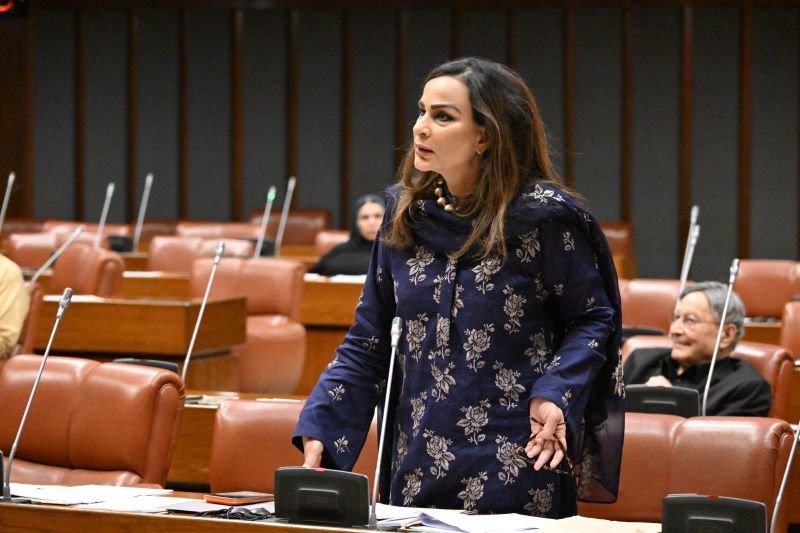
Islamabad (GNP): Senator Sherry Rehman used her Senate address to call for a transparent, independent probe into the deaths of 14 children in the PIMS hospital fire, arguing that the tragedy raises serious concerns about governance, accountability and public safety.
A resolution she moved calling for a special Senate committee to investigate the incident was passed unanimously by the House. She had earlier submitted a Calling Attention Notice directed at the Federal Health Minister, drawing attention to the children’s deaths and reports that basic fire-safety measures at the Pakistan Institute of Medical Sciences (PIMS) had failed.
Rehman said the questions being raised in the chamber were entirely warranted, noting that she had visited PIMS within two hours of the tragedy alongside senior PPP colleagues, where she stressed — as she did again in the Senate — that her intent was not political point-scoring but genuine accountability. She argued that politics, at its core, is about serving the public interest and holding institutions accountable wherever failures occur.
Drawing on her own background as a former federal Health Minister, Rehman said she had once been advised to close emergency gates during her tenure but refused, opting instead to post guards and personally inspect the area. She questioned why individuals indifferent to basic safety protocols continue to be allowed to hold positions of responsibility.
She also shared that she and her husband had received treatment at PIMS even during her time as minister and had encountered irregularities then — suggesting the experience of ordinary citizens using the facility is likely far worse. She said PIMS, in its current state, is not equipped to deliver adequate care.
Rehman pushed back on the account given by the PIMS Executive Director regarding the emergency gate, saying his claim that it had not been closed was false, and that both firefighters and the Capital Development Authority (CDA) confirmed otherwise. She questioned the very purpose of an emergency exit if it isn’t kept accessible during a crisis.
She further pointed to inconsistencies between PIMS’s own report and CDA findings, noting that the CDA has repeatedly flagged the hospital’s fire-safety shortcomings and that PIMS reportedly lacks a fire no-objection certificate (NOC), despite no action being taken.
Rehman highlighted PIMS’s substantial federal funding, questioning why safety standards remained inadequate despite available resources. Official budget figures show the hospital received roughly Rs. 22 billion in federal funding over the past three years, including Rs. 6.84 billion allocated last fiscal year against actual spending of Rs. 7.51 billion — an overrun of about Rs. 670 million. This fiscal year’s allocation stands at Rs. 7.63 billion.
She characterized the failure as one of governance rather than funding, noting that patients travel to PIMS from across the country and that responsibility for the tragedy is shared broadly.
Rehman described lawmakers as public servants rather than rulers, saying she had come to the Senate seeking solutions rather than simply delivering criticism, and warned that public trust in Parliament and the political elite continues to erode due to inaction.
She reiterated her lack of confidence in any committee where officials investigate their own colleagues, calling instead for a House committee formed by the Senate itself — comparable to how parliamentary committees function in the US Senate and elsewhere.
Turning to the human toll of the tragedy, Rehman described the trauma faced by the children’s mothers and troubling details surrounding the fire, including reports that hospital staff were asleep at the time and that a security guard, not staff, rescued one child. She questioned the official explanation that the fire originated from an air conditioner spark, arguing it pointed to a system that had completely broken down. She also alleged that a prior Health Committee report on related issues had been suppressed, warning she would resist normal House proceedings if such practices continued.
She called for the Senate to take a constructive role by forming a committee tasked with producing a report within 40 days, while also helping the hospital establish better systems for managing daily patient loads.
Also read: Nepal Seeks Foreign Technical Aid as Flood Toll Hits 626
The proposed committee would investigate the circumstances of the tragedy, examine institutional failures and accountability, and recommend measures to prevent similar incidents in the future.

Sohail Majeed is a Special Correspondent at The Diplomatic Insight. He has twelve plus years of experience in journalism & reporting. He covers International Affairs, Diplomacy, UN, Sports, Climate Change, Economy, Technology, and Health.