ISLAMABAD (GNP): Several sessions at an event organised by the Sustainable Development Policy Institute (SDPI) covered regional water security, Sindh’s flood housing programme, women’s participation in the economy and power systems in South Asia.
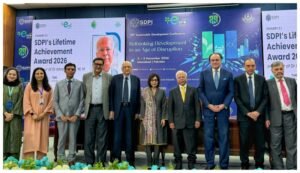
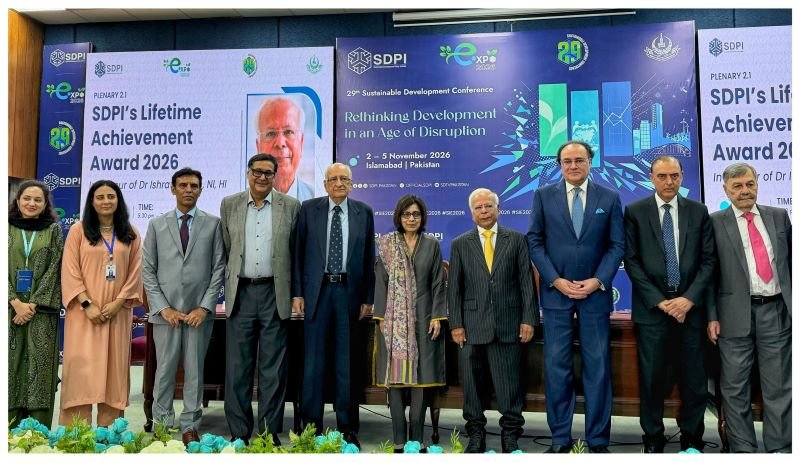
Federal Minister for Finance and Revenue, Senator Muhammad Aurangzeb, addressing the SDPI’s Lifetime Achievement Award Plenary at the 29th Sustainable Development Conference (SDC) 2026.
At a discussion titled “Water Security, Hydro-Diplomacy & Regional Peace,” water experts urged shared efforts to address common water challenges in South Asia, especially between Pakistan and India. Cooperation, sound water management and respect for international agreements, they said, are essential to prevent further tensions and protect the region’s future. Pakistan, they argued, should pursue its rights under the Indus Waters Treaty at bilateral and international forums while also strengthening domestic water governance, implementing existing policies and improving conservation.
Ambassador Shafqat Kakakhel, Chairperson of SDPI’s Board of Governors, called water an existential issue and a basic prerequisite for life. He described the Indus Waters Treaty as an extraordinary agreement, negotiated when international water law was still underdeveloped, which averted a potentially devastating conflict and set out principles later reflected in the UN Watercourses Convention.
Ahmed Kamal, a former chairman of the Federal Flood Commission, said Pakistan cannot treat the treaty as history while India pushes ahead with projects. He warned that doing so would put Pakistan in difficulty, and said India has eight projects on the ground, including one for which a bid has been made and civil works may already be under way.
Dr Shaheen Akhtar of the National Defence University said regional cooperation could greatly improve water security, but the suspension of SAARC activities and strained Pakistan-India relations have weakened prospects for joint action. The treaty, she said, remains the region’s strongest water-sharing framework, with detailed provisions on both countries’ rights and technical requirements for run-of-the-river projects.
Nabeel Goheer, a global development leader, said the dispute goes beyond a sectoral or security matter, touching economic development, human welfare, climate change and bilateral relations.
At a session on “SPHF – The World’s Largest post-Disaster Housing Reconstruction Programme,” World Bank Country Director for Pakistan Bolormaa Amgaabazar called the completion of one million houses within a few years unprecedented, and said she hopes the Sindh People’s Housing for Flood Affectees (SPHF) programme will reach its overall target of about 2.1 million homes. Representatives of the European Union, World Bank and Asian Development Bank described it as a model for other countries facing climate disasters, poverty and inadequate housing. The programme aims to reduce poverty and help poor families have their own shelter.
Dr Emma Xiaoqin Fan, ADB Country Director for Pakistan, called it an internationally significant development success whose scale, speed and inclusiveness hold lessons for housing finance elsewhere. Conventional models, she said, depend on banks and intermediaries that mostly serve bankable households, leaving extremely poor, unbankable families outside the formal system. Pakistan’s experience shows that a sustainable, inclusive approach can reach underserved groups while also delivering wider benefits through land access, skills, jobs and financial inclusion.
At a session titled “From Skills to Economic Independence: Expanding Opportunities for Women,” experts discussed how to close gaps, widen access to economic opportunities and strengthen women’s participation in the workforce. MNA Shaista Pervaiz Malik said skills are the “key” and economic empowerment is the “house,” with five doors in between to be opened: skills, safety, capital, markets and health. She called for examining the institutional and market-level changes needed in each area to remove barriers.
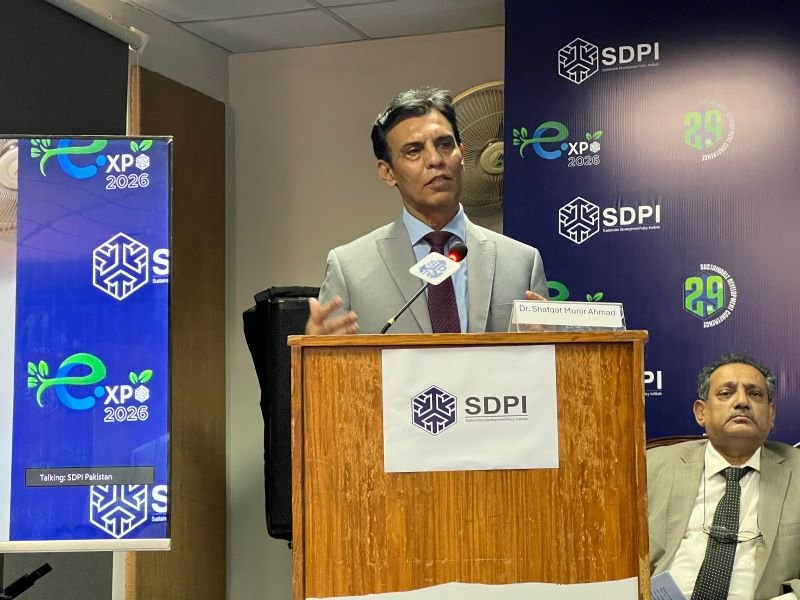
SDPI Executive Director Dr Abid Qaiyum Suleri spoke of a “golden triangle” of skills, finance and market access, all of which must work together to turn women’s skills into real opportunities, and urged widening the discussion to include insurance and microfinance.
At a session on “Strengthening Power Systems for Energy Transition in South Asia,” Mikiko Tanaka, Director and Head of the UNESCAP Subregional Office for South and South-West Asia, said the rising share of solar and wind in Asia-Pacific makes their seasonal variability a critical issue. The region, she noted, faces inadequate transmission infrastructure, regulatory and institutional hurdles and financing limits for grid upgrades, and stronger, integrated grids could help countries electrify their economies.
Also read: Pakistan Welcomes Sri Lankan Delegation for Buddhist Heritage Tour
Mohammad Solaiman, Deputy Secretary at the Power Division of Bangladesh’s Ministry of Power, Energy and Mineral Resources, said Bangladesh’s earlier emphasis on adding generation, with capacity payments and little competitive bidding, has become a heavy burden on the economy, and that the recent regional energy crisis exposed its dependence on imported fuel.

Sohail Majeed is a Special Correspondent at The Diplomatic Insight. He has twelve plus years of experience in journalism & reporting. He covers International Affairs, Diplomacy, UN, Sports, Climate Change, Economy, Technology, and Health.