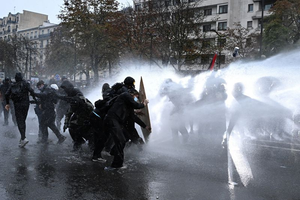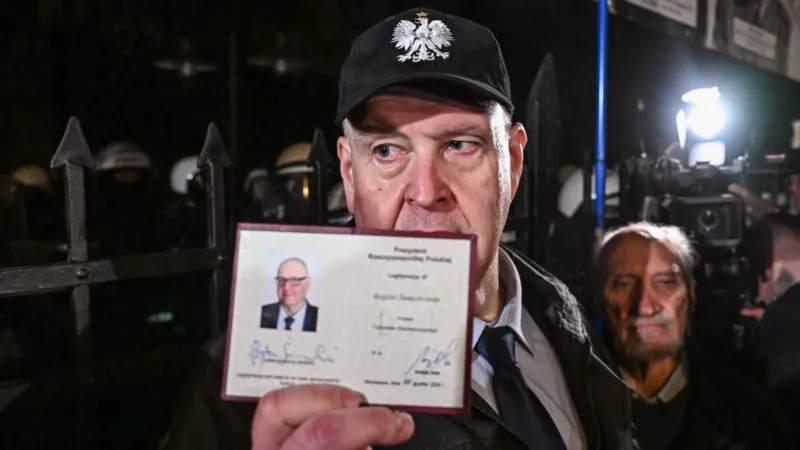
Warsaw (GNP): Riot police were deployed outside Poland’s Constitutional Tribunal on Friday night after the court’s president, Bogdan Święczkowski, was suspended. The move has pushed a decade-old dispute over the judiciary into its most serious confrontation yet.
The tribunal said Anna Korwin-Piotrowska, a judge with the longest service on the bench, had suspended Święczkowski and taken charge of the court. His deputy, Bartłomiej Sochański, was also targeted. Święczkowski is a former deputy justice minister from the era of the Law and Justice party (PiS). Korwin-Piotrowska is one of the judges elected by the current parliament whom President Karol Nawrocki has refused to swear in.
Justice Minister Waldemar Żurek said he had asked for Święczkowski and Sochański to lose their immunity so they could face prosecution for obstructing the court’s work. The tribunal replied on social media that the two remained its legally appointed senior judges. It said everyone involved in the government’s actions was committing the crime of a coup d’état.
Hundreds of protesters, including opposition lawmakers, gathered outside the building in Warsaw, and police stood guard to keep them out. Three people were reportedly arrested for trying to force their way in. PiS leader Jarosław Kaczyński condemned what he called an assault on the court.
Nawrocki, who is backed by PiS, cancelled a state visit to Senegal while in the air. He had been travelling to the Summer Youth Olympic Games in Dakar. He reached the court shortly before 1am on Saturday and, in video footage, was seen pushing through the police cordon to get inside. A statement read on his behalf at 5am said a constitutional body had been seized by force and called for security forces to leave.
The standoff has deep roots. In 2015, the then PiS-led government moved quickly to fill the tribunal with its own appointees, and European courts later ruled that three of those judges had been improperly elected. Those rulings found the tribunal was no longer an independent and impartial court, and Prime Minister Donald Tusk’s government has relied on them to justify its refusal to recognise the court in its current form.
Since returning to power in 2023, Tusk has promised to reverse those changes. His efforts have been repeatedly blocked by presidential vetoes, first from Andrzej Duda and now from Nawrocki, who was elected in 2025. This year Nawrocki refused to swear in judges chosen by parliament. Earlier this month, the Council of Europe’s Venice Commission said his refusal should not stop them from taking their seats.
Also Read: Netanyahu Bloc Falls Short of Majority as Fraud Claims Spread
The government’s own record has also drawn criticism. In September, parliament appointed Tusk ally Maciej Berek to the tribunal, which critics said undermined the aim of restoring checks and balances. Legal experts remain divided over the latest move. Constitutional lawyer Marcin Matczak, a prominent critic of the PiS-era reforms, said the suspension of Święczkowski had no legal basis.
The timing adds to the tension, with parliamentary elections due next year and polls suggesting the right could return to power. The US ambassador to Poland, Tom Rose, warned that thousands gathering outside the tribunal made an already dangerous situation more combustible.
Tusk said, “Restoring the rule of law is our duty.”
Nawrocki said, “At a moment like this, the President must be in Poland.”
Foreign Minister Radosław Sikorski said, “The constitutional tribunal was politicised under the previous government.”

Managing Editor at Global News Pakistan (GNP), with a Bachelor's degree in International Relations from Riphah International University, graduated with a Gold Medal. Reach out at sabahtareengnp@gmail.com