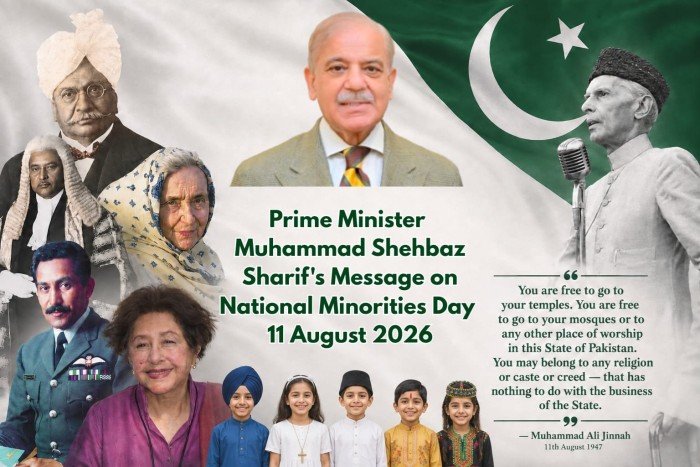
Islamabad (GNP): Pakistan observes National Minorities Day to recognize the invaluable role minorities play in the country, their place within the national mainstream, and their contributions to national progress and prosperity.
Minority communities in Pakistan form an essential part of the nation’s social fabric, reflecting the country’s diverse cultural and social character.
On 11 August 1947, in his address to the first session of the Constituent Assembly, Quaid-e-Azam Muhammad Ali Jinnah made clear that all citizens would be free to practice their own faith, visit their places of worship, and follow whatever religion, caste, or creed they chose, stating this was not a matter for the state to interfere in. These words continue to hold a lasting place in Pakistan’s social values, governance, and religious outlook.
The day also reaffirms Pakistan’s commitment to unity among its various communities, peaceful coexistence, mutual respect, and equal opportunity for all citizens. Pakistan remains a diverse nation where people of different faiths, cultures, and traditions live side by side.
Since the founding of Pakistan, minority communities have played a meaningful role in the country’s development, contributing across economic, educational, social, cultural, and political spheres.
Legal and Policy Framework
Pakistan’s Constitution guarantees protection for the rights of minority communities, backed by a legal framework that safeguards places of worship, prohibits discrimination, and works to prevent hate speech. A major recent step in this direction was the passage of the National Commission for Minorities Act, 2025, under which the Ministry of Human Rights is now working to establish an independent commission.
This body will be responsible for addressing grievances, ensuring constitutional and legal protections are upheld, advising on relevant government policy and legislation, monitoring issues related to places of worship and employment quotas, and promoting equality and inclusion.
Also Read: Pak, U.S. Envoy Discusses Bilateral Economic Cooperation
To further strengthen interfaith harmony, the government introduced the Interfaith Harmony Policy 2025, focused on protecting religious freedom, encouraging interfaith dialogue, and ensuring equal opportunity free of discrimination. This complements the National Policy for Countering Violent Extremism 2024, which is also being implemented.
The Ministry of Human Rights, working with relevant stakeholders, has additionally introduced the National Action Plan for Human Rights 2026, which includes specific measures aimed at protecting and promoting minority rights.
The federal government, alongside provincial governments, relevant institutions, and civil society, reaffirmed its shared commitment to continuing efforts to protect the rights of all citizens — particularly minority communities — ensure equal opportunity, and work toward a peaceful, tolerant, and united society.

Sohail Majeed is a Special Correspondent at The Diplomatic Insight. He has twelve plus years of experience in journalism & reporting. He covers International Affairs, Diplomacy, UN, Sports, Climate Change, Economy, Technology, and Health.