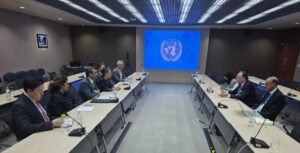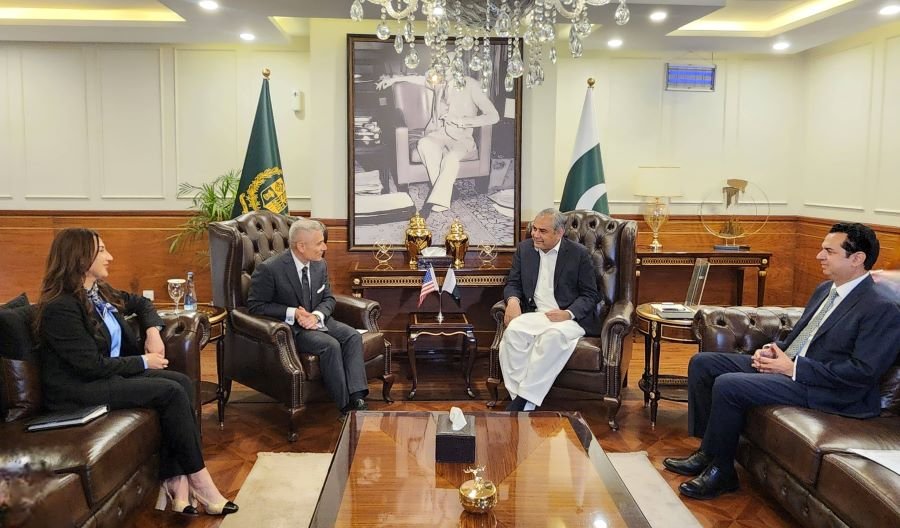
Islamabad (GNP): Interior Minister Mohsin Naqvi Meets US Assistant Secretary of State, Discusses Pakistan-US Relations, Security, and Counterterrorism Cooperation. Federal Interior Minister Mohsin Naqvi met with U.S. Assistant Secretary of State for South and Central Asian Affairs S. Paul Kapur. Acting U.S. Ambassador Natalie Baker, Minister of State for Interior Talal Chaudhry, and the Federal Interior Secretary were also present on the occasion.
The meeting included discussions on Pakistan-U.S. relations and the latest situation in the Middle East, while matters relating to expanding cooperation in security, counterterrorism, and counternarcotics were also reviewed.
Federal Interior Minister Mohsin Naqvi stated that Pakistan-U.S. relations have grown stronger during President Trump’s tenure. He said that Pakistan-U.S. ties are undoubtedly based on mutual trust and bilateral cooperation.
Also Read: Deputy PM Welcomes US Cooperation in Multiple Sectors
Interior Minister further stated that foolproof security arrangements have been ensured for American companies working on the Reko Diq project. Mohsin Naqvi added that Pakistan seeks the early resumption of direct flights between Pakistan and the United States, which would further strengthen people-to-people contacts and boost bilateral trade and economic ties between the two countries.
Mohsin Naqvi also expressed hope for a lasting and peaceful resolution to the Middle East conflict, emphasizing that dialogue and diplomacy remain the only viable path forward.
The U.S. Assistant Secretary of State praised Pakistan’s role in ensuring peace and stability in the region, acknowledging Islamabad’s continued efforts as a responsible regional partner.
Beyond the Meeting Room: The Broader Significance of Pakistan-US Engagement
The meeting between Federal Interior Minister Mohsin Naqvi and U.S. Assistant Secretary of State Paul Kapur is emblematic of a relationship that has endured decades of complexity, yet continues to find common ground on issues of shared strategic interest. Pakistan and the United States share a long and layered history, one that has been tested by geopolitical shifts but consistently anchored by mutual dependencies in security, regional stability, and economic cooperation.
At the heart of the current engagement is a renewed sense of purpose. Interior Minister Naqvi’s assertion that Pakistan-U.S. ties have strengthened under President Trump’s tenure reflects a pragmatic approach from Islamabad, one that seeks to capitalize on the current political climate in Washington to deepen bilateral cooperation across multiple fronts. From counterterrorism to trade, the two nations are finding fresh avenues to collaborate in ways that serve both their national interests.
The counterterrorism dimension of this partnership remains particularly vital. Pakistan has long been at the frontline of the global fight against extremism, bearing significant human and economic costs in the process. A structured and sustained security cooperation framework with the United States not only enhances Pakistan’s operational capabilities but also reinforces the message that Islamabad remains a committed partner in maintaining regional and global security.
Pakistan’s role in the Middle East context is equally noteworthy. As a Muslim-majority nation with deep cultural and religious ties to the region, Pakistan carries unique diplomatic weight when it comes to advocating for peace and a just resolution to ongoing conflicts. Interior Minister Naqvi’s expression of hope for a peaceful resolution to the Middle East crisis aligns with Pakistan’s broader foreign policy tradition of supporting dialogue, sovereignty and humanitarian principles on the international stage.
As both nations continue to build on this momentum, the trajectory of Pakistan-U.S. relations appears increasingly promising, grounded in trust, driven by shared goals and strengthened by consistent high-level engagement.

Sohail Majeed is a Special Correspondent at The Diplomatic Insight. He has twelve plus years of experience in journalism & reporting. He covers International Affairs, Diplomacy, UN, Sports, Climate Change, Economy, Technology, and Health.