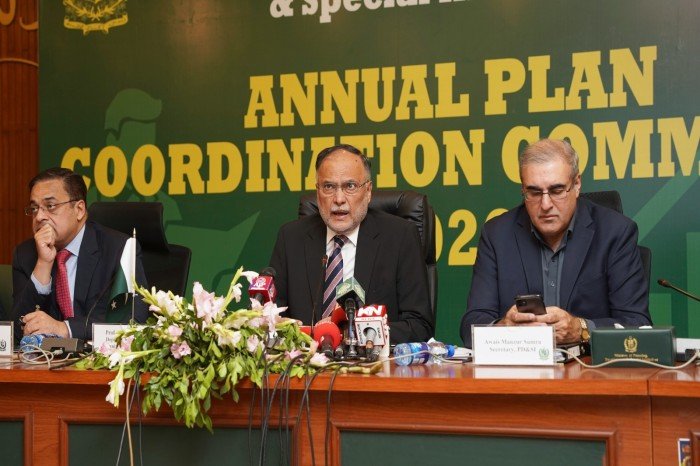
Islamabad (GNP): The Annual Plan Coordination Committee (APCC) convened under the leadership of Pakistan’s Federal Minister for Planning, Development and Special Initiatives and Deputy Chairman of the Planning Commission, Professor Ahsan Iqbal, to evaluate the Public Sector Development Programme (PSDP), review the progress made in development during the 2025-26 period, and finalize the key areas for the Annual Plan 2026-27.
Minister Ahsan Iqbal presented a clear and forward-looking analysis of Pakistan’s developmental challenges, highlighting that the country is working with significantly reduced PSDP funding at a time when the demand for national development is increasing rapidly.
He stressed that Pakistan’s development space has been severely constrained due to rising debt servicing costs, prolonged macroeconomic difficulties, and worsening global economic conditions.
During the meeting, the Minister outlined that the PSDP saw its strongest growth from 2013 to 2018, during which development spending reached its peak and contributed significantly to growth, connectivity, and investor confidence.
He noted that in 2017-18, the PSDP accounted for 19.6% of the national budget and 2.5% of GDP, but by 2025-26, it had dropped to 4.0% of the budget and 0.6% of GDP.
The Committee was informed that the PSDP for 2025-26 was initially set at Rs 1,000 billion, but this was later reduced to Rs 837 billion after implementing two budget cuts due to economic shocks and adjustments in energy pricing.
The Ministry of Planning, Development and Special Initiatives authorized Rs 835 billion for the respective ministries and divisions for the period July-June 2026, as per the quarterly release strategy set by the Finance Division. As of June 1, 2026, sponsors had utilized Rs 529 billion from this allocation.
“The PSDP is not just a line item in the budget; it is a statement of the nation’s intent,” the Minister said, emphasizing that development funding is closely related to economic growth, national productivity, and public well-being.
Minister Ahsan Iqbal warned that Pakistan is still recovering from the 2018 economic crisis, with debt servicing and external challenges limiting investment in transformative projects. He urged a shift from short-term survival to long-term economic independence, stressing that exports must be placed at the heart of national policy.
“Respectable countries generate income through exports and export-related foreign direct investment,” he said. “It is neither dignified nor sustainable for a nation to finance its future through borrowing. The path to respect and stability lies in becoming self-reliant.”
Describing Pakistan’s IMF program as “economic therapy” inherited from a near-bankrupt previous government, he said there is no national pride in relying on bonds, IMF support, or rollover arrangements. Citing South Korea, Malaysia, Vietnam, and China, he stressed that nations rise when they produce, compete, and export.
Also Read: PM Credits GSP+ for Surge in Pakistan-European Union Trade
Minister Ahsan Iqbal stressed that exports are the key to economic sovereignty, calling for a coordinated national effort to put the economy on an export-focused path.
Minister Ahsan Iqbal stressed that exports are the key to economic sovereignty, calling for a coordinated national effort to put the economy on an export-focused trajectory.
The APCC reviewed the development portfolio under the URAAN Pakistan initiative and 5Es Framework amid severe fiscal constraints. The throw-forward crossed Rs 10,000 billion, while the Finance Division allocated an initial budget commitment (IBC) of Rs 1,126 billion against a total demand of Rs 4,100 billion. The federal PSDP has remained stagnant, while provincial ADPs reached Rs 3 trillion. No room exists for new projects in PSDP 2026-27.
Of approved projects, 197 costing Rs 14,687 billion were cleared by ECNEC, 335 costing Rs 1,045 billion by CDWP, and 254 costing Rs 133 billion by DDWP. Core ECNEC infrastructure projects make up over 95% of the total portfolio.
The APCC recommended a National Development Outlay of Rs 4,715 billion for 2026-27, comprising Federal PSDP of Rs 1,126 billion, Provincial ADPs of Rs 3,138 billion, and SOE investments of Rs 451 billion. Over 98% of available resources will go to ongoing projects, prioritising water, energy, transport, and core infrastructure.
The IBC of Rs 1,126 billion covers only 27% of ministry demands, 38% of rationalized planning demand, and 11% of the ongoing throw-forward, leaving the current portfolio requiring ten years to complete.

Sohail Majeed is a Special Correspondent at The Diplomatic Insight. He has twelve plus years of experience in journalism & reporting. He covers International Affairs, Diplomacy, UN, Sports, Climate Change, Economy, Technology, and Health.