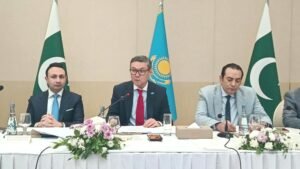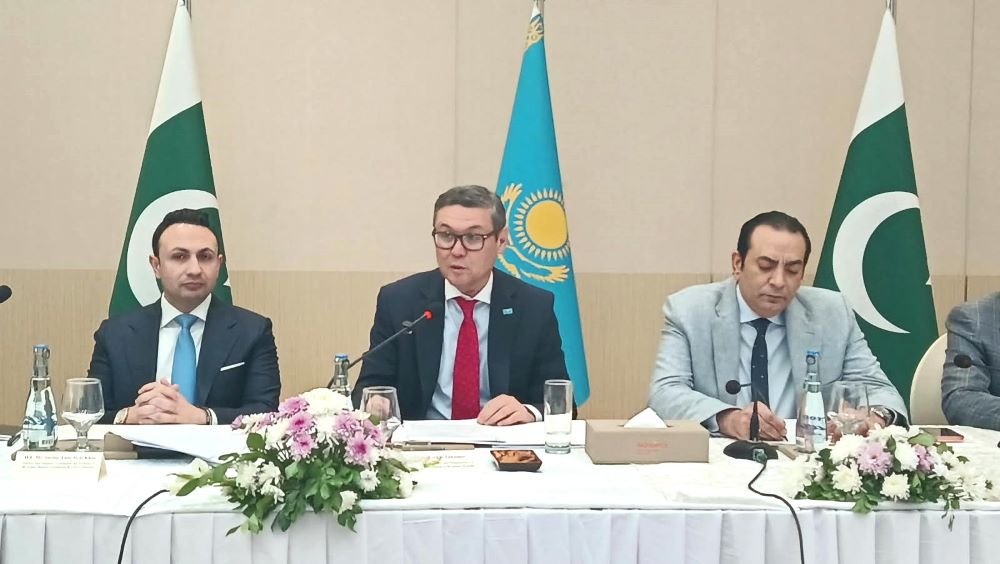
Islamabad (GNP): Embassy of Kazakhstan organised a high-level business meeting to promote trade and economic relations between Pakistan and Kazakhstan, attended by business leaders from both countries.
Prime Minister’s Special Assistant Sardar Yasir Ilyas, FPCCI President Atif Ikram Sheikh and the Kazakh Ambassador also participated in the meeting. Both sides agreed to undertake joint initiatives to enhance bilateral trade and investment.
The Kazakh Ambassador said relations between Pakistan and Kazakhstan were rooted in shared history, religion, culture and common values. He noted that both countries had achieved significant progress in bilateral relations over the past 25 years.
He added that the leadership of both countries was working to take bilateral relations to new heights, while practical steps were being taken to bring their private sectors closer and expand business cooperation.
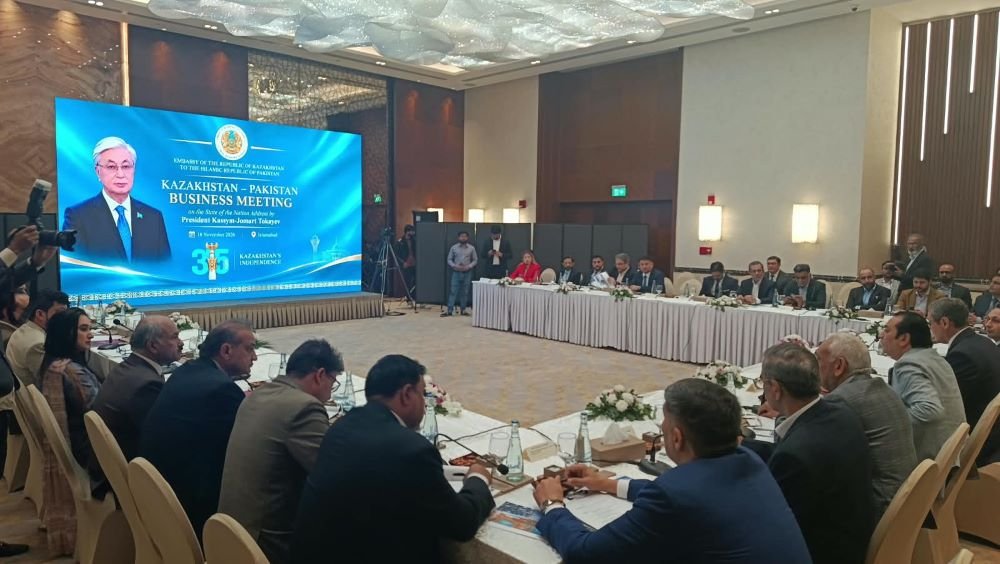
Addressing the Kazakhstan-Pakistan business meeting, the Ambassador of Kazakhstan to Pakistan Dr. Yerkin Tukumov held a meeting with Business Community said his country has made remarkable progress in building sovereign institutions, developing a market economy and forging international partnerships.
He said Kazakhstan is the largest economy in Central Asia and a key driver of regional growth. Its GDP is expected to approach $400 billion this year, with GDP per capita projected to exceed $19,000, placing it among upper-middle-income countries. Its economy is larger than those of the other four Central Asian states combined.
The ambassador said Kazakhstan is also the region’s leading destination for foreign investment. Since independence, it has attracted nearly $500 billion in foreign direct investment, including about $155 billion over the past seven years.
Between 2019 and 2025, he said, the share of manufacturing in foreign direct investment rose from 14 to 21 percent. Manufacturing now accounts for more than 14 percent of GDP, reflecting a gradual shift toward a more diversified economy.
International companies are supporting this transformation. He said global brands such as Kia and Hyundai have set up industrial operations in Kazakhstan, contributing to technology transfer, localization and regional supply chains.
According to a recent UN report, announced greenfield investment projects in Kazakhstan reached about $24 billion in 2025, a major share of such projects across the Eurasian Economic Union.
The ambassador described the Astana International Financial Centre (AIFC) as a key element of the investment ecosystem. Operating under a legal framework based on English common law, it has registered more than 6,600 companies from 90 countries and facilitated over $28 billion in investment. An AIFC representative joined online to present its work in detail.
He said President Tokayev’s address to the nation on 28 October set out the next stage of national development. Its central message is that modernization must strengthen competitiveness, make institutions more efficient and deliver tangible benefits to business. He highlighted the following priorities:
Infrastructure : A People’s Construction Program will build new healthcare, education and social facilities across all regions and modernize public utilities, creating hundreds of thousands of jobs. Trillions of tenge are to be drawn from the National Fund for this purpose.
Energy security: New power plants, nuclear energy development and a strategic uranium reserve are planned. The ambassador noted that Kazakhstan is the world’s largest uranium producer and suggested this could open avenues for cooperation with Pakistan.
Digital technologies: A simplified legal framework for digital employment will be created, along with conditions favorable to digital entrepreneurship. Kazakhstan is also developing a major digital infrastructure cluster, Data Center Valley, and its IT services exports are growing.
Small and medium enterprises : The president proposed a three-year moratorium on inspections of small and medium businesses, continued decriminalization of economic offenses, lower regulatory and tax burdens, and wider participation in public procurement. SMEs already contribute more than 40 percent of GDP.
Agriculture: The president called for technological modernization, including wider use of artificial intelligence, efficient water management, reduced losses in distribution networks and a national water resources database. Kazakh Invest is facilitating 41 agribusiness projects worth about $5.3 billion, covering production, food processing and higher-value export products.
Kazakhstan has also introduced a national digital investment platform covering more than 3,500 projects. It lets government bodies monitor implementation, identify administrative barriers and support investors.
The ambassador said the president stressed that investment policy should be judged not by the capital attracted but by results: new production facilities, advanced technologies, skilled jobs and greater export capacity.
He said these priorities are particularly relevant as Kazakhstan and Pakistan enter a new stage in their relations. The Kazakh president’s state visit to Pakistan earlier this year was an important milestone, ending in a joint declaration establishing a strategic partnership and a broad package of agreements.
The next step, he said, is to move from agreements to tangible outcomes. With the 35th anniversary of diplomatic relations approaching in 2027, the shared task is to turn political goodwill into economic results.
He identified potential in transport and logistics, trade and investment, agriculture, food processing, pharmaceuticals, industrial production, energy and digital technologies.
Pharmaceutical manufacturing, he said, is especially promising. In 2026 Kazakhstan concluded agreements on seven major pharmaceutical investment projects, including the localization of production of dozens of products. Given Pakistan’s established pharmaceutical industry, he saw opportunities for joint manufacturing, technology transfer and production facilities serving Kazakhstan and the wider Central Asian market.
He added that Kazakhstan’s growing agricultural processing sector also offers opportunities for Pakistan.
Prime Minister’s Special Assistant Sardar Yasir Ilyas, address the Kazakhstan Pakistan Business meeting said, Our relationship with Kazakhstan and the other Central Asian states is significant, and it has existed for generations. Unfortunately, we have not capitalized on it.
The Silk Route was never just a trade route. Along it, we exchanged cultures, products, and services, and we celebrated commonalities in religion, craft, ideas, and innovation. Somewhere along the line, that east-to-west connectivity halted. Now we are reviving it.
The concept is a proven one: trade through travel. People traveled, they trained, and new ideas emerged. The potential and the opportunities are clear.
I appreciate our brothers in Kazakhstan, the embassy, and the entire mission. After 23 years, an official state visit was organized, and the president of Kazakhstan came to Pakistan. Multiple agreements and joint ventures were signed.
But as His Excellency said, it doesn’t end there. It is now our obligation to make these agreements materialize. They are worth well over 20 million dollars, with a minimum trade ambition of 1 billion dollars. Given Kazakhstan’s GDP and trade potential, there is room for much more.
Under the leadership of both countries, we are moving beyond traditional diplomatic friendship toward strategic partnership and cooperation. The 37 agreements now need to become measurable outcomes.
They cover tourism, sports, trade, transit, railway and maritime cooperation, electronic trade, digital and AI, and cultural and humanitarian cooperation. Real success will be judged by businesses created, jobs, wealth, and economic growth.
My own sector is tourism, and its closest ally is retail. They go hand in hand, because a traveler wants to shop, stay in hotels, try the food, and experience more.
Tourism contributes roughly 19 billion dollars to GDP, about 6% officially, and probably more unofficially. It employs about 5 million people, a figure expected to reach 8 million in the next five years.
Addressing the meeting, Atif Ikram Sheikh said the gathering provided an important opportunity to strengthen bilateral commercial relations. He said FPCCI was committed to translating the close ties between the two countries into increased trade and investment.
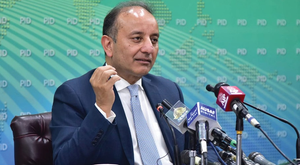
Also read: Musadik Malik Leads Pakistan Team to SCO Forum in New Delhi
He highlighted Kazakhstan’s position as a major Central Asian market with substantial energy resources, adding that both countries should move beyond traditional trade and benefit from each other’s economic potential. He also called for greater private-sector cooperation to utilise the extensive mineral resources of Pakistan and Kazakhstan.

Sohail Majeed is a Special Correspondent at The Diplomatic Insight. He has twelve plus years of experience in journalism & reporting. He covers International Affairs, Diplomacy, UN, Sports, Climate Change, Economy, Technology, and Health.