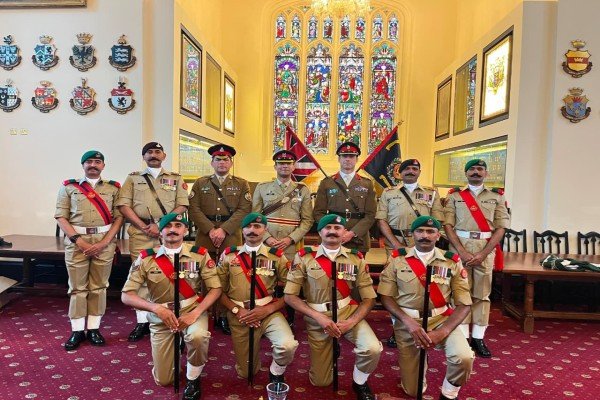
Sandhurst, UK (GNP): In a remarkable display of excellence, the Pakistan Army team, represented by Pakistan Military Academy (PMA), has clinched 1st Position at the prestigious International Pacesticking Competition 2026 held at the Royal Military Academy (RMA) Sandhurst, United Kingdom.
The PMA team made a clean sweep at the competition, securing all major honors, that is 1st Overall Team Trophy, Best Pace Sticker and Best Driver awards.
The 9-member Pakistani contingent, led by Major Haider Gulzar (Adjutant, PMA), arrived in UK on June 5, 2026.
A total of 16 international teams from different armies participated in the fiercely competed annual event. The Pakistan Army team’s victory is reflective of the highest standards of professional training, excellence and dedication maintained by the Armed Forces of Pakistan.
President of the Judging Panel, Lieutenant Colonel Ian Farrell, Grenadier Guards, explains what they are looking for from those taking part:
“Good turnout and excellent personal drill to start. Are they able to pace stick properly, is the stick hitting the ground in the right place and at the right time. And also, we’re looking for a bit of style and panache when they execute all the drill movements.”
As its title suggests, the competition is open to all arms meaning not just the military but any uniformed organisations can enter.
Taking part this year were teams from the Army Foundation College, Harrogate, the Soldier Academy Pirbright and three teams from the Royal Military Academy. Army regiments who entered included the Welsh Guards, Grenadier Guards, The Royal Logistic Corps, and to everyone’s delight the Royal Hospital Chelsea, looking magnificent in their full scarlet coats.
Adds Lieutenant Colonel Farrell: “It’s fantastic to see all the international teams here, and delivering the same drill moves as us. They have their own unique styles which just adds to the competition and adds to the flavour.”
The Royal Regiment of Artillery lays claim to be the originator of the pace stick, using it to measure the correct distances between guns, limbers (a two-wheeled cart designed to support the trail of an artillery piece) and ammunition caissons (a two-wheeled cart designed to carry artillery ammunition).
Also Read: Iqbal Proposes Legislative Assembly, CM for Islamabad
In 1928, the late Academy Sergeant Major Arthur Brand MVO MBE developed a drill for the pace stick and promoted its use through the Army to assure unity and precision amongst Drill Instructors.
It was used as a tool for instructors to check soldiers were the correct distance apart on parade, during drill, and to assist with ensuring soldiers were marching at a full 30-inch marching pace.
However, the pace stick can be traced further back than this as Warrant Officer Class One (WO1) Dwain Oliver, Academy Sergeant Major RMAS explains:
“Although a slightly different design, it was used by the Romans to measure roads and distances. So, 500 turns of the stick was considered a Roman mile.
Today, the pace stick plays a crucial role in the planning of parades such as Trooping the Colour and other state ceremonial occasions.

Sohail Majeed is a Special Correspondent at The Diplomatic Insight. He has twelve plus years of experience in journalism & reporting. He covers International Affairs, Diplomacy, UN, Sports, Climate Change, Economy, Technology, and Health.