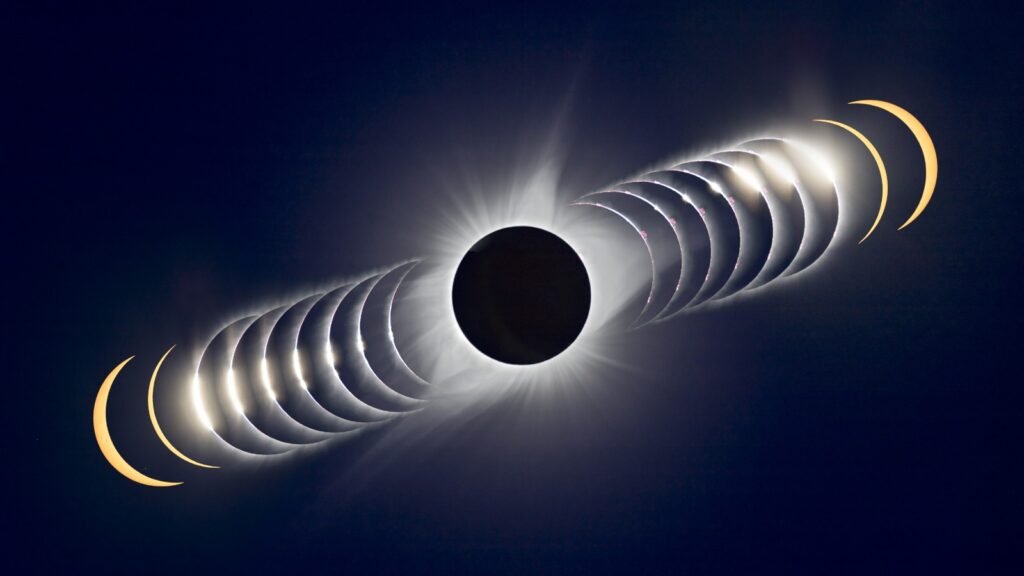
WASHINGTON (GNP): The NASA Solar Eclipse livestream will give millions of people around the world the opportunity to witness the spectacular total solar eclipse on August 12, regardless of their location. Beginning at 1:15 p.m. Eastern Time (1715 UTC), NASA will broadcast the celestial event live as the Moon passes directly in front of the Sun, combining breathtaking views with expert scientific commentary and official safety guidance.
Expect a massive global audience for this one students, teachers, astronomy buffs, researchers, and plenty of families just hoping to catch one of nature’s most jaw-dropping displays. Since it’s free and streamed online, NASA’s making sure even people who live nowhere near the path of totality can still tune in and watch it happen.
According to NASA, viewers can expect real-time telescope footage, live explanations from scientists, some educational content thrown in, and a deeper dive into the science behind why eclipses happen at all. The broadcast will walk through how the Earth, Moon, and Sun line up just right to create a total eclipse, while also touching on why solar observation matters so much for advancing space science more broadly.
Safety’s a big part of the conversation too. Staring directly at the Sun without proper protection can cause permanent eye damage no exceptions. NASA’s advising everyone to grab certified eclipse glasses that meet the ISO 12312-2 safety standard, or use an indirect method like a pinhole projector if glasses aren’t an option. The agency’s already put out educational videos and safety resources to help people get ready before eclipse day arrives.
For anyone lucky enough to be standing in the path of totality, there’s something extra special in store a rare glimpse of the Sun’s corona, that faint outer glow normally drowned out by the Sun’s own brightness. During totality, the sky darkens for a few minutes, temperatures can dip slightly, and bright stars and planets sometimes pop into view honestly, one of the more surreal things you can witness from Earth.
This livestream fits neatly into NASA’s ongoing push to get people excited about science and astronomy. Through live broadcasts, interactive content, and expert interviews, the agency keeps finding ways to turn complex research into something people of all ages can actually engage with and understand.
There’s real science happening here too, beyond the visual spectacle. Scientists use total eclipses as a rare window to study the Sun’s corona, its magnetic fields, and how solar plasma behaves research that feeds directly into our understanding of space weather, which in turn affects satellites, communication networks, GPS, and power grids back on Earth.
Also Read: Pak, JICA agree explore new avenues of cooperation
Schools, science museums, and astronomy clubs are already gearing up for their own viewing events tied to the NASA broadcast. Plenty of classrooms across different countries are expected to use it as a teaching moment a chance for students to learn about astronomy and orbital mechanics through something actually happening in real time, rather than just reading about it in a textbook.
For anyone who can’t safely watch the eclipse in person, NASA’s pointing people toward its official online platforms, where high-definition video, expert breakdowns, and educational content will run throughout the broadcast. That way, weather or location won’t stop anyone from experiencing it.
With excitement building ahead of August 12, this livestream is really a snapshot of what NASA’s been trying to do all along make science accessible, spark curiosity in the next generation of scientists and engineers, and bring people together across borders around something as universal as looking up at the sky. Blending solid science with genuine public outreach, NASA’s once again showing how a single astronomical event can educate, inspire, and unite people no matter where they’re watching from.