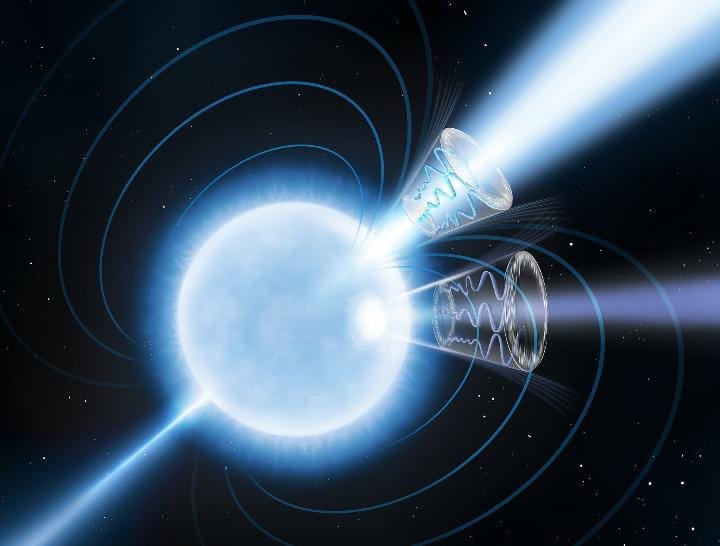
WASHINGTON (GNP): The NASA IXPE Telescope has turned up compelling new evidence backing a 90-year-old quantum theory: the idea that the vacuum of space itself can be altered by extremely powerful magnetic fields. It’s a genuinely big deal for astrophysics and quantum mechanics alike, giving scientists a fresh look at how matter and light behave under some of the most extreme conditions the universe has to offer.
The breakthrough happened while the NASA IXPE Telescope, officially the Imaging X-ray Polarimetry Explorer, was observing a magnetar a highly magnetized stellar remnant. These neutron stars are rare, and their magnetic fields are trillions of times stronger than Earth’s, which basically makes them the perfect natural lab for testing predictions that could never be replicated here on our own planet.
Here’s the wild part: space isn’t actually empty. According to quantum electrodynamics, or QED, what looks like a vacuum is actually full of virtual particles constantly popping in and out of existence for fleeting moments. Under an intense enough magnetic field, those particles can bend how light travels a phenomenon scientists call vacuum birefringence. The theory’s been around for almost a century, but actually catching solid observational proof of it, That’s remained one of physics’ toughest challenges until now.
Using its advanced X-ray polarization tech, IXPE picked up on subtle changes in the X-ray light coming off the magnetar. What it found lined up remarkably well with what theory predicted decades ago, giving real observational weight to a model that’s mostly lived in equations until now. Researchers say this strengthens confidence in QED overall while sharpening our understanding of how light behaves in the most extreme corners of the cosmos.
This mission also says a lot about why X-ray astronomy matters so much these days. Unlike your typical visible-light telescope, IXPE measures the polarization of X-rays meaning it can pin down the direction and characteristics of high-energy radiation streaming off black holes, neutron stars, pulsars, and the remnants left behind by supernovas.
NASA describes the telescope as a combination of sharp imaging and highly sensitive polarization measurement, giving researchers a window into corners of high-energy astrophysics that were basically off-limits before. It’s helping scientists piece together how magnetic fields shape matter’s behavior around some of the universe’s most powerful objects.
The implications go beyond just confirming an old theory, too. Scientists think this could shape future research in both astronomy and fundamental physics refining models around particle interactions, electromagnetic forces, and even the structure of space itself. There’s a decent chance these findings could also shed light on other extreme cosmic phenomena, like what’s happening around black holes or during gamma-ray bursts.
Behind the mission is a collaboration between NASA and international scientific partners, all working to push forward what we know about the high-energy universe. Since launch, the observatory’s kept feeding in data that keeps reshaping how scientists understand some of the cosmos’s strangest objects.
Also Read: Iran and Oman Reach Deal on Hormuz Shipping Route
Experts point out that this is a good example of how modern space observatories are still testing out ideas from decades past, just with far more sophisticated tools than researchers had back then. It’s a solid reminder of why long-term investment in space science and international scientific cooperation actually pays off.
As researchers keep digging through more observations, IXPE is expected to stay central to future investigations into neutron stars, black holes, and other extreme environments scattered across the universe. This latest finding doesn’t just back up one of physics’ most enduring theories it also cracks open new doors for exploring the fundamental laws that govern everything around us.
At the end of the day, this discovery is a solid reminder of NASA’s ongoing commitment to expanding what we understand about space through cutting-edge missions. With every new observation, IXPE keeps deepening our scientific knowledge while stoking curiosity about some of the universe’s most extraordinary mysteries.