New Delhi (GNP): Human Rights Watch (HRW) has accused Prime Minister Narendra Modi’s government of systematically weakening the institutions meant to protect human rights and democratic freedoms in India. The rights group says this has allowed authorities to harass critics and to normalize discrimination and violence against Muslims, Christians and other religious minorities.
The claim is laid out in a 95-page report titled “So What’s This Democracy We’re Talking About?: Modi’s Authoritarian Playbook in India.” It examines how Parliament and the opposition are handled, how federal investigative agencies are used, the condition of bodies such as the Election Commission and human rights commissions, and interference in the judiciary alongside the courts’ own failings.
HRW based the findings on interviews with more than 40 lawyers, journalists, activists, researchers, academics, current and former judges and former officials, conducted between January 2025 and September 2026.
HRW’s Asia director, Elaine Pearson, said the government has spent the past decade hollowing out the independent institutions that check executive power and protect civil liberties. The report’s strongest findings on religious minorities concern anti-conversion laws, which governments present as protection against forced conversion.
HRW counted such state laws in at least 12 states and said authorities have widely used them against people who choose Christianity voluntarily, especially in tribal and Dalit communities. The report says the laws breach international human rights standards and have emboldened vigilantes. It adds that members and affiliates of the ruling Bharatiya Janata Party (BJP) have attacked churches and priests suspected of seeking converts, and have mostly gone unpunished. BJP-run governments in at least seven states have passed or amended such laws since 2019, and some criminalize conversion for marriage.
The report also recalls the case of Stan Swamy, an 84-year-old Jesuit priest with Parkinson’s disease who campaigned for Dalit and tribal rights and died in custody in 2021. He was arrested with 15 other human rights defenders in the Bhima Koregaon case, in which they were accused of supporting a Maoist insurgency. HRW called the case politically motivated.
Voices within India’s Christian community say the findings match what they have seen. Rights activist and veteran journalist John Dayal said many pastors remain in jail while their bail petitions are pending. Rev. Vijayesh Lal, general secretary of the Evangelical Fellowship of India, said some of HRW’s concerns match what his organization has documented over several years.
Beyond minority rights, HRW says the Election Commission now faces a massive crisis of credibility. It points to the Special Intensive Revision (SIR) of electoral rolls, which began in June 2025 with the stated aim of removing dead, duplicate and ineligible voters. By October 2026, the exercise had removed more than 130 million names. HRW called the process arbitrary and said it disproportionately excluded women, the poor and religious minorities, particularly Muslims.
West Bengal shows how this played out. About 9 million people, or 12 percent of the electorate, were struck off before the April 2026 state elections, and HRW says the Supreme Court effectively accepted that they could miss that vote if they were later restored. The BJP then won the state for the first time. About nine in ten voters whose appeals were decided were eventually restored, and in May 2026 the Supreme Court ruled that the data did not show systemic disenfranchisement and upheld the rationale for the exercise. The court is still hearing petitions on the revision.
Also Read: Taliban Opposition Figures Meet in Madrid for Third Round of Talks
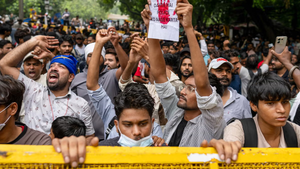
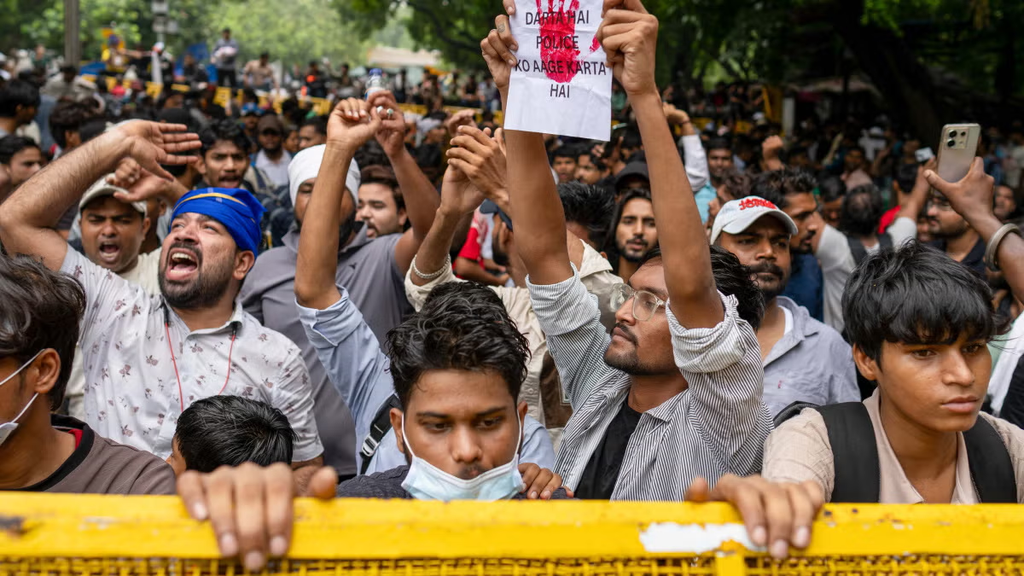
The Election Commission has defended the SIR before the court. After protests, it began reversing some decisions this month and offered deleted voters in six states and Delhi another chance to rejoin the rolls. HRW said that when protesters demanded the exercise be scrapped, authorities suspended mobile internet, deployed more than 40,000 security personnel in Delhi and arbitrarily detained thousands of people.
The report traces the Commission’s troubles partly to a December 2023 law that gave the government greater control over the appointment of election commissioners and granted them wide legal immunity. Parliament passed it while 100 Lok Sabha members and 46 Rajya Sabha members were suspended for the whole session. HRW says this reflects a wider pattern of bypassing parliamentary scrutiny.
HRW cited PRS Legislative Research, an independent research group in New Delhi, to support that point. The government referred 28 percent of bills to parliamentary committees in its first term (2014 to 2019) and 16 percent in its second (2019 to 2024), compared with 71 percent and 60 percent under the governments of 2009 to 2014 and 2004 to 2009.
The report adds that the BJP lacked a majority in the Rajya Sabha from 2014 to 2024, so the government labeled some bills as money bills, which need no upper house approval. HRW says this route was used to expand the powers of the Enforcement Directorate (ED), the federal agency that investigates financial crimes. Former Chief Justice D.Y. Chandrachud had described the use of money bills to legislate as an abuse of the constitutional process.
That expanded power is at the center of HRW’s argument that federal agencies have become political tools. Citing official data, it says the ED filed cases against 193 politicians between April 2015 and February 2025, most of them government opponents, a rise of more than 600 percent from the 26 politicians investigated in the previous decade. The finance minister told Parliament that the agency does not distinguish cases by political affiliation. Opposition parties call the BJP a “washing machine,” HRW said, because investigations stall or charges are dropped when politicians switch sides.
HRW’s conclusion is a call for reform. Pearson said, “State institutions must become safeguards for everyone’s rights, not weapons against critics.”

Managing Editor at Global News Pakistan (GNP), with a Bachelor's degree in International Relations from Riphah International University, graduated with a Gold Medal. Reach out at sabahtareengnp@gmail.com