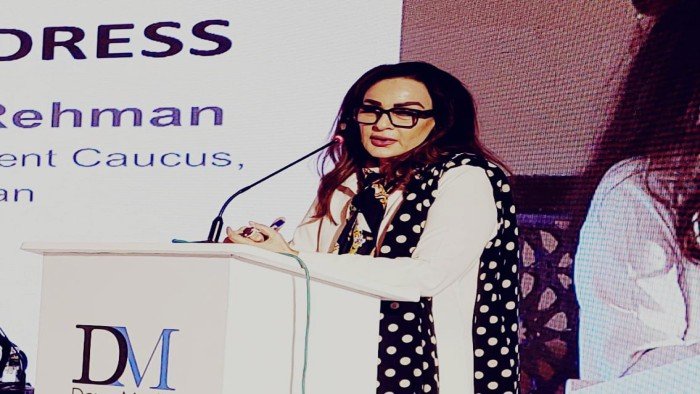
Islamabad, (GNP): Chairperson of Senate Standing Committee on Climate Change Senator Sherry Rehman delivered a stark warning in her Keynote Speech at the Inaugural Session at 2nd Dawn’s Breathe Climate conference, stating that the global climate movement is in visible decline, delegitimized, defunded, and dangerously fragmented, just when humanity needs accelerated, collective responses.
“We are boiling on the frontline because global emissions have blown past every target, yet the world’s attention has retreated from climate to conflict,” Senator Rehman said. “It is frankly a spectacular failure of global climate politics that the carbon footprint of wars is not even counted in the very carbon budgets used to chart our climate goals.”
Thanking Media for convening the conference “in the middle of an unravelling of global security,” she framed her intervention around three core questions, firstly, why is there such a dangerous gap between climate ambition and action?
Senator Rehman noted that the global movement is splintered, divided between elite platforms and indigenous front-line communities, with data disappearing and political space shrinking under new illiberalism.
“All climate ambition rests on one simple bedrock: a carbon budget,” she said. “And yet the science is completely undermined because 95% of conflict-related carbon data is missing. How do nations plan energy transitions or resilience pathways when the world is not even counting the biggest disruptions?”
She cited the 53°C heat waves searing parts of Pakistan and the toxic PM2.5 levels, 13 times higher than WHO guidelines, choking its cities, as evidence of escalating climate injustice.
“Pakistan contributes less than 1% to global emissions, but pays some of the highest adaptation costs on earth. Our baseline crisis today is pollution, breathed in for quarters of the year. Yet the global system that should protect vulnerable nations is unravelling.”
Secondly, she asked what conflict does to the climate, and why is its cost still excluded?
Senator Rehman called this omission “one of the great blind spots of modern governance.”
“Modern wars are devouring our environment. They are eating away our shared future. Yet their carbon cost does not appear anywhere, not in COP negotiations, not in national carbon budgets, not in the Kyoto Protocol.”
She cited staggering figures: “The US-Iran-Israel active conflict generated 5 million tonnes of CO₂ in just 14 days. Global military emissions reach 2,750 million tonnes CO₂e annually, 5.5% of total global emissions. If counted as a country, the world’s militaries would be the fourth-largest emitter on earth. Global military spending hit $2.887 trillion in 2025, the highest share of GDP since 2009. Governments disclose less than 10% of their actual military emissions, with UN data showing underreporting by 95%.”
“We live next door to conflicts. Active conflicts are not abstract for us. They directly reshape our environment, our air, our coastlines, our water security, and our public health.” “Why is the cost of conflict still not counted in the world’s carbon books? Until it is not included, no carbon budget is credible.”
Finally, she asked does climate finance matter anymore, if it only deepens debt traps?
Senator Rehman underscored Pakistan’s worsening debt vulnerability, ‘75% of all climate finance arriving as loans, not grants, while only $8 billion was received from 2010 to 2020.
Also Read: Livoltek Expands Lead with 2.35MWh BESS Deployment
The total public debt is at Rs 80.6 trillion, with 46.7% of the national budget swallowed by debt servicing with a fiscal deficit of Rs 6.17 trillion, with a World Bank projected 18–20% GDP loss due to climate shocks by 2050, and UN estimates of $1.2 trillion in climate-related damages by 2050 for Pakistan.”
“The Bretton Woods financial architecture is broken if it makes indebted countries like Pakistan pile on more debt as climate financing. What we need is a reset that recognises the climate emergency for what it is: an existential threat, not a line item.”
“For countries on the edge, like Pakistan, climate finance cannot come as loans. It cannot deepen fragility. It must be concessional, grant-based, and scalable.”
Touching on Pakistan’s internal vulnerabilities, Senator Rehman warned against “invading rewilded spaces with endless concrete” and reminded policymakers that Pakistan has only 5% forest cover—one of the lowest in the region.
“Green cities are not luxuries; they are public health lifelines. Islamabad is the only green city we have left. Let us not ruin it with poor choices that will cost us for generations.”
She emphasised that Pakistan has already suffered over $30 billion in economic losses from recent climate impacts and faces acute urban water scarcity. “1.5°C is not alive. We must stop pretending it is.”
Senator Rehman concluded with a strong message, “Heating is going past the red lines. Emissions are going past the red lines. Elite privilege can afford denial, but frontline nations cannot. 1.5°C is no longer alive, and the world needs to plan for that reality.”
“Conflict has negated the spirit of collective action. But multilateralism remains our best, perhaps our only, pathway out of this crisis. We must call out the fatal decisions driving the world to war, because they are also driving the world past climate collapse.”

Sohail Majeed is a Special Correspondent at The Diplomatic Insight. He has twelve plus years of experience in journalism & reporting. He covers International Affairs, Diplomacy, UN, Sports, Climate Change, Economy, Technology, and Health.