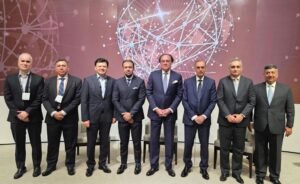
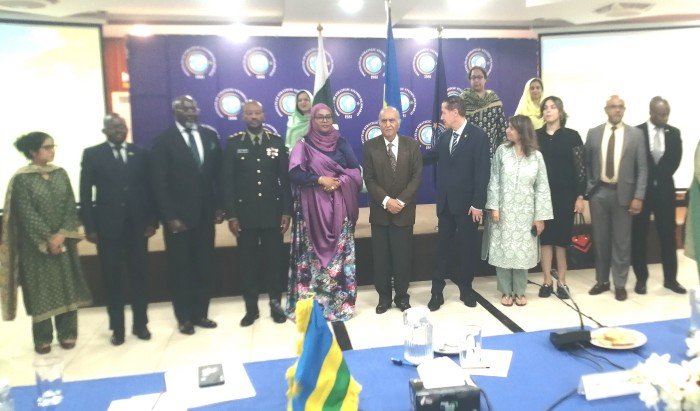
Islamabad (GNP): Centre for Afghanistan, Middle East & Africa (CAMEA) at the Institute of Strategic Studies Islamabad (ISSI), in partnership with the Pakistan Africa Institute for Development and Research (PAIDAR), held a special event to mark Rwanda’s Liberation Day. The ceremony opened with the national anthems of both Pakistan and Rwanda.
Speakers at the event included Ambassador Khalid Mahmood, Chairman of ISSI’s Board of Governors; High Commissioner Harerimana Fatou, Rwanda’s High Commissioner to Pakistan; High Commissioner Muhammad Naeem Khan, Pakistan’s High Commissioner to Rwanda; and Dr. Amina Khan, Director of CAMEA. Senator Mushahid Hussain Sayed, President of PAIDAR, attended as Chief Guest.
Ambassador Khalid Mahmood reflected on Rwanda’s extraordinary path — from the devastating trauma of the 1994 Genocide against the Tutsi to a nation defined today by peace, reconciliation, and steady development. He noted that Pakistan holds its growing ties with Rwanda in high regard, built on mutual respect and common aspirations. Recalling the two countries’ historical connections, he paid special tribute to former Pakistani Foreign Secretary Shaharyar M. Khan, who served as the UN Secretary-General’s Special Representative for Rwanda during one of the most critical periods in the country’s recovery — a role he described as emblematic of Pakistan’s broader commitment to peace and stability in Africa. He also welcomed the opening of diplomatic missions in Kigali and Islamabad as a turning point that has widened the scope for cooperation in trade, education, technology, and people-to-people ties.
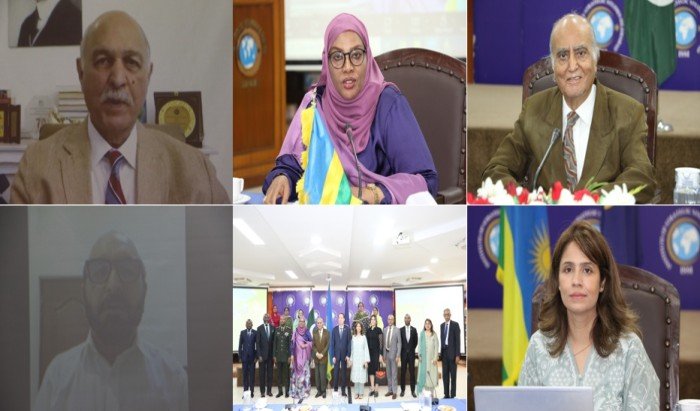
Senator Mushahid Hussain Sayed celebrated Rwanda’s story of resilience and reinvention, calling it a model for the rest of the continent in terms of stability, modernisation, and digital advancement. He highlighted Pakistan’s long record of supporting African liberation causes and pointed to the growing energy in Pakistan-Rwanda relations, especially following recent high-level exchanges. He reaffirmed both countries’ shared determination to deepen cooperation, strengthen people-to-people contacts, and champion Afro-Asian solidarity in a rapidly shifting global order.
High Commissioner Harerimana Fatou honoured the soldiers of the Rwanda Patriotic Army whose courage and sacrifice made Rwanda’s rebirth possible. She described how that foundation of bravery had enabled Rwanda to emerge as one of Africa’s cleanest, most innovative, and most forward-looking nations. She pointed to Rwanda’s advances in artificial intelligence, digital infrastructure, healthcare, and peaceful nuclear energy, as well as its growing reputation as a premier conference destination. Emphasising the warmth of Pakistan-Rwanda ties, she called for expanded cooperation on climate change and green energy, and acknowledged the role of the Pakistani diaspora in Rwanda and the Friends of Rwanda group in Pakistan in nurturing the bilateral relationship.
High Commissioner Muhammad Naeem Khan described Rwanda’s Liberation Day as a milestone that reflects the depth of the country’s achievements in governance, nation-building, and inclusive development. He praised Rwanda’s digital transformation and transparent public service delivery as examples from which many countries could learn. Pointing to the rising trajectory of Pakistan-Rwanda relations — marked by growing high-level visits and business delegations — he noted the positive impact on bilateral trade. He encouraged Pakistani entrepreneurs and tourists alike to explore what Rwanda has to offer and stressed the importance of both sides fully capitalising on the expanding opportunities before them.

Sohail Majeed is a Special Correspondent at The Diplomatic Insight. He has twelve plus years of experience in journalism & reporting. He covers International Affairs, Diplomacy, UN, Sports, Climate Change, Economy, Technology, and Health.