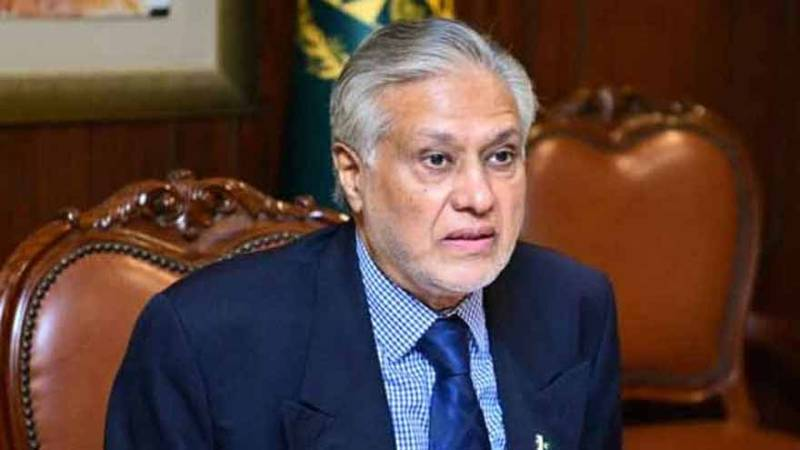
Islamabad (GNP): Deputy Prime Minister and Foreign Minister Ishaq Dar has delivered a keynote address in Washington describing the Indus Water Treaty as more than an agreement about water, calling it a legal framework for a vital shared resource, an instrument of regional stability, and a present-day test of the sanctity of international agreements.
Speaking at a seminar on the treaty and South Asian security, Dar framed the discussion around the same forces that led Pakistan and India to conclude the treaty in 1960 after years of negotiations facilitated by the World Bank, namely the reality that shared rivers create permanent interdependence between the states they cross.
That original agreement, Dar said, allocated the three eastern rivers, the Ravi, Beas and Sutlej, to India for unrestricted use, while the three western rivers, the Indus, Jhelum and Chenab, were reserved for Pakistan’s unrestricted use subject to carefully defined uses permitted to India.
Central to this arrangement was an institutional architecture built to manage disagreement rather than avoid it, including the Permanent Indus Commission, a Neutral Expert mechanism and, where needed, a Court of Arbitration.
This structure, Dar argued, was not incidental to the treaty but central to the bargain itself, and it is precisely what allowed the agreement to endure more than six decades of wars, military crises and diplomatic breakdowns between the two countries.
Turning to the present crisis, Dar addressed India’s decision in April 2025 to place the treaty in abeyance, arguing the move has no basis in the treaty’s text since it contains no provision permitting either party to unilaterally suspend or set aside the agreement.
He said Pakistan’s position remains clear and consistent, that the treaty is valid, binding and fully operative, adding that treaty-based proceedings have continued despite India’s assertion of abeyance, reinforcing the principle that unilateral action cannot displace an agreed legal framework.
Dar situated what is at stake well beyond the bilateral relationship between Pakistan and India, framing it as a question of confidence in international law and a broader proposition that geography must never become a licence for an upstream state to exercise political leverage over a downstream population.
For Pakistan specifically, he said, this is not an abstract legal debate, pointing to the Indus Basin as the lifeline of more than 250 million Pakistanis whose agriculture, food security, energy production and economic development depend on the river system, making water security inseparable from national security.
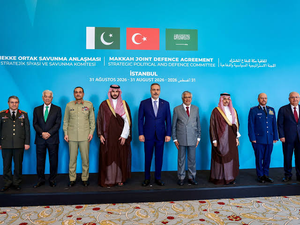
Also Read: Makkah Pact Sends Message of Peace, Says PM Shehbaz
The address also placed these tensions within the context of climate change, with Dar noting that Pakistan is already among the world’s most water-stressed countries, facing declining per capita water availability alongside glacial retreat, floods, droughts and increasing hydrological variability.
He said these pressures should compel greater cooperation through improved data-sharing and technical engagement, while stressing that climate adaptation cannot mean abandoning agreed legal rights, since climate stress makes treaty-based cooperation more essential rather than less.
Dar closed by reaffirming that Pakistan has consistently sought to resolve differences through dialogue, diplomacy and the mechanisms built into the treaty itself, describing resort to the Permanent Indus Commission, a Neutral Expert or a Court of Arbitration as the implementation of a legal framework both countries agreed to and remain bound by, not an act of confrontation.
He noted that recent arbitral proceedings have reinforced that treaty-based processes cannot be defeated through non-participation or unilateral assertions, adding that recent awards have continued to clarify the limits governing projects on the western rivers.

Managing Editor at Global News Pakistan (GNP), with a Bachelor's degree in International Relations from Riphah International University, graduated with a Gold Medal. Reach out at sabahtareengnp@gmail.com