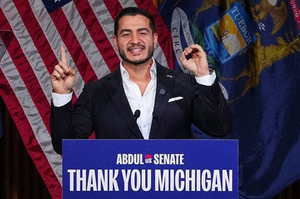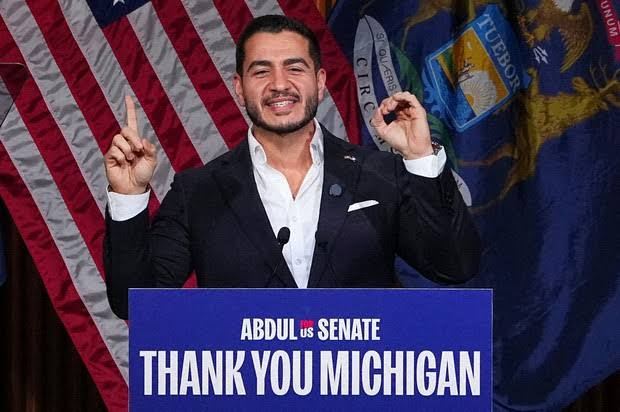
Detroit (GNP): Abdul El-Sayed has become the first Muslim elected to the United States (US) Senate, winning Michigan’s open seat after a campaign in which his faith was a constant target. The Democrat beat Republican Mike Rogers in Tuesday’s midterm elections, then used his victory speech to answer his critics with Arabic phrases, a “habibi” for Vice President JD Vance and a fresh round of “shawarma law” jokes.
The speech made sense only against the race that came before it. President Donald Trump repeatedly called El-Sayed a jihadist and a terrorist, and he compared him to the September 11 hijackers. Campaign mailers also hinted at links to terrorists and warned that El-Sayed would bring Sharia law to Michigan.
Rogers questioned El-Sayed’s loyalty to the country but said his objections were political, not religious. Even so, he cast the Democrat as a security threat and appeared at events with Republican senators who went further. Senator John Kennedy of Louisiana made a joke tying El-Sayed to Osama bin Laden, and Senator Ted Cruz of Texas mocked him with a derisive nickname and warned that Americans could die if he won.
Republicans also tried to connect El-Sayed to the Muslim Brotherhood, using writings he published about political change in Egypt more than a decade ago and social media posts by his half-sister. The US designated some branches of the group as terrorist organizations earlier this year. El-Sayed rejected the group and denied any connection, and no evidence has surfaced to link him to it.
A second line of attack focused on his reaction to the March assault on Michigan’s Temple Israel synagogue. He condemned the violence but said that hurt people hurt people, a remark some Jewish leaders said excused antisemitic violence. He later apologized and said his words may have been misread.
Rogers’ allies kept returning to the remark until the end. On the eve of the vote, the Michigan Republican Party held a press conference with Jewish and Black community leaders, where a large red sign accused El-Sayed of giving safe harbor to terrorists. The party’s communications director, Ted Goodman, pointed to the synagogue remark when asked to support that claim.
A university scholar who studies politics, race and religion said the campaign stood out for how many Republicans joined in. Nazita Lajevardi, an associate professor at the University of Michigan, said she had never seen a more bigoted campaign of this kind. She added that, unlike after September 11 or during Trump’s first-term Muslim ban, party leaders offered little pushback.
Voters were divided about the effect. Of about 30 people interviewed around Detroit, five said El-Sayed’s faith or his perceived links to extremism strongly shaped their vote for Rogers. Most others dismissed the attacks as a distraction from the cost of living, pointing to Muslim and Arab American friends, neighbors and doctors in their daily lives.
Those concerns were closest to home in Dearborn, which has one of the nation’s largest Arab American communities. Residents said the rhetoric fueled fears for their safety. Business owner Imad Soofi, a Yemeni immigrant and three-time Trump voter, said he saw more hostility toward Muslims, including remarks aimed at women in hijabs, once Trump began targeting El-Sayed. State Representative Alabas Farhat said the race revived questions Arab Americans have faced for years about how American they can be.
El-Sayed answered all of this on election night. He opened his speech with his full name, Abdulrahman Mohamed El-Sayed, and then turned to the Arabic words his supporters knew. He said he had often replied to questions about the race with “Inshallah,” meaning God willing, and that the word could now become “Alhamdulillah,” meaning praise be to God. He added a quick translation for the right-wing operatives who had tried to paint him as a danger.
His best-known line was aimed at the vice president. El-Sayed called Vance “habibi,” an Arabic term of affection that means “my love,” and said it was a delicious irony that Vance must swear him in this January. Vance is from Ohio, so El-Sayed added a college sports joke, saying Michigan’s Wolverines had beaten Ohio State’s Buckeyes.
Also Read: Midterm Memes Flood Internet as Iran Embassy Mocks Trump
The Arabic came with a policy message. El-Sayed said Michigan wants its tax dollars spent at home, on schools, healthcare and infrastructure, and not sent abroad to fund war. He also spoke about Gaza, arguing that people who care about Palestinian children are often unfairly labeled hateful.
That brings the story back to “shawarma law.” The phrase is a joke that grew out of the Sharia claims in the campaign. A fact check found that those claims distorted an old video of El-Sayed, and online commentators answered with satire, treating “shawarma law” as a mock policy. It also echoes a quip he made years ago about putting shawarma trucks on every corner. It is a running gag, not a real proposal.
Reaction to the speech split along the same lines as the race. Critics called it combative and said it did little to heal divisions, while supporters said a candidate attacked for his name and faith had every right to celebrate both. Many also saw a sign of change, noting that a senator-elect speaking Arabic and talking openly about Gaza would have been hard to picture in earlier campaigns.
The result was also not only about identity. Republicans painted several Democrats as radical or un-American, yet voters mostly focused on prices and everyday finances, and Democrats won widely. El-Sayed, 42, a Michigan-born Egyptian American physician and former Detroit health director, ran on healthcare and the cost of living.
In the end, he gave his opponents a simple verdict on the tone of their campaign. El-Sayed said, “You chose hate, and Michigan chose hope.”

Managing Editor at Global News Pakistan (GNP), with a Bachelor's degree in International Relations from Riphah International University, graduated with a Gold Medal. Reach out at sabahtareengnp@gmail.com