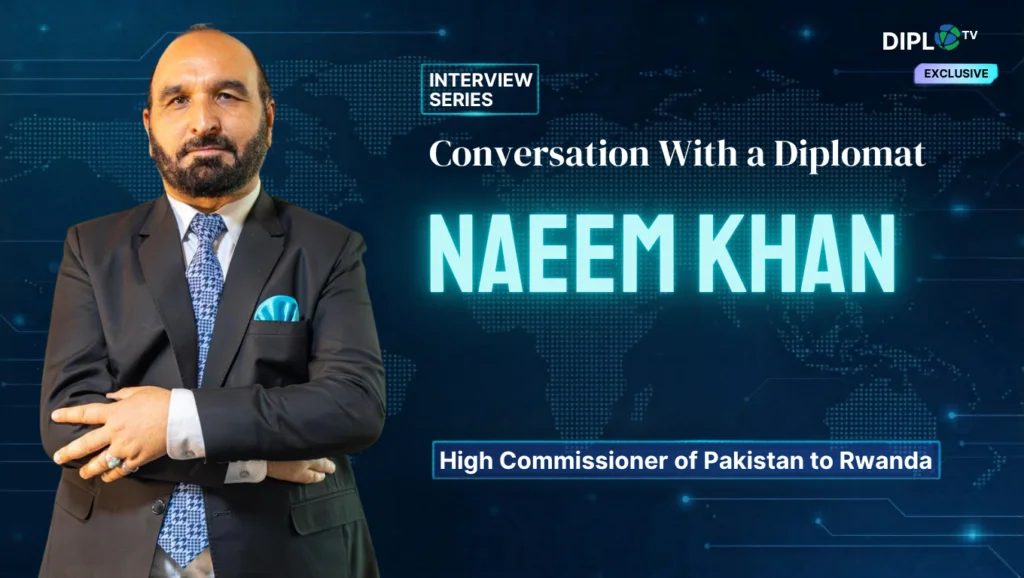
High Commissioner of Pakistan to Rwanda
TDI/GNP: In this episode of Conversation With a Diplomat, we engage with His Excellency Naeem Khan, High Commissioner of Pakistan to Rwanda, whose distinguished career in the Foreign Service spans over two decades of global engagement and public service. From his early beginnings in Swat to representing Pakistan across multiple continents, his journey reflects a deep-rooted passion for learning, communication, and international affairs.
Having served in diverse roles across countries including Afghanistan, Canada, Cuba, Argentina, and Spain, he brings with him a wealth of experience shaped by diplomacy at both bilateral and multilateral levels. Beyond his official responsibilities, he is also an educator and mentor, contributing to youth development and communication initiatives.
In this conversation, he shares insights into his personal journey, the realities of diplomatic life, and the evolving role of diplomacy in today’s interconnected world—offering a thoughtful perspective on purpose, global understanding, and the importance of meaningful dialogue.
Before we discuss your professional journey, could you tell us about your early life and what motivated you to pursue diplomacy?
Naeem Khan: I come from a small village in Swat, and my journey began there. From an early stage, I was deeply interested in geography. When I was in seventh grade, I had memorized details about countries—their capitals, currencies, and other facts. That passion gradually shaped my direction.
I pursued my education, completed my MPhil, and initially joined other services, including banking and provincial civil services as an Assistant Commissioner. However, my true aspiration was always the Foreign Service of Pakistan. When I appeared for the CSS examination, I chose only the Foreign Service as my preference. My knowledge of multiple languages, including Arabic and Persian, also supported my selection. Looking back, it feels like I had been preparing for this path all along.
Many consider CSS preparation extremely challenging. What was your experience like, and did you face major sacrifices?
Naeem Khan: I did not perceive my journey as one of sacrifice. I believe I naturally combined hard work with enjoyment. I studied for long hours—sometimes 15 to 16 hours a day—but I genuinely enjoyed learning.
I was also very active socially, participating in debates, associations, and public speaking. My focus was always on communication and expanding my knowledge. Over time, I realized that when you enjoy your work, hard work transforms into smart work.
There is often a glamorous perception of diplomacy. What are the realities that people should be aware of?
Naeem Khan: Diplomacy is indeed exciting, but it comes with significant challenges. Early in my career, I faced financial constraints, especially when transitioning from other services to the Foreign Office.
One of the biggest challenges is being away from family. As diplomats, we often miss important life events—funerals, weddings, and family gatherings. You also do not have a permanent home; you move from country to country, living what can be described as a nomadic life.
While you gain global exposure and interact with world leaders and intellectuals, you also experience a sense of distance from your roots. That balance between global engagement and personal connection is one of the defining realities of this profession.
Despite these challenges, do you think this lifestyle is worth it?
Naeem Khan: Yes, absolutely. This is a conscious choice. Diplomacy offers unparalleled exposure—you learn languages, experience cultures, and understand civilizations firsthand.
I have had the opportunity to travel extensively and engage with diverse societies. While there are challenges, the learning and growth that come with this profession make it worthwhile. It allows you to see the world not just through books, but through lived experience.
What do you miss most about Pakistan while serving abroad?
Naeem Khan: I miss the warmth of Pakistani society—the sense of community, family gatherings, and shared experiences. Pakistani culture is deeply rooted in collectivism, where relationships and social bonds are central.
I also miss Pakistani food, which is not easily available everywhere. Beyond that, it is the genuine human connection—the authenticity and affection—that I miss the most.
Your current posting is in Rwanda. What is something about the country that surprised you?
Naeem Khan: One of the most striking aspects of Rwanda is its strict stance on environmental protection. Plastic is completely banned—you cannot bring it into the country. Instead, people use paper bags or carry items by hand.
Rwanda is also exceptionally clean, green, and safe. Even late at night, people can move freely without fear. The governance system is highly digitalized, transparent, and efficient, with a strong emphasis on zero corruption.
The country’s commitment to environmental sustainability and public safety is truly impressive.
In your view, what defines a true diplomat?
Naeem Khan: A true diplomat is fundamentally a communicator and negotiator. Diplomacy is about resolving conflicts through dialogue rather than confrontation.
There are three primary ways to resolve conflicts: dialogue (diplomacy), legal mechanisms, and ultimately war. Diplomacy is always the preferred option.
A diplomat must possess logic (logos), emotional intelligence (pathos), and ethical authority (ethos). These elements help in presenting arguments effectively and representing one’s country with credibility.
Optimism is also essential. A diplomat must inspire hope, even in difficult situations, and work towards constructive outcomes.
Finally, what message would you like to share with our viewers?
Naeem Khan: I would emphasize the importance of understanding the world with an open mind. There are many misconceptions, particularly about regions like Africa.
Africa is not just the future—it is the present. It offers immense opportunities in trade, investment, and development. It is important for Pakistan and others to engage more actively with the continent.
At a broader level, we must remain curious, continue learning, and strive to understand different cultures. This is the essence of diplomacy and the foundation of meaningful global cooperation.
Courtesy: The Diplomatic Insight & Global News Pakistan

Sohail Majeed is a Special Correspondent at The Diplomatic Insight. He has twelve plus years of experience in journalism & reporting. He covers International Affairs, Diplomacy, UN, Sports, Climate Change, Economy, Technology, and Health.