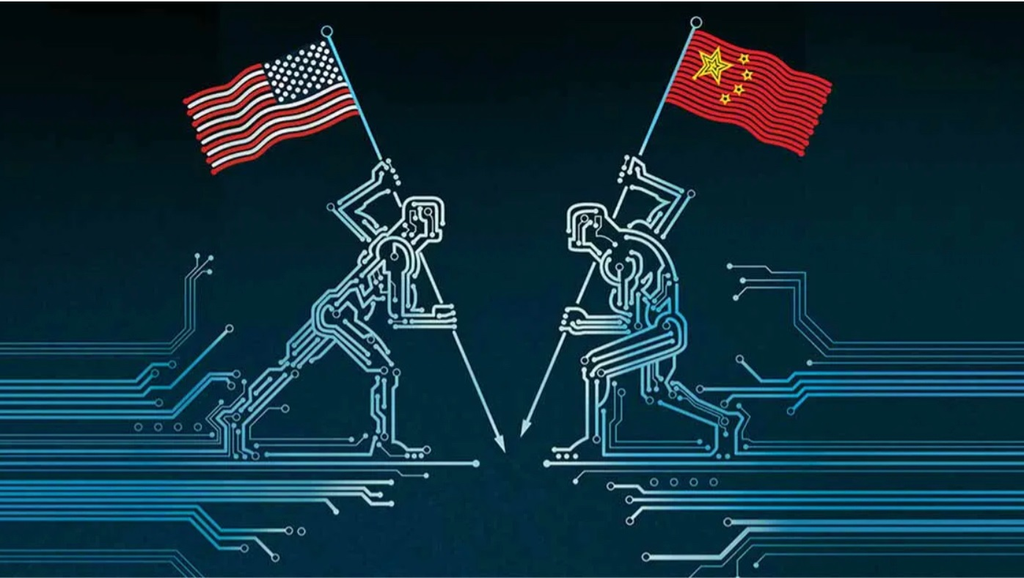
Beijing (GNP): As the world’s two largest economies, China and the United States are shaping the future of science and technology, with their relationship often framed as rivalry, though the reality is more complex.
From artificial intelligence to space exploration and advanced manufacturing, the two countries remain deeply connected through supply chains, research and shared challenges, according to CGTN.
The debate over technology decoupling has intensified in recent years, yet cooperation continues in areas where interests overlap between the two nations.
Understanding how Chinese and US tech ecosystems differ, and where they complement each other, remains essential for anyone following global AI competition, industrial policy and the future of innovation.
As the Chinese and US presidents prepare to meet, the world is watching whether their discussions can help stabilise one of the most important and complex bilateral relationships.
Experts Say China’s Tech Edge Runs Deeper Than Subsidies
This complexity has also been explored by experts at the Johns Hopkins School of Advanced International Studies, who argue that common assumptions about US-China tech competition oversimplify how China’s technology ecosystem actually functions.
Jonas Nahm, Andrew W. Mellon Associate Professor at SAIS, said a widely held misconception is that China’s advantages in technology and manufacturing stem mainly from cheaper labour, lax environmental rules and government subsidies, when in fact automation and embedded AI now drive much of its competitive edge.
Nahm pointed to visits at Chinese electric vehicle plants, including Xiaomi’s Beijing facility, where AI-driven systems handle scheduling, defect detection and robot coordination with minimal human staffing, alongside experiments by manufacturer Zeekr using humanoid robots for tasks such as lifting and quality checks.
He said Chinese factory employment peaked in 2013 and has been declining since, as automation increasingly replaces the labour-cost advantage China once relied upon, a shift that also challenges expectations that reshoring manufacturing to the US would restore mass employment.
On security concerns, Jessica Chen Weiss, David M. Lampton Professor of China Studies and founding faculty director of the Institute for America, China, and the Future of Global Affairs at SAIS, said risks from tech ties with China are real but vary significantly by domain, citing recent intrusions into US telecom networks and overreliance on Chinese-dominated rare earth supply chains as genuine concerns.
Weiss said the relationship involves mutual risk, noting that the United States also conducts cyber operations and that China remains dependent on US technology and markets, making wholesale decoupling unfeasible and blanket restrictions potentially counterproductive.
Also Read: Meta Shares Surge After Muse AI Assistant Launch
On dialogue as a diplomatic avenue, Weiss said unofficial talks between the two countries had already produced tangible results, including an agreement between the US and Chinese presidents to keep a human in the loop on nuclear weapons use, a draft AI code of conduct, and shared practices for AI testing and evaluation.
She cited examples of cross-border technical cooperation between companies, including an American firm using an open-source Chinese AI model to investigate a cyberattack, and a US company working with Tencent to fix a vulnerability in WeChat, pointing to shared risks that require shared solutions as AI development accelerates.
Weiss cautioned against framing the US-China relationship as a zero-sum race, saying such framing obscures trade-offs and makes it harder for policymakers to define US priorities on their own terms and at a clear cost.
She said China should not be treated as a monolith, noting that Chinese firms often have their own interests, including a desire for US market access, that differ from those of the Chinese government.
Weiss added that policy responses need to be tailored by technology domain, since the risks posed by different Chinese-made products and dependencies vary widely and are not addressed effectively by broad restrictions or blanket openness.
Jessica Chen Weiss said, “A zero-sum framing obscures trade-offs and crowds out strategic thinking.”

Managing Editor at Global News Pakistan (GNP), with a Bachelor's degree in International Relations from Riphah International University, graduated with a Gold Medal. Reach out at sabahtareengnp@gmail.com