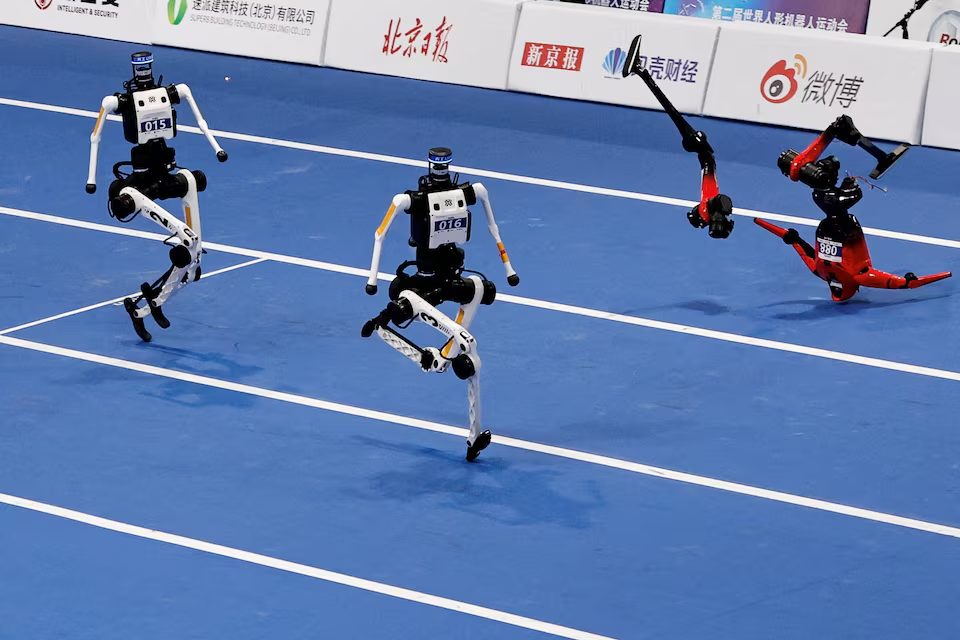
Beijing (GNP): China’s military establishment is intensifying research into humanoid robots for battlefield use, moving the machines beyond entertainment and sport toward eventual deployment in warfare. The shift follows the World Humanoid Robot Games held in Beijing last month, where robots competed in boxing, wushu and sprinting events, drawing global attention to how far the technology has advanced in balance, speed and coordination.
Within days of the Games concluding, the People’s Liberation Army (PLA) newspaper called on researchers to speed up the transfer of laboratory breakthroughs into military training grounds, framing the robots as future “combatants.”
A review of over a hundred military procurement notices, academic studies, patents and defence-company materials shows this ambition is already reflected in concrete planning, with Chinese institutions testing humanoids against battlefield requirements and studying how they might operate alongside soldiers. Much of this activity has intensified through 2025 and 2026, concentrating on improving robot perception, manipulation and the training data needed to prepare machines for unpredictable environments.
China’s dominance in humanoid manufacturing underpins this military push. Chinese firms accounted for roughly 95 percent of global humanoid robot shipments in 2025, giving the country’s defence sector a deep commercial base to draw upon as it develops specialised military applications.
Researchers at the National University of Defense Technology (NUDT), the PLA’s leading research institution, have already modelled scenarios in which six combat robots, including humanoids, robot dogs and unmanned vehicles, are split into assault teams to clear enemy-occupied buildings floor by floor alongside ground troops. The study, projecting equipment that could be available within five to ten years, did not specify how the robots would be armed or how they would distinguish civilians during such operations.
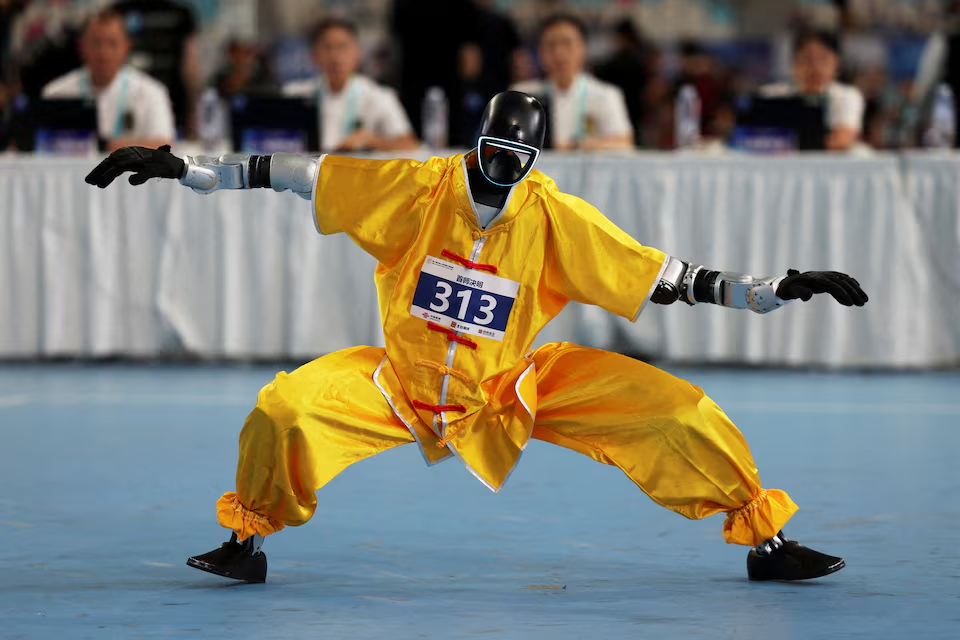
Military commentary in China has gone further, discussing a future in which humanoid missions evolve from supporting roles into primary combat functions, including scenarios where robots could be authorised to fire on a human-verified target. Beyond direct combat, NUDT has run university competitions simulating infiltration behind enemy lines, tasking robots with mapping unfamiliar areas and locating targets, as well as exercises involving identity checks and security patrols at military installations.
Procurement records point to the same trajectory, with tenders issued for humanoid robots and for systems capable of intelligent perception and dexterous operation, alongside budget allocations for camera, radar and motion data used to train the machines on different terrain.
China’s defence industry has since carried this research beyond academic circles. State-owned conglomerate Norinco has developed a full-size humanoid described as capable of sentry duty, all-weather reconnaissance and intelligent patrol, which can also be paired with a teleoperation system allowing a human to control it remotely.
Also Read: Flock Safety Cameras: 5 Alarming Reasons Behind Their Shocking Sabotage
That remote-control option addresses one of the central challenges facing humanoid robotics, since fully autonomous decision-making by machines remains technically difficult and ethically contested. International humanitarian law requires combatants to distinguish fighters from civilians and to avoid attacking those who are wounded or surrendering, obligations that autonomous systems have historically struggled to interpret reliably.
Despite this momentum, experts caution that humanoid robots remain far from battlefield-ready. The machines are still energy-intensive and unreliable outside controlled demonstrations, and no evidence has emerged of an armed humanoid being deployed with an operational PLA unit. Even so, the pace of investment signals that China views humanoids as a long-term component of future warfare, mirroring broader global military interest in autonomous systems already reshaping conflicts elsewhere, including the use of artificial intelligence-guided drones for reconnaissance and strike missions.
Wang Yonghua said, “Humanoid robots will stream onto the battlefield once movement, perception and manufacturing challenges are resolved.”

Managing Editor at Global News Pakistan (GNP), with a Bachelor's degree in International Relations from Riphah International University, graduated with a Gold Medal. Reach out at sabahtareengnp@gmail.com